
Get Something CNC Machined: Four Routes Compared
Four routes ship real parts: a local job shop, an online marketplace, a contract factory, or your own machine. Each one trades cost against control in a different way. This page shows how to pick using tolerance, quantity, and IP risk, not marketing pages.
In this article
- 1
- 2
- 3
- 4
- 5
- 6
- 7
The four real answers when you get something CNC machined
There are only four places a part actually gets cut: a local machine shop, an online marketplace that brokers the job out, a contract manufacturing factory, or a machine you own. Everything else is a variation on those. The question of where to get something cnc machined is really a question about which of these four fits your part, your volume, and how much of your design you are willing to hand over.
Each route has a different failure mode. Local shops fail on capacity. Marketplaces fail on traceability. Factories fail on minimum order quantity. Owning a machine fails on your time. Knowing which failure you can live with narrows the choice fast.
The rest of this page walks through how each route actually processes your part, what tolerance and material limits show up in practice, and the point where you should switch from one route to another.
Local job shops: fast talk, limited travel
A local shop is usually a 3-axis or 4-axis mill with a manual lathe in the corner. You talk to the person who runs the machine. That is worth a lot when a drawing is ambiguous. Setup happens the same week, and you can drive over and look at the first part before the rest of the run is cut.
The limit is machine travel and axis count. Most local shops cannot cut a part that needs five sides in one setup, so they refixture two or three times. Every refixture adds stack-up error. If your print calls for ±0.005 mm across a bore pattern on three faces, a shop that refixtures will struggle to hold it and will tell you so.
Material is the second limit. A small shop stocks 6061 and 303 stainless. Ask for Inconel, 17-4PH, or PEEK and they order it, which adds days and often a minimum purchase of a full bar. You pay for the leftover bar.
Local shops fit one-off fixtures, weldments, repair parts, and brackets where the tolerance is loose and the schedule is short. They are a poor fit for a 10,000-piece run or a part with an organic surface that needs simultaneous 5-axis motion.
- 1Good fitOne to fifty parts, loose tolerance, drawing questions you want answered in person
- 2Poor fitMulti-face tight tolerances, exotic alloys, runs above a few hundred pieces
- 3Watch forRefixturing on the quote. Ask how many setups.
Online marketplaces: instant price, hidden process
Marketplaces take your STEP file and return a price in minutes. Behind that price is a queue of partner shops you never see. The platform picks one based on load and margin. For a simple bracket in 6061 that is genuinely convenient, and the price is often lower than a local shop because the work goes to whoever is cheapest that week.
The process is invisible. You do not know the machine, the fixture, or who inspected the part. If the part is out of tolerance, you ship it back and hope the second attempt is better. There is no engineer to call and ask why the bore came in oval.
IP is the real cost. Your CAD file moves through a broker and at least one subcontractor. If the part is a patent-pending mechanism or a medical device, that path is hard to defend in an audit. A marketplace is fine for a fixture or a housing. It is a weak choice for a competitive product you have not launched.
- 1Good fitSimple geometry, cost comparison, one-off prototypes, no sensitive IP
- 2Poor fitTight tolerances, regulated industries, parts you cannot show a broker
- 3Watch forWho actually cuts the part and who signs the inspection report
Contract factories: the process chain is the product
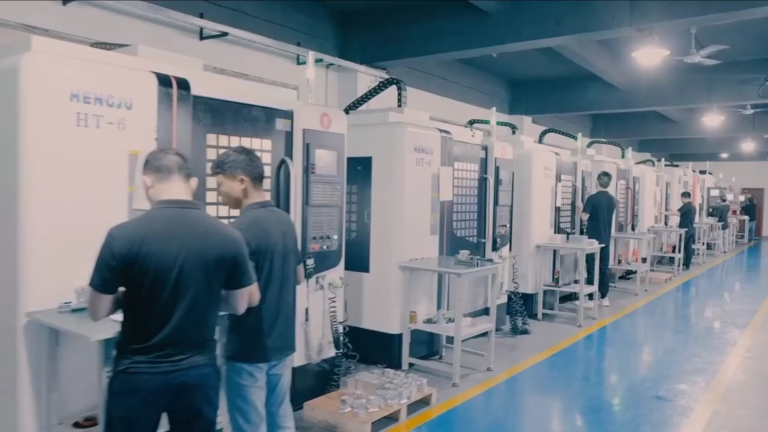
A contract factory owns the machines, the metrology, and the finishing line. GreatLight runs 127 high-precision CNC machines across three plants in Dongguan and Singapore, including 16 simultaneous 5-axis machining centers and 16 mill-turn centers. Maximum processing size is 4,000 mm, with a Ø400 mm rotary table for parts that need rotation in the cut.
The reason to use a factory is not just axis count. It is that one supplier holds the whole chain. A part that needs machining, anodizing, laser marking, and a final CMM report does not travel between three vendors with three sets of handling marks. It stays on one route with one inspection record.
Tolerance is where this route separates from the other two. GreatLight holds ±0.005 mm (±0.0002 in) and finishes down to Ra 0.2–0.8 μm when the drawing asks for it. That number only means something with inspection behind it. Every shipment gets 100% inspection, and raw material, in-process, and final checks are recorded and available on request.
Certifications matter for regulated buyers. ISO 9001:2015, IATF 16949:2016, ISO 13485:2016, and ISO 27001:2022 cover quality, automotive, medical, and information security. If your part goes into a car or a patient-contact device, those certificates are the entry ticket, not a bonus.
- 1Good fitComplex geometry, regulated markets, finishing plus machining under one PO
- 2Poor fitA single loose-tolerance part where the quote paperwork costs more than the part
- 3Watch forWhether finishing and inspection are in-house or subcontracted
Machining it yourself: control you pay for in hours
A benchtop mill and a CAM seat will cut a real part. For a hobby bracket or a quick fixture, that is often the fastest route because there is no quoting, no shipping, and no NDA. You iterate the same afternoon.
The math changes when the part needs to be right. A hobby-class machine rarely holds ±0.005 mm over a long cut, and thermal drift shows up on aluminum after an hour of roughing. You also become the inspector, and you need a micrometer and a granite plate to know whether the part is good.
The honest boundary is this: machine it yourself when the part is a means, not a product. Once the part is something a customer pays for, the cost of a scrapped run and a missed date usually beats the savings from cutting it in-house.
What to send and what to ask before you commit
Any of the four routes can quote from a STEP file and a PDF drawing. The drawing is what decides the price. A print with a tight tolerance on a non-functional face drives cost up for no reason. Call out only the dimensions that matter and let the rest run to general tolerance.
Ask three questions before you place the order. How many setups does the part need? What machine will run it? Who inspects it, and with what? The answers tell you more than the price. A shop that cannot answer the setup question has not looked at the part.
Send material, quantity, finish, and any certification requirement in the first message. A quote that assumes 6061 when you need 7075 is not a real quote. At GreatLight, quotation and free DFM analysis come back within 12 hours, and production can start within 24 hours after approval.
Keep the NDA question early if the design is sensitive. GreatLight treats uploads as secure and confidential and signs an NDA on request, which is standard practice for a factory and rare with a broker.
Which route fits your part
Read across your own part: quantity, tightest tolerance, and whether the design is sensitive.
| Route | Best quantity | Tolerance floor | IP exposure |
|---|---|---|---|
| Local job shop | 1–50 parts | ±0.025 mm typical | Low, you meet the machinist |
| Online marketplace | 1–100 parts | ±0.05 mm typical | High, file passes through a broker |
| Contract factory | 1–10,000+ parts | ±0.005 mm | Low, NDA available on request |
| Own machine | 1–20 parts | ±0.05 mm realistic | None, file stays local |
| Hybrid: factory + local finishing | 50–5,000 parts | ±0.01 mm | Medium, two vendors hold data |
The short version
If the part is simple and cheap, a marketplace or a local shop is fine. If the part needs ±0.005 mm, a regulated certificate, or a finish applied after machining, use a contract factory. If the design is confidential and small, machine it yourself or sign an NDA before you upload anything.
Questions buyers ask next
How tight a tolerance can I actually expect from each route?
A local 3-axis shop holding ±0.025 mm across a few features is normal. A marketplace partner is usually around ±0.05 mm unless the platform verifies the shop. A contract factory running 5-axis with in-process checks holds ±0.005 mm as a working number, not a best case.
Ask for the inspection method, not just the number. A tolerance without a CMM report behind it is a claim.
What file formats do I need to send?
STEP or IGES for the 3D model, plus a PDF drawing with tolerances, material, finish, and quantity. A native CAD file is not required and is often not wanted because it ties the shop to one CAM seat.
If you only have an STL, expect the quote to include a note about surface faceting.
Does quantity change which route I should use?
Yes, sharply. Below 50 parts, setup time dominates the price and a local shop competes well. Above a few hundred parts, per-piece cycle time dominates and a factory with dedicated fixtures wins. The crossover is usually somewhere between 100 and 300 parts, depending on geometry.
A contract factory with no minimum order quantity lets you run the first ten parts and the ten-thousandth on the same process, so the inspection record stays comparable.
How do I protect a design I have not patented yet?
Sign an NDA before uploading the model, and send only the geometry the shop needs to quote. Split sensitive assemblies so no single vendor sees the whole system.
Ask where files are stored and who can open them. ISO 27001:2022 covers exactly this, and it is a reasonable thing to request from a supplier.
Can one supplier handle machining and finishing?
A full-service factory can. Anodizing, plating, powder coating, black oxide, bead blasting, and laser marking can all run after machining on the same order, which avoids shipping parts between vendors and losing traceability.
If the finishing is subcontracted, ask who inspects the part after coating. Coating thickness can move a tight dimension out of tolerance.
What lead time is realistic for a first prototype?
For a straightforward part in aluminum, a factory quote comes back within 12 hours and production can start within 24 hours of approval, with parts shipping in 3–5 days. Complex 5-axis work with finishing takes longer, and the shop should tell you why.
Marketplace lead times are usually quoted by the platform, not the shop, so treat them as an estimate until the shop confirms.
Send the STEP file and get a real answer
Upload your model and drawing for a quotation and free DFM analysis within 12 hours. No minimum order quantity, from one prototype to a 10,000+ part run.
12-hour quote±0.005 mm100% inspectionNDA on request
More from the shop floor
We publish setup notes, tooling trials and inspection data from the factory floor.











