
Where to Buy Used CNC Machines: Channels, Risks and Real Numbers
A used machining center is cheap on the invoice and expensive in the floor plan. This page walks through the seven channels where used CNC equipment actually changes hands, what each one hides, and how to price the risk before you wire money. Written for engineers and shop owners who intend to run the machine, not park it.
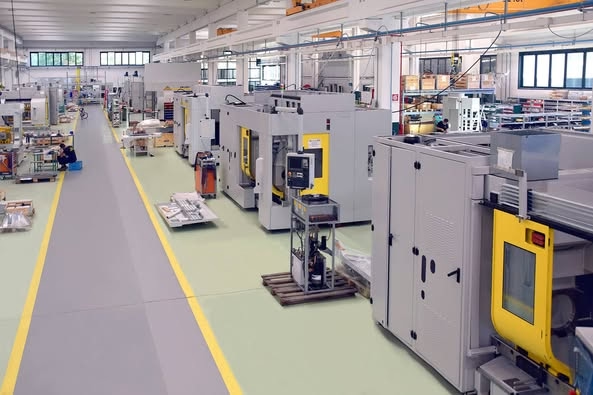
What You Are Actually Buying in a Used Machine
A CNC machine is a frame, a set of motion elements, a spindle, and a control. The frame rarely wears out. The other three do, and each has its own failure curve and its own replacement cost. When you evaluate where to buy used CNC machines, you are really ranking sources by how much of that wear you can measure before purchase.
Mechanical wear shows up first in the guideways and ballscrews. Backlash on a linear guide machine that has run three shifts for eight years can reach 0.02–0.05 mm in the worn zone, even when the control still holds position on a cold morning. A ballbar test over a 300 mm circle tells you more about geometry than any hour meter.
The spindle is the single most expensive wear item. Ceramic bearings in a 12,000 rpm spindle may be rated around 20,000 hours, but thermal cycling, coolant ingress, and crash events shorten that unpredictably. Ask for a spindle runout reading at the taper and a vibration signature, not just a run-hour counter.
The control ages on a different clock. A 1990s control may be mechanically sound but short on memory, tool management, and network options. If the machine carries a control that the OEM no longer supports, spare boards become an eBay hunt. That risk belongs in the price.
The Seven Channels Where Used Machines Trade
Online marketplaces list the widest inventory and the thinnest information. A listing photo shows the outside of the enclosure, not the taper. Sellers are often dealers, liquidators, or shop owners clearing a corner. Reputation systems help, but a five-star rating on a $40,000 purchase from a stranger is not due diligence.
Industrial auctions reward preparation. Banks repossess, plants close, and companies upgrade, so machines reach the block through no fault of their own. The catch is that most auction sales are as-is, where-is, with no power-on guarantee. If you cannot inspect in person, budget a full rebuild into your bid and treat the hammer price as scrap-plus.
OEM dealers and certified refurbishers sit at the other end. They re-scrape ways, replace bearings, realign geometry, and often supply a short warranty plus documentation. You pay a visible premium, and in return you get a machine that has been measured against a specification rather than described.
Machine tool resellers occupy the middle. Some are genuine rebuilders with an in-house scraping and alignment team. Others are traders who steam-clean a machine and add a coat of paint. Ask what was replaced, in what year, and whether you can see the alignment report before the machine is skidded.
Trade shows, shop closures, and private sales from manufacturers round out the list. These are relationship channels. You meet the maintenance manager, see the machine running production, and hear why it is leaving. Pricing is negotiable and terms are flexible, but availability is unpredictable.
Auction houses that specialize in industrial assets deserve their own line. They publish inspection dates, run videos, and rigging contacts. The trade-off is buyer premium, which typically adds 10–18 percent to the hammer price on top of rigging and freight.
Online machine tool brokers and dealer networks aggregate inventory across regions. They are useful for price discovery even when you do not buy. Watch for listings that have been reposted for a year; a machine that nobody wants at that price usually has a reason.
- 1MarketplaceWidest choice, least verifiable history
- 2AuctionLowest entry price, highest rebuild exposure
- 3OEM refurbisherDocumented geometry, visible premium
- 4Private saleBest price when trust already exists
Inspection Checks That Separate a Deal from a Trap
Geometry comes first because it is the hardest thing to fix cheaply. A ballbar test at 300 mm radius, run cold and again after a 30-minute warm-up, exposes squareness, backlash, and servo mismatch. On a healthy VMC you want circular deviation inside roughly 0.01–0.02 mm. Values above 0.05 mm mean the machine needs realignment before it holds tolerance.
Backlash is measurable with a dial indicator against the table while you command small moves. On a machine with linear guides, more than 0.01 mm of lost motion in the worn zone signals ballscrew or bearing replacement. On box ways with Turcite, the same number may just need gib adjustment.
Spindle condition needs two numbers: runout at the taper, and growth after a one-hour warm-up. Runout under 0.005 mm is workable for general milling. Thermal growth above 0.02 mm over an hour will push you out of ±0.01 mm work unless you warm up and re-zero every shift.
Electrical condition is where hidden cost lives. Open the cabinet and look for scorched contactors, brittle wire insulation, and replaced drives from mismatched sources. Ask for a parameter backup on a USB stick. A control without a backup is a control you cannot restore after a battery failure.
Tooling and fixturing often decide the real price. A machine that comes with 40 taper holders, a presetter, and a probe package can be worth several thousand dollars more than a bare spindle, and those accessories transfer without a rebuild.
Finally, run a test cut in the material you intend to machine. Aluminum proves nothing about a machine that will cut 4140. Bring a small block of your own stock and a print with a tight tolerance, then measure the result on your own CMM.
Retrofit Math: When a Cheap Machine Is Not Cheap
Used machine pricing only makes sense against a rebuild budget. A 20-year-old VMC bought for a low five-figure sum often needs ballscrews, thrust bearings, a spindle rebuild, and a control retrofit. Add rigging, freight, foundation work, and commissioning, and the gap to a documented refurbished machine narrows fast.
The decision rule is simple. If the rebuild cost plus purchase price exceeds roughly 60 percent of a comparable new machine, and you need production within a quarter, buy the refurbished or new machine. If you have in-house maintenance, time, and a spare spindle, the project route can still win.
Control retrofits change the calculus. Replacing a legacy control with a modern CNC adds capability such as high-speed lookahead, Ethernet, and better tool management. It also adds integration labor and a new post-processor for your CAM system. Budget both, not just the hardware.
Availability matters as much as price. A machine that runs tomorrow at ±0.02 mm may be worth more than a tighter machine that needs six weeks of work, especially when a customer program is waiting. Downtime has a cost per day that rarely appears in the purchase comparison.
For shops that need parts rather than machines, the alternative is straightforward. Sending the work to a contract machining partner removes the capital outlay, the floor space, and the maintenance burden in one step.
When Buying Used Is the Wrong Move
Buy used when the part family is stable, tolerances sit at ±0.02 mm or looser, and you have maintenance capacity. Buy used when the machine has a common control with an active aftermarket, because spares and knowledge are what keep a 20-year-old machine productive.
Do not buy used when the job requires ±0.005 mm across a large envelope. Thermal growth, worn geometry, and aging drives stack up, and no amount of operator skill compensates for a machine that moves while it cuts. New or freshly rebuilt machines hold those numbers with far less babysitting.
Do not buy used when the process is regulated. Medical and aerospace work with traceability requirements expects calibration records, maintenance history, and a support chain. A machine with an unknown past is a documentation problem before it is a machining problem.
Do not buy used when the volume is unknown. If the program may double next year, a second-hand machine with one spindle and no automation path becomes a bottleneck. Look at pallet changers and bar feeders before you look at price.
A practical middle road: run the low-volume, loose-tolerance work in-house on a used machine, and send the tight-tolerance and high-volume work to an outside partner. That keeps capital low and keeps your delivery promises intact.
Channel Comparison for Used CNC Equipment
Read each row as a trade: what the channel gives you against what it hides.
| Channel | Typical condition | Inspection access | Main risk |
|---|---|---|---|
| Online marketplace | Running or unknown | Photos and video only | Hidden wear, weak recourse |
| Industrial auction | As-is, where-is | Scheduled preview days | No power-on, buyer premium |
| OEM refurbisher | Rebuilt to spec | Alignment report supplied | Highest purchase price |
| Machine tool reseller | Cleaned, partly rebuilt | Varies by dealer | Paint over worn ways |
| Private shop sale | In production now | Machine under power | Limited spare parts support |
| Industrial auction house | Mixed lots | Run video, rigging contact | Freight and rigging surprise |
| Broker network | Aggregated listings | Depends on seller | Stale listings, inflated ask |
The Short Version
If you can inspect under power and you have maintenance capacity, buy used and budget a rebuild. If you need ±0.005 mm, documented traceability, or parts next week, buy new or send the work out.
Used CNC Buying Questions
How many spindle hours is too many?
There is no universal number. A 12,000 rpm spindle may be rated near 20,000 hours, but coolant quality, crash history, and duty cycle matter more than the counter.
Treat hours as a starting point. Then ask for taper runout, a warm-up growth reading, and a vibration signature. Those three measurements predict remaining life better than any meter.
Should I buy a machine I cannot inspect under power?
Only if the price already assumes a rebuild. Auction lots that are not under power should be valued as a frame, a control, and a spindle core.
If the hammer price plus a full rebuild lands close to a refurbished machine, the auction route has no advantage left.
Is a control retrofit worth it on an older machine?
It can be, when the iron is good and the geometry can be restored. A retrofit adds lookahead, networking, and modern tool management.
Budget the post-processor work and operator retraining as well. Those items are easy to forget and they delay first-part approval.
What documents should come with a used machine?
Ask for the parameter backup, maintenance log, alignment or ballbar report, spindle service record, and electrical schematics.
If the seller cannot produce a parameter backup, plan to rebuild the control configuration from scratch. That is a multi-day job on most platforms.
How do I compare a used machine against outsourcing the parts?
Compare cost per part, not purchase price. Include floor space, power, coolant, tooling, maintenance labor, and the hours you spend keeping it running.
For low-volume or one-off programs, a contract machining partner often wins on total cost and removes the capital risk entirely.
What tolerance can a used VMC realistically hold?
A well-maintained used VMC with fresh geometry can hold around ±0.01–0.02 mm in aluminum under stable thermal conditions.
Push toward ±0.005 mm and you need a machine with documented accuracy, active thermal compensation, and a controlled environment.
Skip the Machine Purchase, Keep the Parts
Send your drawing and we return a quotation with free DFM analysis within 12 hours, from one prototype to 10,000+ part runs.
12-hour quote±0.005 mmNo minimum order
Follow GreatLight
We publish setup notes, tooling trials and inspection data from the factory floor.











