
Which Watch Brands Use the CNC Machine?
Buyers ask which watch brands use the CNC machine because the answer tells them how a case, bezel or bridge was really made. This page lists the five machining signs we look for on real parts, and the cases where casting is the cheaper call.
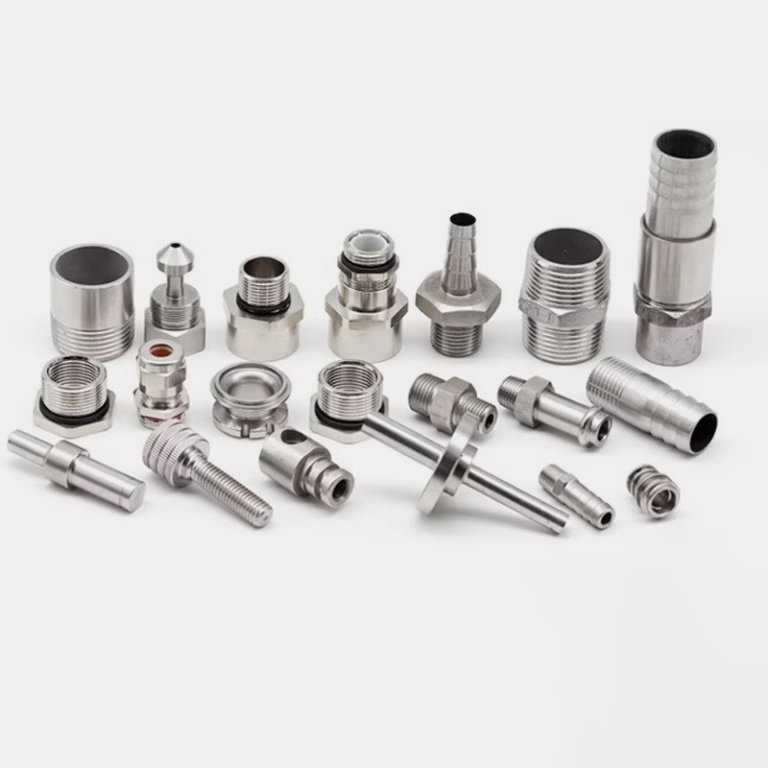
Watch brands use CNC machine tools: what this page covers
- 1
- 2
- 3
- 4
- 5
Five machining signs and what each one tells you
Read the middle column on the part first, then the right column for the machine that usually produces it.
| Sign on the part | What it proves | Typical machine |
|---|---|---|
| Tool marks, one direction | Cut from solid, not cast | 3-axis mill |
| Undercut on case flank | Side was reached in one setup | 5-axis mill |
| Concentric bezel steps | Turned on a lathe | Mill-turn center |
| Mirror lug inner face | Fine finish, no hand polish | 5-axis + polishing |
| Sharp, thin bezel edge | Low stock removal per pass | 5-axis, small cutter |
2. Which watch brands use CNC machine tools: the part list that gives it away
Watch brands use CNC machine tools for the parts that must hold a shape across thousands of units. The clue is never the logo. It is the geometry. A case with a deep undercut under the lug, a bezel with 60 clean index steps, or a bridge with two different radii meeting at a sharp corner all point the same way: the part was cut from solid bar or plate on a controlled machine, not poured into a mold and cleaned up by hand.
Start with the case middle. Casting leaves a draft angle on every vertical wall, usually 1° to 3°, because the part has to release from the die. A machined case middle can hold a true 90° wall, or even a deliberate undercut, because a 5-axis spindle reaches in from the side and lifts out. On a 40 mm case that difference is small in numbers and huge in feel. The flank sits flat against the wrist instead of tapering away.
Now look at the bezel. A fluted or stepped bezel is the easiest tell in the whole watch. Each step needs a consistent depth, a consistent width and a clean corner where it meets the next step. On our 5-axis centers we hold ±0.005 mm on those features, which is why the light catches every step the same way. A stamped bezel shows rounded corners and a slight taper on the step walls.
The movement side follows the same logic. Bridges, main plates, rotor blanks and balance cocks are small, thin and full of holes. A plate 0.8 mm thick with a 0.3 mm wall between two bores will distort if you stamp it or cast it. Milling it from a 2 mm sheet, then thinning the web in a second pass, keeps the bore spacing stable. That is the part of the watch where the CNC decision matters most, and it is the part a customer never sees.
3. Materials and finishes that separate a machined watch part from a cast one
Material choice narrows the process fast. If the case is 316L stainless, 904L-type stainless, grade 5 titanium or a copper-beryllium alloy, you are almost certainly looking at a machined part. These alloys are tough, they work-harden, and they do not like thin die walls. A die for 316L wears out quickly and the casting shows porosity at the lug roots, exactly where the part sees the most stress.
Grade 2 and grade 5 titanium go the same way. Titanium is light and it resists corrosion, but it also galls and it holds heat at the cutter edge. We run it on 5-axis centers at reduced feed, with high-pressure coolant, and we accept a slower cycle. A cast titanium case would need a vacuum furnace and a hot isostatic press to close the porosity, which costs more than milling at any volume below roughly 10,000 pieces.
Brass and copper alloys sit on the other side. They cast well, machine fast and take plating evenly. If a brand sells a gold-plated case at a low price, that case is likely a brass casting with a turned seat for the crystal and the case back. Nothing wrong with that. It is a different product, and the price reflects it.
Finishes tell you the rest. Bead blasting hides tool marks, so a blasted case can be cast or machined and you cannot tell by eye. Brushed and polished surfaces do not hide anything. A brushed flank with straight, unbroken lines means the surface was cut and then brushed in one direction. A mirror-polished lug inner face means someone spent time on it, either on a machine or at a bench.
Anodizing, electroless nickel, zinc, silver and gold plating all sit on top of the base metal, so they cover the process too. If you need to know, ask for the raw part photo before finishing. That is the only honest answer.
4. When casting beats machining on a watch case
Machining is not always the right call, and a good supplier will say so. Zinc and aluminum die casting wins when the case is thick, simple and the annual volume is high. A 42 mm diver case with a plain round flank, no undercut and no complex bezel can be cast in a two-part die, trimmed and then machined only on the sealing faces. Unit cost drops hard above roughly 5,000 pieces per year.
The trade-off is surface and tolerance. A cast case needs a draft angle on every wall, so the flank cannot be truly vertical. Porosity can appear at thick-to-thin transitions, and the lug roots are the usual spot. You also cannot hold ±0.005 mm on a cast face, so the crystal seat, the case back thread and the bezel track still get machined after casting. That hybrid route is common and it works.
Machining wins when the geometry is complex, the volume is low, or the material is hard. An openworked case, a cushion case with a twisted flank, a monobloc case with an integrated bracelet, a titanium case, a bronze case with a hand-finished patina. These parts are cut from solid because a die cannot make them and because the customer is paying for the shape.
Volume changes the answer too. Below about 1,000 pieces per year, the die cost alone kills the casting case. Between 1,000 and 5,000 pieces it depends on the part. Above 5,000 pieces with simple geometry, casting usually wins on price. We quote both routes when a customer asks, and we say which one we would pick.
5. How to tell which route your own watch case should take
If you are developing a watch and trying to decide, work through four questions in order. First, how many pieces per year. Second, how complex is the outer geometry. Third, what material. Fourth, what surface finish does the customer actually touch. The answers point to one route most of the time.
Under 1,000 pieces a year, machine it. The die cost is not recoverable and the design will change after the first samples anyway. Between 1,000 and 5,000 pieces, machine the complex faces and keep the design flexible. Above 5,000 pieces with a simple case, cast the body and machine the sealing faces, the thread and the bezel track.
Material pushes the same way. Titanium, 316L, 904L-type stainless, copper-beryllium and bronze all go to the mill. Zinc and aluminum are the casting metals. If your design uses one of the casting alloys but the flank has an undercut, the undercut has to go, or the part has to be machined.
Finish decides the last detail. If the customer sees a brushed or polished surface, plan for a machined or a well-prepared cast part, because those finishes show every defect. If the surface is bead blasted or coated, a casting has more room. Send us the 3D file and we will tell you which route fits, with the tolerance and finish we can hold on each one.
The short answer
If the case has an undercut, a complex bezel or a titanium body, machine it. If it is a plain round case in zinc or aluminum above 5,000 pieces a year, cast the body and machine only the sealing faces.
Questions buyers ask about watch brands use cnc machine
Do all luxury watch cases come off a CNC machine?
No. Many entry and mid-range cases are die cast in zinc or aluminum and then machined only on the crystal seat, the case back thread and the bezel track.
The outer shape can still look good, but the flank will carry a draft angle and the surface will be softer than a machined 316L case.
How do I check a case without cutting it?
Look at the inner face of a lug and the underside of the bezel with a 10× loupe. Straight, parallel tool marks mean the part was cut from solid.
A soft, slightly porous texture with rounded corners points to casting.
Can a cast case hold the same tolerance as a machined one?
Not on the as-cast surface. Casting typically holds ±0.1 mm or looser on the outer form.
The sealing faces, the thread and the bezel track are machined after casting, and those features can reach ±0.005 mm on a 5-axis center.
What materials are usually machined rather than cast for watch parts?
Titanium (grade 2 and grade 5), 316L and 904L-type stainless, copper-beryllium and bronze are normally machined.
Zinc and aluminum are the common casting alloys for watch cases.
What file do you need to quote a watch case?
A STEP or IGES file with the tolerance callouts, the material and the finish. A 2D drawing helps for the thread and the sealing faces.
We return a quotation and a free DFM analysis within 12 hours, and production can start within 24 hours.
Can you machine a single watch case prototype?
Yes. There is no minimum order quantity. We run from one prototype to 10,000+ part runs on the same 5-axis centers.
For a one-off, we usually mill the case from 316L or titanium bar and bead blast or brush the finish.
Send us your watch case file
Upload a STEP file and we will tell you which route fits, with the tolerance and finish we can hold.
12-hour quote100% inspectionNDA on request
More from the shop floor
We publish setup notes, tooling trials and inspection data from the factory floor.











