
Wholesale High-Precision CNC Machining at Volume
This page explains what changes when a tight-tolerance job moves from one prototype to a 10,000-part run. It is written for design engineers and sourcing engineers who have to approve a process, not just a price. Read it to judge whether your geometry, tolerance callouts and inspection plan survive volume, and where the real cost drivers sit.
In this article
- 1
- 2
- 3
- 4
- 5
- 6
What wholesale high-precision CNC machining actually controls
A CNC machine does not hold a tolerance. A process does. The machine supplies motion, the tool removes material, the fixture decides where the part sits, and the thermal state decides whether that position is still true an hour later. When a shop quotes ±0.005 mm, it is quoting the whole chain, not the spindle.
At prototype quantity you can absorb a weak link. A machinist nudges an offset, checks the feature, runs the next part. At 5,000 pieces that same weak link becomes a distribution. Every part drifts a little, and the drift is what the customer measures.
So the engineering question is not how accurate the machine is. It is how much of that accuracy survives tool wear, chip load, clamping force and a shift change. That is the part wholesale buyers should be testing in a first article.
Tool wear is the clearest example. A carbide end mill cutting 6061 aluminium can hold a few micrometres for a long time. The same tool in 17-4PH stainless wears noticeably in a fraction of that time, and the wear shows up as a slow dimensional slope across the batch.
- 1MachineProvides motion and repeatability; not the final word on tolerance.
- 2FixtureSets position and clamping distortion; usually the largest error source.
- 3ToolWear shifts dimensions across a run, not within one part.
- 4ThermalSpindle and workpiece growth move features over hours.
Which parts suit wholesale runs, and which do not
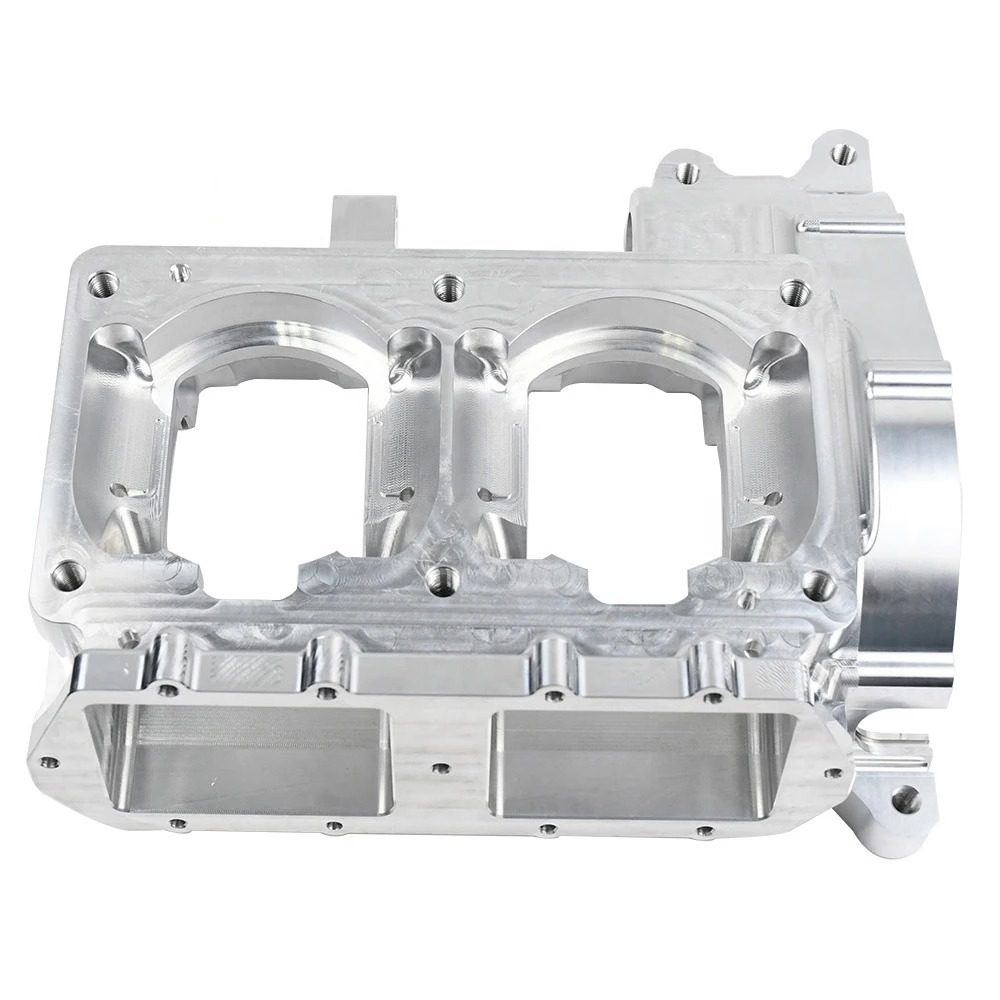
Volume rewards parts that can be held in one orientation or reached from a small number of setups. A housing with bores on five faces is a good candidate for a simultaneous 5-axis center. A shaft with concentric diameters and a keyway is better on a mill-turn center.
Thin walls are the classic failure case. A 0.8 mm wall in aluminium moves under clamping pressure and again when the clamps come off. If the drawing demands ±0.05 mm on that wall, the process has to be re-thought: lighter fixturing, more passes, or a stress-relief step between roughing and finishing.
Deep cavities with small corner radii are another. A long tool reaching 5 × diameter deep will deflect, and no amount of machine accuracy fixes a tool that bends. The fix is usually a design change, not a machining change.
Parts with a single critical feature and loose everything else are the easiest to scale. Concentrate the tight tolerance where it functions. Blanket ±0.005 mm across a whole drawing multiplies cost with no functional gain.
- 1Good fitCompact prismatic parts, few setups, reachable features.
- 2WorkableThin walls with generous tolerances and a stress-relief step.
- 3Poor fitDeep pockets with tiny radii and blanket tight tolerances.
Where the money goes between prototype and 10,000 pieces
Prototype cost is dominated by programming and setup. Volume cost is dominated by cycle time, tooling life and inspection labour. The two curves cross somewhere in the low hundreds of parts for most parts, and that crossing point is what a wholesale quote is really telling you.
Setup cost is amortised across the batch, so it fades. What does not fade is inspection. If a drawing calls for full dimensional reports on every part, inspection can cost more than the cut. Sampling plans exist for this reason, and they have to be agreed before the run starts, not after.
Tooling is the quiet line item. A custom fixture that takes two days to build is expensive on 20 parts and free on 20,000. That is why wholesale pricing depends on how repeatable the setup is, not only on how fast the spindle turns.
Finishing can also break the economics. Anodizing and plating are usually priced per batch or per rack, so small runs pay a disproportionate share. Grouping parts into a larger finishing lot is often the single biggest lever on a wholesale unit price.
How to verify a batch without inspecting it to death
Start with a first article inspection that covers every dimension on the drawing. That confirms the process, the fixture and the program before the batch is committed. It is the cheapest insurance in the whole job.
Then define what drifts. On a milled aluminium part, the drift is usually in the tool-wear direction. On a turned stainless part, it is often thermal. Pick the two or three features most sensitive to that drift and check those at a set interval.
Measurement method matters as much as frequency. A caliper reads to 0.02 mm on a good day. If the tolerance is ±0.005 mm, the check needs a CMM or a micrometer with a known reference, otherwise you are measuring the gauge, not the part.
Keep the inspection data with the batch. Reports on request is a reasonable default, but for regulated industries the record is part of the deliverable. ISO 9001, IATF 16949, ISO 13485 and ISO 27001 all push toward documented, traceable inspection rather than a verbal nod.
When wholesale high-precision CNC machining is the wrong answer
Machining is a subtractive process with a cost that scales with removed volume. When a part is mostly a simple shape with one precise bore, casting or forging plus a finishing cut is usually cheaper at volume. Machining from solid wastes material and time.
Very high quantities of a small, simple part often belong to die casting or injection moulding. CNC stays competitive where geometry is complex, quantities are moderate, or the design is still moving.
There is also a tolerance floor. Below roughly ±0.002 mm, grinding, lapping or EDM take over from milling, because cutting forces and tool deflection dominate. Asking a mill to hit that is asking for scrap.
Finally, if the design is not frozen, do not commit to a wholesale run. Tooling and fixtures built around a drawing that changes next month become expensive scrap. Run the prototype first, lock the geometry, then scale.
- 1Choose castingSimple shapes, high quantity, one or two precise features.
- 2Choose grindingTolerances tighter than about ±0.002 mm on hard material.
- 3WaitDesign not frozen; fixtures built now will be wasted.
Prototype approach versus wholesale approach
Same part, different process intent
| Factor | Prototype run | Wholesale run |
|---|---|---|
| Setup | One-off, hand-tuned | Dedicated fixture, repeatable |
| Tolerance strategy | Chase every callout | Tight only where functional |
| Tooling | General-purpose cutters | Job-specific tools, wear tracking |
| Inspection | Full check on each part | First article plus sampling |
| Finishing | Small batch, high share | Grouped lot, lower share |
| Cost driver | Programming and setup | Cycle time and tool life |
| Main risk | Part does not fit | Drift across the batch |
The takeaway
If your part is compact, has few setups and one or two tight features, scale it. If it is thin-walled, deep-cavity or tightly toleranced everywhere, fix the design before you fix the price.
Questions engineers ask before a bulk run
How tight a tolerance can a milling process hold at volume?
±0.005 mm is achievable on a well-fixtured feature in a stable material, and it is what we quote on qualifying jobs. That figure applies to a specific feature, not to every dimension on the drawing.
Below about ±0.002 mm, milling stops being the right process. Grinding, lapping or EDM hold those numbers with less risk.
Does quantity change the inspection plan?
Yes. One-off parts are fully checked. On a batch we run a first article across the full drawing, then sample the features most likely to drift.
If your industry requires full records, say so at quoting stage. It changes the plan and it changes the price.
What is the smallest run you will take?
There is no minimum order quantity. A single prototype and a 10,000-part run go through the same quoting route.
What changes is the economics. Setup and tooling spread over a small batch, so unit price falls as quantity rises.
Which materials are hardest to hold tight at volume?
Titanium alloys and Inconel. They wear tools quickly, generate heat and move under residual stress, so dimensions drift more across a run.
Aluminium 6061 and 7075 are far more predictable. Stainless 17-4PH sits in the middle and usually needs a stress-relief step.
Can you keep a design confidential during a bulk order?
Uploads are handled as confidential, and a non-disclosure agreement can be signed before drawings are shared.
Our information security management is certified to ISO 27001:2022, which covers how files and records are stored and accessed.
How fast can a bulk order start?
Quotation and a free DFM analysis come back within 12 hours. Production can start within 24 hours of approval.
Typical parts ship in 3–5 days. For long runs we schedule in batches so early units reach you before the last ones are cut.
Send the drawing, get a real process answer
Upload your files and we will return a quotation plus a free DFM analysis within 12 hours, with every part inspected before it ships.
12-hour quoteNo MOQ100% inspectionNDA on request
More from the shop floor
We publish setup notes, tooling trials and inspection data from the factory floor.











