
Wholesale Price 4 Axis CNC Machining: How to Buy Without Getting Burned
This guide is for engineers and buyers sourcing wholesale price 4 axis CNC machining. It explains what the fourth axis actually buys you, where the cost hides, and which checks separate a real production partner from a reseller.
In this article
- 1
- 2
- 3
- 4
- 5
- 6
- 7
Key takeaways
When 4 axis is the right call
Match the part to the machine before you argue about price.
| Part feature | 3 axis | 4 axis | 5 axis |
|---|---|---|---|
| Features on one face | Best fit | Overkill | Overkill |
| Holes on two or three faces | Two or three setups | One setup | One setup |
| Repeating pattern around a bore | Manual index, slow | Natural fit | Works, costs more |
| Deep pocket plus side access | Tool reach limits | Good with long reach | Best, short tools |
| Complex contoured surfaces | Needs many setups | Hard to reach | Best fit |
| Long shaft, Ø under 400 mm | Difficult to index | Best fit | Rarely needed |
| One-off prototype | Cheapest route | Only if indexing needed | Highest setup cost |
The verdict
If your part has features on three or more faces and fits inside a Ø400 mm rotary swing, quote it as a 4-axis job and ask for the machine time, material, and setup split. If it is a one-face part, a 3-axis quote is the honest comparison.
Where the money goes in wholesale price 4 axis CNC machining
A quoted price is three numbers added together: machine time, material, and setup. Machine time is the hour rate multiplied by cycle time. Material is bar stock, plate, or casting plus the scrap you pay for. Setup is the fixture, the first article, and the programming that makes the run repeatable. When a supplier quotes a single lump sum, you cannot tell which of the three is carrying the margin. Ask for the split. It takes them ten minutes and tells you whether the quote is competitive or just padded.
Cycle time on a fourth axis drops when the part needs indexing. If a housing has four bolt patterns at 90°, a three-axis machine stops three times to re-clamp. Each stop adds load, unload, and re-datum time. A rotary table indexes in seconds and holds the same datum across all faces. On a 200-piece order, that difference is often 15 to 25 percent of the machining cost. On a 5-piece order, it is usually not enough to cover the fixture.
Material is where buyers get surprised. A 6061-T6 plate costs less than 7075, and both machine faster than 17-4PH stainless. Titanium and Inconel cut cycle time by half or worse because tool life drops. If your design allows 6061 or 6082, you will see a lower wholesale price for the same geometry. Do not switch to a harder alloy late in the program unless a load case demands it.
Setup is the line item to negotiate at volume. A tombstone that holds four parts at once can cut the per-part setup cost fourfold, but the fixture itself costs money. Run the math on your annual quantity before you ask for it. Under about 100 parts, soft jaws are usually cheaper. Above that, a dedicated fixture starts paying back within one or two runs.
- 1Ask for the three-line quoteMachine time, material, setup. A single number is not a quote, it is a guess.
- 2Check the scrap allowancePlate bought 2 mm oversize is normal. Paying for 10 mm is not.
- 3Confirm what the hour rate includesProgramming, deburring, and inspection are sometimes billed separately.
What to verify before you place a 4 axis order
Start with the work envelope. A Ø400 mm rotary table sets the practical limit for parts that rotate around one axis. Our 4,000 mm maximum processing size covers long shafts and rails, but a part that is 3,000 mm long and 600 mm wide will not swing on a standard fourth-axis trunnion. Send the bounding box, not just the model. A supplier who quotes without asking the envelope is guessing.
Tolerance is the next gate. ±0.005 mm is achievable on a rigid setup with the right cutter and a temperature-stable shop. It is not achievable on a thin-wall part that deflects during clamping, no matter what the machine can do. Ask how the shop holds the part. If the answer is a vise and a prayer, the tolerance on the drawing will not appear in the box.
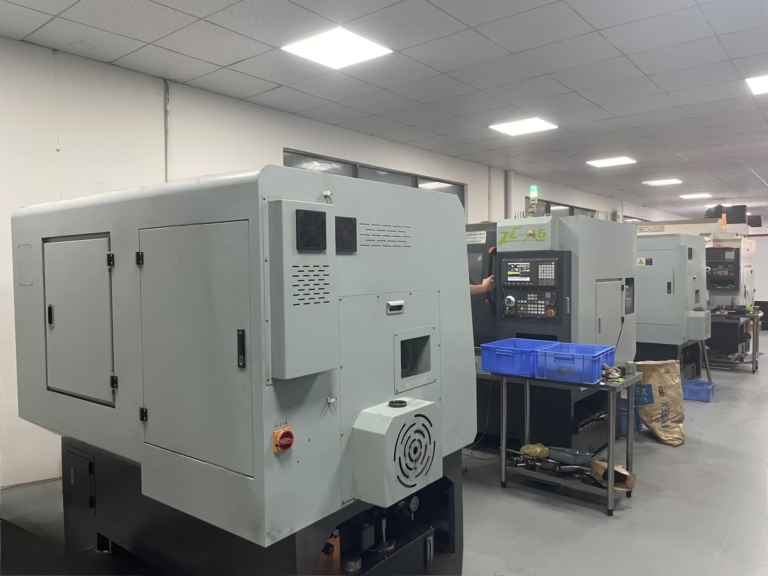
Look at the machine list, not the brochure. Four-axis capability means a rotary table with a controller that can interpolate the A axis with X, Y, and Z. A manual indexer is not the same thing. Ask for the machine model and the rotary table size. On our floor, 12 four-axis mills run alongside 16 simultaneous 5-axis centers and 27 three-axis machines, so parts are routed to the machine that fits.
Finally, check material and finish coverage. A shop that stocks 6061 and 304 but has to order 17-4PH and Inconel every time will add a week to your lead time. Ask what is on the shelf. Surface finish matters too: as-machined at Ra 1.6–3.2 μm, high finish at Ra 0.8–1.6 μm, and fine finish at Ra 0.2–0.8 μm. Each step adds hand or machine time.
- 1Send the bounding boxLength, width, and swing diameter decide whether the part fits at all.
- 2Ask for the datum strategyHow the shop locates the part drives the tolerance you actually get.
- 3Confirm the rotary table sizeA Ø400 mm table is a hard limit, not a suggestion.
Five checks that filter weak 4 axis suppliers
Certifications tell you which industries a shop is audited for. ISO 9001:2015 covers general quality management. IATF 16949:2016 is the automotive and EV standard. ISO 13485:2016 applies to medical devices. ISO 27001:2022 covers information security, which matters if your drawings are sensitive. A supplier with all four has been audited on process control, not just on paper.
Inspection depth is the second filter. 100% inspection before shipment sounds good until you ask what is measured on every part versus what is sampled. A sensible answer covers raw material check, in-process monitoring, and final inspection, with reports available on request. If the shop cannot describe its in-process checks, it is inspecting at the end, when it is too late to fix anything.
Lead time claims need structure. A quotation and free DFM analysis within 12 hours is a reasonable first response. Production starting within 24 hours after approval is fast but plausible for stocked material. Parts shipping in 3–5 days fits short runs. Treat any promise of next-day delivery on a 500-piece order as a red flag until the fixture is proven.
Volume flexibility matters more than a headline MOQ. A supplier that runs from one prototype to 10,000+ part runs without a minimum order quantity can absorb your ramp. That also means they are set up for changeovers, which is exactly what a fourth-axis job needs. Ask how they schedule a 20-piece rework next to a 5,000-piece production run.
Confidentiality is the last check. Uploads should be secure and confidential, and an NDA should be available on request. If a shop hesitates on an NDA for a new program, walk. Your drawings are the product.
- 1Match certification to industryISO 9001 is the floor. Add IATF, ISO 13485, or ISO 27001 as your market requires.
- 2Ask for a sample inspection reportOne page tells you more than a quality policy PDF.
- 3Test the small order firstA 10-piece run proves the setup, the communication, and the paperwork.
Design details that change the wholesale price
A fourth axis rewards parts that can be held in one setup. That means a single datum, a clamping feature that survives the whole cycle, and features that are reachable without a tool change longer than the pocket is deep. If a design needs two datums, the second setup erases most of the fourth-axis advantage. Redesign the datum before you ask for a lower price.
Wall thickness drives chatter, and chatter drives cost. Below about 1.5 mm in aluminum or 2 mm in stainless, the part starts to sing unless the shop slows down or adds support. Both add cycle time. If the wall is not functional, thicken it. If it is functional, tell the supplier up front so the quote includes the support fixture.
Hole depth is another quiet cost. A hole 8× diameter deep needs a long drill, peck cycles, and a reamer to hold size. On a fourth axis, that hole is often drilled on a face that can be indexed, which is good. But the deeper the hole, the more the tool wanders, and the more the shop has to slow down. Specify depth tolerance where it matters and leave the rest loose.
Finally, finish and marking. Anodizing, electroless nickel, and powder coating all add a step and a lead time. Laser marking at a minimum character height of 1.5 mm is fast, but smaller text needs a different process. If a serial number has to be readable after coating, say so. The marking step moves in the routing, and the price moves with it.
- 1One datum, one setupIf the part needs two datums, the fourth axis is not saving you money.
- 2Watch the wall thicknessThin walls need support, slower feeds, or both.
- 3Decide finish before quotingCoating can hide or blur small laser marks.
How to source wholesale price 4 axis CNC machining
Run these in order. Skipping step 2 is the most common mistake.
- 1Define the part envelopeGive length, width, height, and swing diameter around the rotation axis. Include the largest and smallest material condition. 4,000 mm is the maximum processing size here; anything wider than the rotary table swing will not run as a single 4-axis setup.
- 2List the faces that need machiningMark each face with its tolerance and finish. If three or more faces carry tight features, a fourth axis is likely cheaper than multiple 3-axis setups. If only one face matters, ask for a 3-axis quote as a baseline.
- 3Send material and quantityState the alloy (for example 6061-T6 or 17-4PH) and the annual quantity, not just the first order. Quantity decides whether a tombstone fixture is worth building. Under about 100 parts, soft jaws are usually the cheaper route.
- 4Request the three-line quoteMachine time, material, setup. Ask what the hour rate includes and whether programming and inspection are billed separately. A quote that cannot be split is not comparable to another quote.
- 5Ask for the DFM notesA free DFM analysis within 12 hours should flag thin walls, deep holes, and unreachable features. If the notes are generic, the supplier did not read the model.
- 6Confirm the inspection planAgree on what is measured 100% and what is sampled. Request a first article report for the first run and a final inspection report on request. Raw material check and in-process monitoring should both exist.
- 7Place a small qualification runOrder 10 to 20 parts before the full volume. This proves the fixture, the tolerance, the finish, and the paperwork. Production can start within 24 hours after approval, and parts ship in 3–5 days on short runs.
Frequently asked questions
Is 4 axis always cheaper than 5 axis?
No. The hour rate for a 5-axis center is higher, but it can finish a complex part in one setup where a 4-axis machine needs two or three.
The break-even sits around parts with contoured surfaces or features on five faces. For prismatic parts with holes around a bore, the fourth axis is usually the lower-cost route. Send the model and we will quote both.
What tolerance can I expect on a 4 axis part?
±0.005 mm (±0.0002 in) is achievable on rigid setups with stable temperature and the right cutter. That is a capability, not a default on every feature.
Thin walls, long tool reach, and hard alloys all loosen the practical number. Tell us which dimensions are functional. We will hold those tight and leave the rest at a normal machining tolerance.
Do you have a minimum order quantity?
No minimum order quantity. We run from one prototype to 10,000+ part runs.
For a single prototype, expect soft jaws and a simple setup. For volume, a dedicated fixture or tombstone can cut per-part setup cost, but the fixture cost has to be amortized over the order.
How fast can I get a quote and parts?
Quotation and free DFM analysis within 12 hours. Production can start within 24 hours after approval when material is stocked.
Short runs ship in 3–5 days. Parts that need outside finishing, such as anodizing or plating, add a step to the routing. We will show that in the quote rather than surprise you later.
Which materials do you stock for 4 axis work?
Aluminum 6061, 6061-T6, 2024, 5052, 5083, 6063, 6082, 7075, and ADC12. Stainless 303, 304, 316, 316L, 420, 430, 431, 440C, and 17-4PH.
Steel 1018, 1045, 4130, 4140, 4340, A36, and tool steel. Also copper and brass, titanium TA1, TA2, TC4 (Ti-6Al-4V), Inconel, magnesium, and engineering plastics including PEEK and POM.
How do you protect my drawings?
Uploads are secure and confidential, and an NDA is available on request. We hold ISO 27001:2022 for information security.
If your program needs an NDA before you send files, say so in the first message. We will sign it before the model is uploaded.
Send the model, get a split quote
Upload your STEP file and we will return a DFM analysis and a quote with machine time, material, and setup shown separately. No minimum order quantity, and uploads stay confidential.
12-hour quoteNo MOQ100% inspectionNDA on request
More from the shop floor
We publish setup notes, tooling trials and inspection data from the factory floor.











