
Prototype CNC Processing Options for Wholesale Batches
This page explains how prototype CNC processing options work when you need more than one or two units. It is written for design engineers and sourcing engineers who must pick a process, a material and a finishing route before committing to tooling. Read it and you can judge which option fits your batch size, tolerance and surface requirement.
In this article
- 1
- 2
- 3
- 4
- 5
- 6
How batch size changes prototype CNC processing options
A single prototype is mostly a geometry question. A batch of 30, 200 or 500 units is a process question. Setup time stops dominating the cost, and the real risks shift to fixture repeatability, tool wear, and whether the finish stays the same from unit 1 to unit 400.
Wholesale prototype machining sits between one-off prototyping and hard tooling. You still skip the mold or die, so design changes remain possible between batches. But you now need a process that holds the same datum and the same cutting strategy across every unit in the run.
That is why the option list looks different at volume. A part that was a natural fit for a 3-axis vise setup at quantity 2 may be better served by a 4-axis tombstone fixture or a mill-turn cycle at quantity 300. The geometry has not changed. The economics and the consistency risk have.
Our floor runs 127 high-precision CNC machines across 3 wholly-owned plants, including 16 simultaneous 5-axis machining centers. No minimum order quantity, so a run can start at one unit and scale to 10,000+ without re-quoting the process from scratch.
5-axis, 4-axis, 3-axis and mill-turn: what each one buys you
Three-axis machining moves the tool in X, Y and Z only. The part is repositioned by hand or by a fixture when a face needs a new angle. For flat plates, housings and simple brackets in the 500 × 500 × 450 mm envelope, this is still the cheapest and fastest route, and it is the easiest to inspect.
Four-axis adds a rotary table, typically Ø400 mm. The part rotates around one axis while the tool cuts, so features on four sides can be reached in one setup. At batch sizes above roughly 50 units, this cuts setup time hard and removes the stacking error you get from manual re-fixturing.
Five-axis moves the tool along five axes at once. It reaches undercuts, blended surfaces and deep pockets that would need long, weak tooling on a 3-axis machine. Shorter tools mean less deflection, so a 5-axis cycle often holds ±0.005 mm more reliably on thin walls and tall ribs.
Mill-turn combines turning and milling in one machine. Parts like shafts with cross-holes, or fittings with a turned body and milled flats, come off complete in one cycle. No second op, no re-chucking error, and the concentricity between the turned diameter and the milled features stays tight.
- 13-axisCheapest per part for flat or prismatic geometry. Best under 50 units.
- 24-axisOne setup for four faces. Good from about 50 to 500 units.
- 35-axisUndercuts, blends and thin walls. Necessary when 3-axis needs long tools.
- 4Mill-turnTurned plus milled features in one cycle. Removes a second operation.
Tolerance and surface finish limits that decide the option
Tolerance drives the machine choice more than part count does. General machining holds ±0.005 mm (±0.0002 in). If a drawing calls for something looser, say ±0.05 mm, you are paying for capability you do not need. Tighten the callout only where the assembly actually requires it.
Thermal drift is the hidden variable in a long batch. A machine that holds ±0.005 mm at 9 a.m. can drift as the spindle and the coolant warm up. In-process monitoring during the run catches that drift before it becomes scrap. We check raw material on receipt, monitor during cutting, and inspect 100% before shipment.
Surface finish is specified in Ra. As-machined aluminum typically lands at Ra 1.6–3.2 μm. A high-quality machined finish is Ra 0.8–1.6 μm. Fine finishing reaches Ra 0.2–0.8 μm and usually needs a separate pass, a sharper tool, or a finer stepover, so it costs more per unit.
Watch the interaction between finish and tolerance. A very fine Ra on a thin wall invites chatter. If the wall is under about 1 mm, expect to trade some finish quality for dimensional stability, or to add a stress-relief step before the final cut.
Material and finishing routes for wholesale prototype runs
Material choice should match what the production part will be, not what is easiest to cut. If the final part is 6061-T6, prototype in 6061-T6. If it is 17-4PH stainless, prototype in 17-4PH. Testing a prototype in a softer or lighter alloy tells you little about fit, wear or thermal behavior in service.
Aluminum grades 6061, 7075, 2024 and 6082 cover most housings and brackets. Stainless 303, 304, 316L and 17-4PH cover medical and food-contact parts. Titanium TC4 (Ti-6Al-4V) and Inconel suit aerospace and high-temperature work. Plastics such as POM, PEEK, PC and ABS cover non-metallic enclosures and insulators.
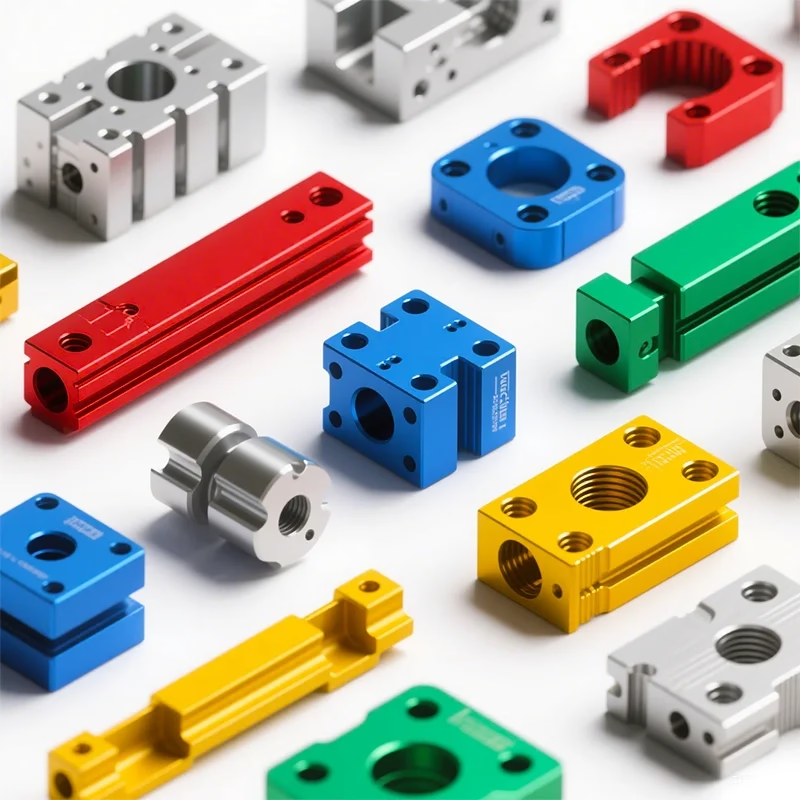
For finishing, anodizing in clear, color or hardcoat is the common route on aluminum. Electroless nickel, zinc, silver and gold plating cover conductivity and corrosion needs. Powder coating and black oxide handle larger frames. Bead blasting, tumbling, brushing and polishing set the cosmetic baseline.
Keep finishing in house where you can. When one supplier machines and finishes the batch, the cosmetic standard is set once and applied to every unit. Splitting the work between two vendors is where color and texture drift between the first article and the last one.
When CNC is the wrong option for a prototype batch
CNC is not always the answer. If the geometry is a hollow shell with uniform wall thickness and you need 500 units, vacuum casting or 3D printing may cost less and ship sooner. If the part is a thin sheet bracket, sheet metal fabrication will beat machining on both price and lead time.
CNC loses on very high volumes of simple parts. Past roughly 10,000 units of a small, simple geometry, die casting or injection molding usually wins on unit cost. CNC keeps its edge when geometry is complex, tolerances are tight, or the design is still moving.
CNC also loses when the material is hard to cut and the feature is deep. A 300 mm deep pocket in Inconel with a 6 mm tool is a slow, high-risk cut. Sometimes the better engineering answer is to redesign the pocket or split the part, not to force the machining route.
The honest rule: pick CNC when you need tight tolerance, real production material, and freedom to change the design between batches. Pick another process when the geometry is simple, the volume is high, and the design is frozen.
Prototype CNC processing options compared
Use this table to narrow the option before you send the drawing.
| Option | Typical batch | Best geometry | Watch out for |
|---|---|---|---|
| 3-axis | 1–50 units | Flat plates, simple housings | Multiple setups stack error |
| 4-axis | 50–500 units | Four-sided parts, brackets | Rotary table size limits part |
| 5-axis | 10–1,000 units | Undercuts, blends, thin walls | Higher hourly rate |
| Mill-turn | 50–2,000 units | Shafts with cross features | Not for prismatic blocks |
| Vacuum casting | 20–200 units | Hollow shells, covers | Softer than production resin |
| Sheet metal | 50–5,000 units | Enclosures, brackets | Limited 3D geometry |
| Die casting | 10,000+ units | Small simple metal parts | Tooling cost and lead time |
Which option to pick
If the geometry is complex or the tolerance is under ±0.02 mm, stay with CNC and pick the axis count from the geometry, not the price. If the part is a simple shell above 500 units, vacuum casting or sheet metal will beat CNC on cost. Send the drawing and we will confirm the route in the DFM analysis.
Common questions
Can the same prototype CNC processing options scale from 1 unit to 10,000?
Yes, within limits. The geometry and material stay the same, but the fixture and the cycle change as volume rises. A vise setup at quantity 5 becomes a soft-jaw or tombstone fixture at quantity 500.
Above roughly 10,000 units of a simple part, die casting or molding usually wins on unit cost. Below that, CNC keeps the design flexible and the tolerance tight.
How do you keep tolerance consistent across a wholesale batch?
We control three things: fixture repeatability, thermal drift and tool wear. The fixture holds the same datum for every unit. In-process monitoring catches drift during the run.
Every part is inspected 100% before shipment, and inspection reports are available on request.
What surface finish can I expect on a machined prototype?
As-machined aluminum lands around Ra 1.6–3.2 μm. A high-quality machined finish is Ra 0.8–1.6 μm. Fine finishing reaches Ra 0.2–0.8 μm.
Finer finishes need a separate pass and cost more per unit. On thin walls, expect to trade some finish for dimensional stability.
Do you offer finishing and assembly with the machining?
Yes. Anodizing, plating, powder coating, black oxide, bead blasting, tumbling, brushing, polishing and laser marking are all handled in house.
Keeping machining and finishing under one roof sets the cosmetic standard once and applies it to every unit in the batch.
How fast can a wholesale prototype batch ship?
Quotation and free DFM analysis come back within 12 hours. Production can start within 24 hours, and parts ship in 3–5 days.
Lead time depends on batch size, material and finishing. Historical late-delivery probability is below 2%.
Is my design data kept confidential?
Uploads are secure and confidential. An NDA is available on request.
We hold ISO 27001:2022 for information security, alongside ISO 9001:2015, IATF 16949:2016 and ISO 13485:2016.
Send the drawing, get the route back
Upload your CAD file and we will return a quotation, a free DFM analysis and a recommended process route within 12 hours.
12-hour quoteFree DFM analysis100% inspectionNo minimum order quantity
More from GreatLight
We publish setup notes, tooling trials and inspection data from the factory floor.











