
Why Choose 12V DC Brushless Cooling Fans for CNC Machines
When a spindle, drive or control cabinet runs hot, the fan is often the last part anyone checks. This page is for maintenance engineers and machine builders who need to trace a cooling fault to its root cause, then decide whether a 12V DC brushless fan is the right replacement. Read it and you can tell a failing fan from a blocked airflow path in under ten minutes.
In this article
- 1
- 2
- 3
- 4
- 5
- 6
Fan-related symptoms, likely causes, and what to do
Match the symptom you see on the machine to the cause, then work the fix in order.
| Symptom | Likely cause | Action |
|---|---|---|
| Spindle housing hot after 30 min | Fan stopped or running slow | Check tach output, replace fan |
| Cabinet air 15 °C above ambient | Blocked filter or clogged fins | Clean filter, clear fin gaps |
| Fan noisy at 8,000 rpm spindle | Sleeve bearing worn | Fit ball-bearing fan, rebalance |
| Drive faults on hot afternoons | Fan airflow below spec | Measure CFM, upsize or add duct |
| Fan starts then stops | Under-voltage on 12V rail | Load-test supply under running load |
| Repeated fan failures each year | Wrong IP or wrong bearing type | Match IP rating to coolant mist |
Where the heat actually comes from
Heat in a CNC machine has three sources, and they do not behave the same way. The cutting zone generates the most heat, especially in titanium, Inconel or hardened tool steel, but most of that leaves with the chip and the coolant. The spindle bearings and the spindle motor are the second source. They run continuously and their losses scale with speed, so a spindle at 12,000 rpm makes far more heat than the same spindle at 4,000 rpm.
The third source is electronics. Servo drives, the CNC controller, the power supply and the I/O rack all sit in the cabinet. Their losses are fairly steady, but the cabinet is often sealed against coolant mist and metal dust. Without forced airflow, cabinet air temperature can climb 15–20 °C above shop ambient within an hour of a heavy cycle.
The first symptom is rarely a hard fault. It is drift. A spindle grows 20–30 μm as it warms, and that shows up as a taper or a size shift between the first and tenth part of a batch. If your operator is chasing size all morning, check the thermal path before you touch offsets.
- 1Cutting zoneMost heat leaves with the chip and coolant.
- 2Spindle and motorLosses rise with spindle speed.
- 3Cabinet electronicsSteady losses, but often in sealed air.
Why 12V DC brushless cooling fans for CNC machines fail less often
A brushed AC fan wears out by design. Carbon brushes rub against a commutator, produce dust, and lose contact area over time. Brush dust is conductive and it lands on the very circuit boards the fan is supposed to protect. On a machine running two shifts, a brushed fan can be a yearly replacement item.
A brushless DC fan replaces the brush and commutator with a Hall sensor and a small driver IC. Nothing rubs. The only wear parts are the bearings, and even those can be sealed. That is why brushless cooling fans for CNC machines tend to run three to five times longer between replacements in the same duty cycle, and why they do not shed conductive dust into the cabinet.
There is a control benefit too. Because the motor is driven electronically, speed can be set by a PWM signal or read back through a tach wire. You can run the fan at half speed at night to cut noise, ramp it up when a thermistor in the cabinet passes 45 °C, and alarm out when the tach reads zero while the spindle is running.
- 1No brush dustNothing conductive is shed into the cabinet.
- 2Speed controlPWM in, tach out, easy to close the loop.
- 3Sealed bearingsBall type handles higher ambient than sleeve.
Sizing the fan to the fault you found
Do not replace a fan with the same part number until you know why the old one died. If the label says 12V and 0.25 A but the rail sags to 9.8 V under load, a new fan will die the same way. Measure the supply with the fan connected, not open-circuit. Most 12V brushless fans tolerate 7–13.8 V, but they lose speed and airflow at the low end.
Airflow matters more than the printed CFM number. A fan rated at 120 CFM through free air can drop to 40 CFM once it pushes through a filter and a fin stack. If the cabinet has a filter, size for the static pressure, not the free-air figure. A blower type handles restriction better than an axial type at the same size.
For a spindle housing, axial fans in the 40–80 mm frame size are common. For a sealed cabinet, look at 80–120 mm axial or a small centrifugal blower. Match the IP rating to the environment: IP55 is a sensible floor where coolant mist is present. A standard IP20 fan in a misty cabinet will short out within months.
- 1Measure loaded voltageA sagging 12V rail kills new fans fast.
- 2Size for static pressureFilters and fins cut free-air CFM hard.
- 3Match the IP ratingIP55 minimum around coolant mist.
When a 12V DC brushless fan is the wrong answer
A 12V DC fan is not always the fix. If the cabinet has no DC rail and you would need a separate power supply, an AC fan may be simpler and cheaper. If the heat load is above roughly 300 W in a sealed enclosure, a fan alone will not hold temperature; you need a cabinet air conditioner or a heat exchanger.
If the machine sits in a shop with fine conductive dust, an open-frame fan just moves the problem around. You need a filtered intake and a positive-pressure setup, meaning more intake fans than exhaust fans, so dust is pushed out of every gap instead of being drawn in.
Also watch the bearing choice. Sleeve bearings are quieter and cheaper, but they do not like ambient above 50 °C or any shaft-down mounting position. Ball bearings cost more and are noisier at low speed, but they handle heat and orientation. For a spindle-top fan on a machine running all day, ball bearings are the safer call.
- 1Above about 300 WA fan cannot hold a sealed cabinet alone.
- 2Dusty shopsUse filtered intakes and positive pressure.
- 3Hot or shaft-downChoose ball bearings, not sleeve.
Step by step: trace and fix a fan cooling fault
Work in this order. Stop as soon as the symptom clears.
- 1Log the temperatures firstRun the machine through a normal cycle and record spindle housing, cabinet intake and cabinet exhaust temperature every 10 minutes. A rise above 15 °C over ambient at the exhaust points to restricted airflow, not a dead fan.
- 2Check the fan is actually turningWith the cabinet closed, look through the grille or use a tach readout. If the tach reads zero while the drive is enabled, the fan or its supply has failed. Do not assume a spinning fan is a working fan; a worn bearing can spin at half speed.
- 3Measure the 12V rail under loadProbe the fan connector with the fan running. Anything below 11 V suggests a supply or wiring problem. Check the connector crimp and the ground return before replacing the fan.
- 4Inspect the airflow pathRemove the filter and shine a light through the fin stack. A filter loaded with mist and dust can cut airflow by 50% or more. Clean or replace it, then re-run the temperature log before deciding on a new fan.
- 5Verify airflow direction and pressure balanceConfirm the arrow on the fan body points the way you expect. On a filtered cabinet, intake fans should outnumber exhaust fans so the enclosure runs at slight positive pressure.
- 6Replace with the right fan, then re-testMatch frame size, voltage, bearing type and IP rating. After fitting, log temperatures again for one full cycle. A drop of 8–12 °C at the exhaust confirms the fix; a smaller drop means the heat load, not the fan, is the limit.
Common questions
Can I swap a 24V fan for a 12V fan on the same machine?
Only if the supply rail matches. A 12V fan on a 24V rail will burn out its driver IC within seconds, and a 24V fan on a 12V rail will run slow or not start.
If the machine has both rails, match the fan to the rail it is wired to. Never use a resistor to drop 24V to 12V for a fan; the voltage will swing with load and the fan speed will follow.
How long should a brushless fan last in a CNC cabinet?
There is no single number, because life depends on ambient temperature, bearing type and how much dust reaches the fan. A ball-bearing fan in a filtered cabinet at 35 °C will outlast a sleeve-bearing fan in the same spot by a wide margin.
Track replacement dates on the machine. If a fan fails twice inside a year, the cause is usually the environment, not the fan.
Why does my fan run at full speed all the time?
Most 12V brushless fans default to full speed when the PWM input is left floating. If the controller is not driving the PWM wire, the fan will not modulate.
Check whether the PWM wire is connected and whether the controller is configured to output a duty cycle. A tach wire left unconnected is harmless; a PWM wire left unconnected usually means full speed.
Is a larger fan always better?
No. A larger fan moves more air at lower speed and lower noise, but it also needs more space and may not fit the mounting pattern. On a restricted path, a well-matched smaller fan can beat a large one that is stalled against static pressure.
Choose by the airflow you need at the pressure the cabinet actually presents, not by frame size alone.
What IP rating do I need around coolant mist?
IP55 is a practical minimum for a fan exposed to coolant mist. IP20 fans have no protection against water ingress and will short out when mist condenses on the board.
If the fan sits directly in the mist path, consider a sealed blower or relocate the fan and duct clean air to the hot spot instead.
Should I add a filter to an open cabinet fan?
Yes, if the shop has airborne dust or mist. An unfiltered intake pulls that material straight onto the boards and fin stacks.
Plan for filter maintenance. A loaded filter is worse than no filter at all, because it starves the cabinet of airflow while you believe the fan is working.
Send us the fan bracket or the housing you need
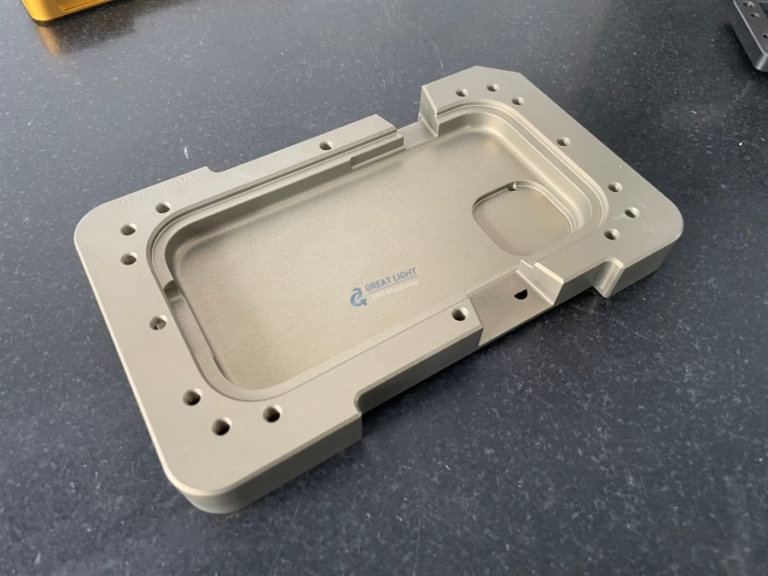
We machine fan brackets, mounting plates and heat-sink housings in aluminium and stainless, with quotation and free DFM analysis within 12 hours.
12-hour quote100% inspection±0.005 mm tolerance
More from GreatLight
We publish setup notes, tooling trials and inspection data from the factory floor.











