
Why Choose an ODM Rapid Prototyping China Expert
Most sourcing problems show up before the first chip is cut: files sent to a shop that only mills to print, tolerances quoted that no 3-axis machine can hold, post-processing split across three vendors. This page is for engineers and procurement staff comparing ODM rapid prototyping partners in China. Read it and you can tell, from a quote and a DFM reply, whether a supplier will carry the part to a finished, inspected prototype.
In this article
- 1
- 2
- 3
- 4
- 5
- 6
- 7
Troubleshooting Table: Common ODM Prototyping Failures
Read the left column first. If two or more rows match your current supplier, the problem is the partner, not the drawing.
| Symptom | Likely cause | What to do |
|---|---|---|
| Quote comes back in 3 days | Shop re-quotes after checking machine load | Ask for quote and DFM analysis in 12 hours |
| No DFM notes on the quote | Quote clerk, not an engineer, priced it | Request written DFM before you release the PO |
| Tolerance missed on angled faces | Part was re-fixtured across 3-axis setups | Move compound angles to simultaneous 5-axis |
| Surface finish varies by face | Hand polishing done by different operators | Specify finish as a Ra range, not 'smooth' |
| Prototype fits, run 1 does not | Process was never recorded after the prototype | Ask for the setup sheet and inspection report |
| Anodize color drifts between lots | Coating farm changed without notice | Lock the finishing vendor in writing |
| Parts arrive with no paperwork | Inspection was visual only | Require dimensional report with each shipment |
| Lead time slips after deposit | Material was not in stock when promised | Confirm stock or mill cert before deposit |
The Verdict: Choose on Engineering Response, Not on Price Alone
If a supplier returns a price with no DFM notes and no report format, the low number is not a saving. Move the project to a partner that reviews the design, owns the post-processing, and can show you the inspection data.
What an ODM Rapid Prototyping China Expert Actually Does
An ODM partner is not a machine shop with a nicer website. The difference shows up in who owns the decisions. A job shop waits for your drawing revision, then cuts metal. An ODM expert reads the function of the part, proposes a material or geometry change, and takes responsibility for the finished prototype meeting that function. That is a wider scope, and it changes what you should ask for in the first email.
The reason this matters more in prototyping than in production is iteration speed. A prototype is usually the first time a design touches real material. Wall thicknesses that looked fine in CAD turn out to be unmachinable at 0.8 mm in 6061. A bearing bore that needs a press fit at H7 gets specified as a clearance fit. An engineer on the supplier side catches these before the setup, not after.
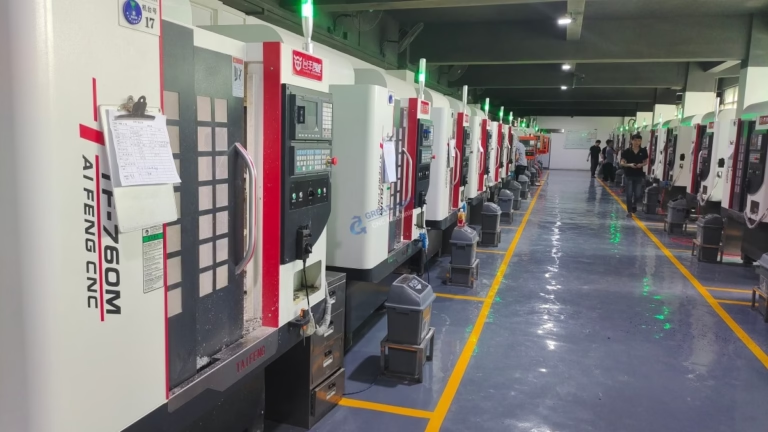
China's manufacturing clusters make this model practical rather than theoretical. In Dongguan, a single industrial area can supply machining, heat treatment, anodizing, and laser marking within a short drive. When one partner coordinates those steps, your prototype does not sit in a queue at each vendor. GreatLight runs 3 wholly-owned plants covering 7,600 m², with 150 technicians and 127 high-precision CNC machines, so the coordination stays in-house.
The word 'expert' is doing real work in the phrase ODM rapid prototyping China expert. It should mean someone who can tell you when your design is wrong for the process, not just someone who can run the machine. If the only feedback you ever get is a price and a lead time, you are buying capacity, not expertise.
Precision: Why 5-Axis Changes the Prototype, Not Just the Price
The most common cause of a failed prototype is not a bad machine. It is too many setups. Every time a part comes off the table and gets re-fixtured, you add a positioning error. On a part with compound angles, undercuts, or deep pockets, three-axis machining can need five or six setups, and the stack-up eats your tolerance budget before the tool touches the part.
Simultaneous 5-axis machining removes most of that stack-up. GreatLight operates 16 simultaneous 5-axis machining centers alongside 12 four-axis mills and 27 three-axis machines, so the process is matched to the geometry rather than forced onto whatever is free. Held tolerances reach ±0.005 mm (±0.0002 in) on features that would need re-fixturing on a 3-axis machine.
Size matters too. Maximum processing size is 4,000 mm, with travels of 4,000 × 400 × 150 mm on the large frames and 750 × 1,150 × 550 mm on the medium ones. A Ø400 mm rotary table handles parts that need rotary indexing. That range covers everything from a humanoid robot joint housing to a long aerospace sensor bracket.
Surface finish is specified separately from tolerance, because it is a separate cost. As-machined surfaces land at Ra 1.6–3.2 μm. A high-quality finish is Ra 0.8–1.6 μm. Where a seal or a sliding surface needs it, fine finishing reaches Ra 0.2–0.8 μm. Tell the supplier which faces actually need the fine range. Specifying it everywhere multiplies cycle time for no functional gain.
Post-Processing Gaps Are Where Prototypes Slip
A machined part is rarely a finished prototype. It may need anodizing, electroless nickel, bead blasting, or laser marking. When those steps sit at separate vendors, the schedule is no longer in your supplier's hands. Each handoff adds a queue, and each queue adds a chance for the part to be packed badly or handled with the wrong gloves.
Keeping the chain under one roof shortens the path. GreatLight covers anodizing in clear, color, hardcoat and conductive versions, plating in electroless nickel, zinc, silver and gold, powder coating and black oxide, plus bead blasting, tumbling, brushing and polishing. Laser marking and engraving handle character heights down to 1.5 mm, which is the practical floor for legible part numbers on small housings.
Material choice drives the finishing decision more than most engineers expect. Aluminum 6061-T6 anodizes evenly and is the default for functional prototypes. 7075 takes hardcoat well but machines differently and can distort in thin walls. Stainless 17-4PH in the H900 condition gives high strength but is hard on tooling, so it is usually reserved for parts that will see real load. Titanium Ti-6Al-4V and Inconel are available when the application demands them, at a cost in cycle time.
Plastics follow different rules. POM and PEEK machine cleanly and hold tight tolerances; ABS and PC are better for fit checks than for load. Carbon fiber is available but is abrasive and needs carbide tooling. If the prototype's job is to prove a mechanism, the material choice should follow the mechanism, not the production material.
How to Evaluate a Claimed ODM Rapid Prototyping China Expert
Start with the response to your first email. A supplier that returns a quotation and a free DFM analysis within 12 hours has an engineering review step in its intake process. A supplier that returns a price with no comments has a quoting step. The second one will not catch a design problem, because nobody looked at the design.
Next, ask what happens between prototype and production. The strongest signal is whether the prototype process gets documented. If the supplier records the setup, the tooling, and the inspection results, the transition to a 10,000+ part run is a scale-up. If the prototype is treated as a one-off, run 1 starts from scratch and the first-article problems repeat.
Certifications are a filter, not a ranking. ISO 9001:2015 covers general quality management. IATF 16949:2016 matters if the part is going into a vehicle program. ISO 13485:2016 applies to medical devices. ISO 27001:2022 covers information security, which is relevant when you are sending unreleased CAD. GreatLight holds all four. Ask which one applies to your part, and ask to see the certificate scope.
Finally, check the inspection routine. A supplier that inspects 100% of parts before shipment, checks raw material on arrival, monitors in-process, and inspects at final, with reports available on request, is telling you the part was measured. A supplier that says 'we check everything' without a report format is telling you nothing you can audit.
Where the Cost of an ODM Prototype Actually Goes
Engineers often assume a low quote means an efficient shop. In prototyping, a low quote frequently means the quote excludes something. Common exclusions are programming time, custom fixturing, secondary operations, and inspection. The part arrives, and the missing steps show up as a second invoice or as a part that does not meet the print.
A complete quote names the material grade, the machine class, the tolerance, the finish on each critical face, and the inspection method. It should also say whether stock material is on hand. Production can start within 24 hours only when the material is actually there. That single check prevents most schedule surprises.
Volume flexibility is part of the cost picture. No minimum order quantity means a single prototype and a 10,000+ part run go through the same intake. That matters when a design changes after the first article. You are not re-negotiating a minimum, and you are not paying a small-batch penalty that quietly disappears at volume.
Confidentiality belongs in this section because it affects cost and speed. Uploads are handled as secure and confidential, and an NDA is available on request. If the project is unreleased, settle the NDA before the first file transfer. Doing it afterward means the drawings already moved.
Step by Step: Vetting and Running a Prototype Order
Each step has a check that either moves the project forward or ends the conversation early.
- 1Send STEP plus a 2D drawing with tolerancesThe STEP defines geometry; the 2D drawing defines what is critical. Mark datum features and which faces carry the tight tolerance. A drawing with a single title-block tolerance forces the supplier to guess, and guessing is where ±0.005 mm becomes ±0.05 mm.
- 2Request DFM feedback with the quoteAsk specifically for manufacturability comments, not a price alone. Expect notes on wall thickness, tool reach, thread depth, and any feature that needs 5-axis. A quote and DFM analysis within 12 hours is a reasonable benchmark.
- 3Confirm material grade, stock, and mill certState the grade, for example 6061-T6 or 17-4PH, and ask whether it is in stock. If it is not, the lead time changes. Production can start within 24 hours when stock is on hand.
- 4Lock the finish per face, not per partList which surfaces need Ra 0.8–1.6 μm and which can stay as-machined at Ra 1.6–3.2 μm. Add the coating type and color. Anodize dye lots vary, so if color matters, say so before the parts go out.
- 5Agree the inspection report formatDecide up front whether you want a dimensional report, a first-article report, or both. 100% inspection before shipment is the baseline; the report is the evidence. Ask for it before the parts ship, not after.
- 6Sign the NDA before the first uploadIf the design is unreleased, get the NDA in place first. Files transfer over secure, confidential channels, but the agreement should exist before anything moves. It takes less time than a redesign.
- 7Review the first article against the drawingMeasure the datum features and the critical faces yourself. Compare against the report. If a dimension is out, raise it with the setup data in hand so the correction is a process change, not a re-cut.
- 8Decide on scale-up after fit and functionOnce the prototype passes, confirm that the process will carry to the run. No minimum order quantity means the transition is a volume change, not a new sourcing cycle. Parts ship in 3–5 days for prototype quantities.
Questions Engineers Ask Before Committing
What tolerance can an ODM rapid prototyping partner in China actually hold?
For machined metal prototypes, ±0.005 mm (±0.0002 in) is achievable on critical features when the part is set up on the right machine class. That number is not universal. It applies to specific features under specific fixturing, not to every dimension on the drawing.
The practical move is to tell the supplier which dimensions are functional and which are reference. Tightening the whole drawing raises cost and cycle time without improving the part. Finish is separate again: as-machined is Ra 1.6–3.2 μm, and fine finishing reaches Ra 0.2–0.8 μm where a surface actually needs it.
How fast can a prototype ship, and what decides the date?
Quotation and DFM analysis come back within 12 hours, and production can start within 24 hours once the design and material are settled. Prototype quantities ship in 3–5 days. Historical late-delivery probability is below 2%.
The date is set by three things: whether the material is in stock, whether the geometry needs 5-axis work, and whether the finish is an in-house step or an outside one. Ask about all three before you commit to a review date.
Is there a minimum order quantity for prototyping?
No. GreatLight runs from a single prototype to 10,000+ part runs through the same intake process. That matters when the design changes after the first article, because there is no minimum to re-negotiate and no small-batch penalty that disappears later.
It also means the prototype and the production run can use the same setup logic. The process carries over instead of restarting.
How do you handle confidential designs?
Uploads are treated as secure and confidential, and an NDA is available on request. If the design is unreleased, settle the agreement before the first file transfer.
ISO 27001:2022 covers information security management and applies to how design data is stored and shared. Ask which certification scope covers your project if the part is regulated.
Which materials are available for a functional prototype?
Aluminum includes 6061, 6061-T6, 2024, 5052, 5083, 6063, 6082, 7075 and ADC12. Stainless covers 303, 304, 316, 316L, 420, 430, 431, 440C and 17-4PH. Steel grades run from 1018 and 1045 to 4130, 4140, 4340, A36 and tool steel.
Copper and brass include C101, C103, C110, beryllium copper and the C27400, C28000 and C36000 grades. Titanium and special alloys cover TA1, TA2, TC4 (Ti-6Al-4V), Inconel, and magnesium AZ31B and AZ91D. Plastics include ABS, PC, PMMA, POM, PA, PEEK, PP, HDPE and carbon fiber.
What certifications should I ask a China prototyping supplier to show?
Ask which certificate applies to your part rather than collecting all of them. ISO 9001:2015 is the general quality baseline. IATF 16949:2016 applies to automotive programs. ISO 13485:2016 applies to medical devices. ISO 27001:2022 covers information security.
Then ask to see the scope statement, not just the certificate number. A certificate that does not cover the process your part needs does not help you.
Send Your Files and Get a DFM Review
Upload your STEP and 2D drawing. You get a quotation and a free DFM analysis within 12 hours, with the tolerance and finish steps called out before anything is cut.
12-hour quote and DFMNo minimum order quantity100% inspection before shipmentNDA available on request
More Machining Notes
We publish setup notes, tooling trials and inspection data from the factory floor.











