
Wood CNC Machining Service Near Me: How to Pick One
This guide is for engineers and buyers sourcing machined wood parts, from one prototype to 10,000-unit runs. It covers the checks that separate a shop that can hold your print from one that only cuts flat panels. Read it before you send the RFQ.
In this article
- 1
- 2
- 3
- 4
- 5
- 6
- 7
- 8
- 9
What matters most
Which wood machining route fits your part
Use this table to narrow the field before you request quotes.
| Part type | Best route | Typical tolerance | Watch for |
|---|---|---|---|
| Flat panels, cabinet doors | 3-axis router | ±0.2 mm | Grain mismatch between panels |
| Curved or sculpted shells | 4-axis or 5-axis mill | ±0.3 mm | Fixture marks on finished faces |
| Wood body with metal insert | 5-axis, single setup | ±0.05 mm at insert | Insert pull-out under load |
| Long architectural trim | 3-axis, 4,000 mm bed | ±0.5 mm over 2 m | Spring-back after clamping |
| Prototype, 1–5 units | 3-axis + hand finishing | ±0.5 mm | Setup cost per unit |
| Sealed outdoor parts | CNC + resin or oil finish | ±0.3 mm | Coating build on mating faces |
| Thin ribs or lattice | 3-axis, reduced feed | ±0.3 mm | Chatter and grain tear-out |
How to compare two wood CNC quotes line by line
Put both quotes in this grid. The gaps show up fast.
| Line item | What to ask | Red flag |
|---|---|---|
| Species and grade | Named species, grade, thickness | Wood or hardwood only |
| Moisture content | Target EMC range at machining | No answer or a guess |
| Tolerance by feature | Wood vs metal features listed separately | One tolerance for the whole print |
| Fixture and tooling | Cost, ownership, reuse on reorders | Large lump sum, no detail |
| Finishing | Sand grit, sealer, topcoat build | Sand and seal only |
| Inspection | Critical dims, grain check, report | Visual check only |
| Lead time | Days after drawing approval | Fast or ASAP |
| Confidentiality | NDA before file upload | No NDA offered |
The short version
If your part is flat panels and appearance is secondary, almost any 3-axis shop will do. If it has curved surfaces, a metal insert, or a tight interface, pick a shop that machines both materials in one setup and tells you the moisture content of the stock.
Why wood changes the tolerance conversation
Metal buyers are used to a number on the print. Wood does not work that way. The same cut on maple and on MDF gives two different results, because one has grain and the other has resin binder. A shop quoting wood cnc machining service near me needs to ask what species and what moisture content before it can commit to a tolerance.
Solid hardwood moves with humidity. A 300 mm oak part can grow or shrink 0.3–0.6 mm between a dry winter shop and a humid summer warehouse. Plywood and MDF move far less because the grain is cross-laminated or random. If your assembly has a metal frame, that difference shows up as a gap or a bind.
Engineered panels are the practical choice when dimensional stability matters more than appearance. Baltic birch plywood holds a flatness of roughly 0.3 mm over 600 mm. MDF holds tighter, near 0.2 mm, and machines cleanly with no tear-out. Neither takes a stain the way solid wood does, so decide early which property you are buying.
Particleboard and OSB are not good CNC substrates for tight parts. The chips tear, the edges crumble, and edge quality depends on tool sharpness more than on programming. For hidden structure they are fine. For visible or load-bearing features, move up to plywood or solid stock.
- 1Solid woodBest appearance, worst stability. Expect movement with humidity.
- 2PlywoodGood stability, visible edge layers, moderate tool wear.
- 3MDFVery stable and uniform, no grain figure, heavy dust load.
- 4Densified laminateTightest tolerance, highest tool wear, limited thickness range.
What a wood cnc machining service near me can and cannot hold
Cutting tools set a hard limit on feature size. A 3 mm end mill can cut an internal corner radius of 1.5 mm, no tighter. If your drawing calls for a 0.8 mm internal radius in oak, the shop has to either change the design or refuse the job. Ask for the smallest tool the shop will actually run in your material, not the smallest tool it owns.
Depth-to-diameter ratio matters more in wood than in aluminum. A tool that is 4× its diameter deep in aluminum will chatter in hardwood and burn the wall. Practical limit for a 6 mm cutter in dense hardwood is around 24 mm of depth in one pass set, and that assumes a rigid fixture and a sharp flute.
Thin walls are the second limit. Below 2 mm, wood fibers deflect under cutting force and the wall thickness varies along the part. If the design needs a 1.5 mm rib, consider a different material or add a supporting web that gets trimmed later.
Surface finish is where wood rewards you. A sharp cutter at 16,000–18,000 rpm and a 6–8 m/min feed leaves a surface that needs light sanding only. A dull cutter at the same settings leaves fuzz that no amount of sanding fixes without rounding the edge.
- 1Minimum internal radiusHalf the cutter diameter. A 3 mm tool gives 1.5 mm.
- 2Maximum depth per passAbout 4× cutter diameter in hardwood before chatter.
- 3Minimum wall2 mm in solid stock, 1.2 mm in MDF with support.
- 4Edge breakAdd 0.4–0.8 mm chamfer. Sharp wood edges chip in handling.
Wood bodies with metal inserts: one setup, one tolerance stack
Many wood parts are really assemblies. A handle has a threaded insert. A housing has a metal bushing. A panel has a steel bracket. The moment two materials meet, the tolerance question changes, because wood and metal expand at very different rates.
The practical fix is to machine the wood pocket and the metal feature in the same setup, or at least on the same machine with the same datum. Splitting the wood work and the metal work between two vendors adds a second tolerance stack and a second shipping step. That is where most fit problems come from.
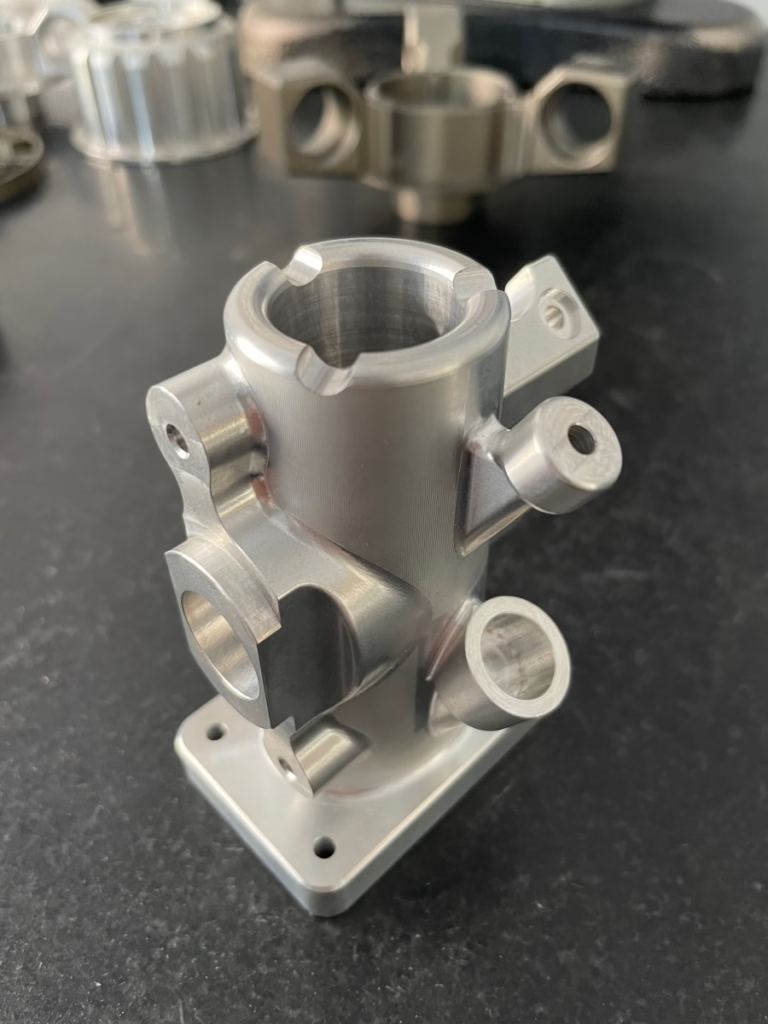
GreatLight runs 16 simultaneous 5-axis machining centers, 12 four-axis mills, and 27 three-axis machines across three plants. A wood fixture with an aluminum insert can be cut in one program on a 5-axis center, which keeps the insert bore concentric to the wood pocket.
For metal features, the shop holds ±0.005 mm and finishes to Ra 0.8–1.6 μm when the print calls for it. The wood portion of the same part will not hold that, and should not be dimensioned that way. Split the drawing: tight tolerances on metal, realistic tolerances on wood.
- 1Datum strategyPick one face and one hole used by both materials.
- 2Insert retentionKnurled or flanged inserts resist pull-out better than plain.
- 3Thermal gapLeave 0.1–0.2 mm clearance where wood meets metal.
Seven things to verify before you place the order
First, ask what species and grade the quote assumes. A quote that says only wood is not a quote. Species changes tool wear, feed rate, and finish quality, and it changes the price. Get it in writing.
Second, ask about moisture content at the time of machining. Interior parts want 8–12% equilibrium moisture content. If the shop cannot tell you the number, it is not measuring, and your parts will move after delivery.
Third, ask how the fixture is made and who pays for it. On runs under 50 pieces, fixture cost can be a real fraction of the unit price. A shop that amortizes it across the run is easier to compare than one that bills it separately with no visibility.
Fourth, check the inspection routine. For wood, that means checking the critical dimensions and the grain orientation, not just counting parts. A written report on request is a reasonable ask and a good sign.
Fifth, check certifications only where they apply. ISO 9001:2015 covers quality process. IATF 16949:2016 matters for automotive programs. ISO 13485:2016 matters for medical. ISO 27001:2022 covers data handling, which matters if your drawings are confidential.
Sixth, confirm the lead time and what starts the clock. A quote that says 3–5 days after drawing approval is clear. One that says fast is not.
Seventh, confirm the confidentiality terms. If your part is not yet public, an NDA should be available before you upload files.
What actually drives the price of a wood part
Machine time is not the largest cost on small wood runs. Setup and fixture building usually are. A 30-part run of a sculpted shell can spend more hours on the fixture than on the cut. If you plan to reorder, ask whether the fixture is kept and reused, because that changes the second order price.
Species affects both material cost and cutting speed. Dense species like hard maple and ipe wear tooling faster and need slower feed rates. Softwoods like pine cut fast but tear at the edges and need more sanding. A shop that quotes all species at one rate is either guessing or planning to lose money on one of them.
Finishing is a separate cost center and often underestimated. A sealer plus two topcoats with sanding between coats can take longer than the machining. If your part needs a specific sheen or a color match, say so at RFQ, not after the parts are cut.
Volume changes the answer. One prototype is priced on setup. A 10,000-unit run is priced on cycle time, material yield, and tool life. GreatLight has no minimum order quantity, so the same shop can quote both ends without a handoff.
- 1Small runsSetup and fixture dominate. Ask for reuse terms.
- 2Large runsCycle time and material yield dominate. Ask for nesting.
- 3FinishingBudget it separately. It is not a rounding error.
Step by step: from RFQ to shipped wood parts
This is the sequence a well-run shop follows. Use it to check whether your supplier is skipping steps.
- 1Send STEP or 3D model plus a 2D printInclude species, finish, and where tolerances are tight. A model alone leaves the critical dimensions open to interpretation.
- 2Get the DFM review backGreatLight returns a quotation and free DFM analysis within 12 hours. Read the notes on radii, wall thickness, and grain direction before you approve.
- 3Confirm material and moistureAgree on species, grade, and target moisture content. Ask for the stock thickness tolerance, typically ±0.2 mm for planed hardwood.
- 4Approve the fixture planAsk how the part is held and where the clamp marks will land. Clamp marks on a visible face are a finishing problem.
- 5Lock the cutting parametersSpindle 16,000–18,000 rpm, feed 6–8 m/min for hardwood, lower for dense species. Confirm the shop adjusts per species.
- 6First article inspectionCheck critical dimensions and grain orientation on the first part. Fix the program before the run continues.
- 7Run production and finishSand, seal, and topcoat as specified. Production can start within 24 hours of approval, and parts ship in 3–5 days.
- 8Inspect before shipment100% inspection before shipment covers raw material check, in-process monitoring, and final inspection. Reports on request.
Questions buyers ask before the first order
Can a wood cnc machining service near me also cut the metal inserts?
Yes, if the shop runs both materials. GreatLight machines aluminum, stainless, steel, brass, and titanium alongside wood work, so a wood body with a metal insert can be cut on one machine with one datum.
The metal features hold ±0.005 mm and can be finished to Ra 0.8–1.6 μm. The wood features will not hold that, so dimension them separately on the print.
What tolerance should I put on a solid wood part?
For a part under 300 mm, ±0.2 mm is realistic in stable stock at 8–12% moisture content. Over 1,000 mm, expect ±0.5 mm or looser because of movement and spring-back.
Do not copy a metal tolerance onto a wood drawing. The shop will either refuse the job or quote it high to cover the risk.
Is there a minimum order quantity?
GreatLight has no minimum order quantity. The same process runs one prototype or a 10,000+ part production order.
On very small runs, expect the fixture cost to be visible in the unit price. That is normal and not a markup.
How fast can parts ship?
Quotation and free DFM analysis come back within 12 hours. Production can start within 24 hours of approval, and parts ship in 3–5 days.
The clock starts when the drawing and material are confirmed, not when the inquiry arrives.
Are my drawings kept confidential?
Uploads are secure and confidential, and an NDA is available on request before you send files.
GreatLight holds ISO 27001:2022 for information security, which covers how customer data is stored and handled.
What certifications should I check for my industry?
ISO 9001:2015 is the baseline quality system. IATF 16949:2016 applies to automotive programs, and ISO 13485:2016 applies to medical device work.
Ask which certificate covers the plant that will actually run your parts, not just the company name on the website.
Send your wood part for a DFM review
Upload a STEP file and a print. You get a quotation and DFM notes within 12 hours, with no minimum order quantity.
12-hour quote100% inspectionNDA on requestNo minimum order quantity
More from GreatLight
We publish setup notes, tooling trials and inspection data from the factory floor.











