
10 Essential Tips for Choosing the Perfect Home Shop CNC Machine
This guide is for engineers, prototypers and small shop owners who are choosing the perfect home shop CNC machine and do not want to buy twice. It walks through workpiece geometry, spindle torque, frame rigidity, control software, tool change, real precision claims and support. Read it and you can tell which specs matter for your parts, and which are just sticker numbers.
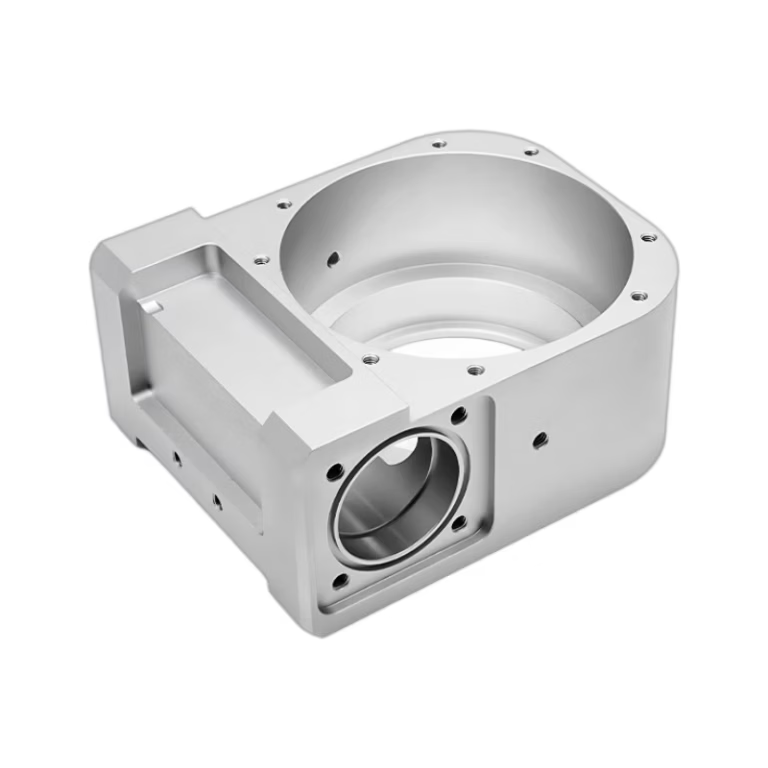
Match the Machine to the Parts, Not the Brochure
Ten checks, in the order that usually decides whether a machine earns its floor space.
Start With Part Geometry, Then Add Up the Real Cost
Before you compare spindle speeds, list the parts you actually expect to make. Write down the largest envelope, the smallest internal corner, the deepest pocket, and the material mix. Travel of 500 × 310 × 200 mm covers most brackets, plates and small housings. If your work includes long extrusions or fixture plates, you need travel closer to 750 × 1,150 × 550 mm. Buying capacity you never use costs money and floor space. Buying too little means you send work out within a month.
Material behavior decides more than table size. Aluminum 6061 cuts cleanly on a benchtop frame. Stainless 304 and 17-4PH work-harden, so they need lower surface speed, more coolant and a stiffer machine. Titanium Ti-6Al-4V punishes chatter and heat. If most of your parts are plastics or brass, a light machine is fine. If steel and titanium are on the list, plan for mass and torque from the start.
The purchase price is the smallest number. Add a mist collector, a proper vise or fixture plate, ER collets and holders, a dial indicator and edge finder, and CAM software that posts to your controller. Then add inserts, end mills and the occasional broken tap. Many owners spend 50 to 100 percent of the machine price again in the first year. Budget that before you buy, not after.
Count the hours you will spend on setup and maintenance. A cheap machine that needs tramming every week costs you weekends. A used machine with no documentation costs you evenings. If your shop rate is real money, downtime is a line item. Some jobs are cheaper to send to a contract shop than to run at home.
Spindle Torque and Frame Rigidity Beat Peak RPM
High RPM sells machines. Torque removes metal. A 24,000 RPM spindle with 0.5 Nm of torque will stall when you face-mill a block of 4140 steel. Look at the torque curve across the speed range, not the maximum number on the label. Low-speed torque is what gets you through interrupted cuts and deep slots.
For a home shop cutting aluminum and plastics, a 2.2 kW water-cooled spindle with a proper VFD and ER20 collet is a sensible benchmark. It holds speed under load and stays quiet. For steel, you want more mass and lower gearing, or a belt-driven head with real low-end torque. Air-cooled spindles are louder and lose torque as they heat up.
Rigidity comes from mass and geometry. Cast iron and epoxy granite damp vibration better than thin steel tube. Linear rails with preloaded blocks resist deflection better than unsupported round rail. Check the distance from the spindle nose to the column. A long cantilever flexes under load, and no controller setting fixes that.
Push on the spindle by hand with the machine off. If you can feel movement, the cut will show it. Ask for a test cut in the material you plan to run. Chatter marks, taper in a deep pocket and poor surface finish are rigidity problems, not feed and speed problems.
Control Software, Tool Change and Day-to-Day Workflow
The controller decides how you work. Mach3 and LinuxCNC are open and cheap but need tuning. Industrial controls like Siemens, Fanuc and Mitsubishi are stable and well documented, with post-processors available for common CAM packages. Check that your CAM software posts clean G-code to the control you pick. A great machine with no post-processor is a paperweight.
Look at what the control gives you for offsets, tool tables and probing. Manual tool length entry is slow and error-prone. A touch probe or tool setter pays back on the first job with more than five tools. If the control cannot run a tool change macro, you will type offsets by hand for the life of the machine.
Tool change is where cycle time disappears. A manual R8 or ER collet chuck is fine for one-off work. A quick-change system or an automatic tool changer matters when you run batches. Count the tools per part. If a job needs six tools and you change each one by hand, you lose ten minutes per part.
Workholding deserves more attention than most buyers give it. A T-slot table, a fixture plate with threaded holes, and a good vise cover most jobs. Plan for coolant containment and chip removal too. Chips pile up fast, and recutting them ruins surface finish and tool life.
Read Precision Claims Carefully, Then Plan for Support
Accuracy and repeatability are different numbers. Accuracy is how close you get to the commanded position. Repeatability is how close you return to the same spot. A machine may repeat to ±0.005 mm and still cut a part that is 0.05 mm off if the screws are not calibrated. Ask which number is quoted, and over what travel.
Thermal drift moves the zero point as the spindle and screws warm up. A machine that holds ±0.01 mm cold may drift past that in an hour of cutting. Warm up the machine, or run a warm-up cycle before precision work. Backlash compensation and ball screw preload matter more than the resolution printed on the spec sheet.
Parts availability decides the machine's life. Check that the spindle, drives, controller and linear rails are standard items you can buy in three years. Ask for a wiring diagram and parameter backup. A machine with proprietary parts and no documentation becomes scrap when one board fails.
Buy from a builder who answers technical questions before the sale. Ask for the torque curve, the rigidity data, and a test cut. If the seller cannot explain how the machine holds tolerance, they will not help when it does not. The same logic applies to choosing perfect home shop support: the relationship matters as much as the iron.
Machine Class vs. Typical Work
Use this as a starting filter, not a final answer.
| Machine class | Typical envelope | Best fit |
|---|---|---|
| Benchtop mill | 500 × 310 × 200 mm | Aluminum, brass, plastics |
| Mid-size VMC | 600 × 600 × 600 mm | Steel brackets, small molds |
| Large travel mill | 750 × 1,150 × 550 mm | Fixture plates, long parts |
| 5-axis center | Ø400 mm rotary table | Complex contoured parts |
Questions Engineers Ask Before Buying
How much spindle power do I need for aluminum?
For 6061 and similar alloys, 1.5 to 2.2 kW is enough for light face milling and pocketing with modest depth of cut.
Step up if you plan heavy roughing or regular steel work. Power without rigidity just moves the chatter around.
Is a 5-axis machine worth it for a home shop?
Only if your parts need it. Five-axis work pays off on contoured surfaces, undercuts and multi-face parts that would otherwise need three setups.
For flat plates and simple brackets, a three-axis machine with a good vise is faster to set up and easier to program.
What tolerance can a home shop machine realistically hold?
A well-built benchtop machine with calibrated screws and a warm spindle can hold ±0.01 to ±0.02 mm on small aluminum parts.
Holding ±0.005 mm consistently needs a controlled environment, probing and careful tool setting. Treat catalog numbers as best-case.
Should I buy new or used?
Used industrial machines often give more rigidity per dollar, but check spindle runout, backlash and controller support.
New benchtop machines come with warranty and documentation. Either way, budget for tooling and a post-processor.
How do I check a machine before I commit?
Ask for a test cut in your material, a torque curve, and a list of consumable part numbers.
Request a parameter backup and wiring diagram. If those are not available, support after the sale will be difficult.
When should I send parts out instead of machining them?
Send work out when the geometry needs five axes, when the material is difficult, or when the quantity makes a contract shop cheaper than your own setup time.
A shop with 127 machines and 16 simultaneous 5-axis centers can run one prototype or 10,000 parts with no minimum order quantity.
Not Ready to Buy a Machine? Run the Part With Us First
Send your drawing and get a quotation with free DFM analysis within 12 hours. Uploads are secure and confidential, and an NDA is available on request.
±0.005 mm tolerance12-hour quote100% inspectionNo minimum order quantity









