
11 Gear Processing Steps You Need to Know
A shop-floor walkthrough of the gear processing steps we use at GreatLight, from blank prep through hobbing, shaping, heat treatment and final inspection. Written for design engineers and buyers who need to pick a route and read a gear drawing.
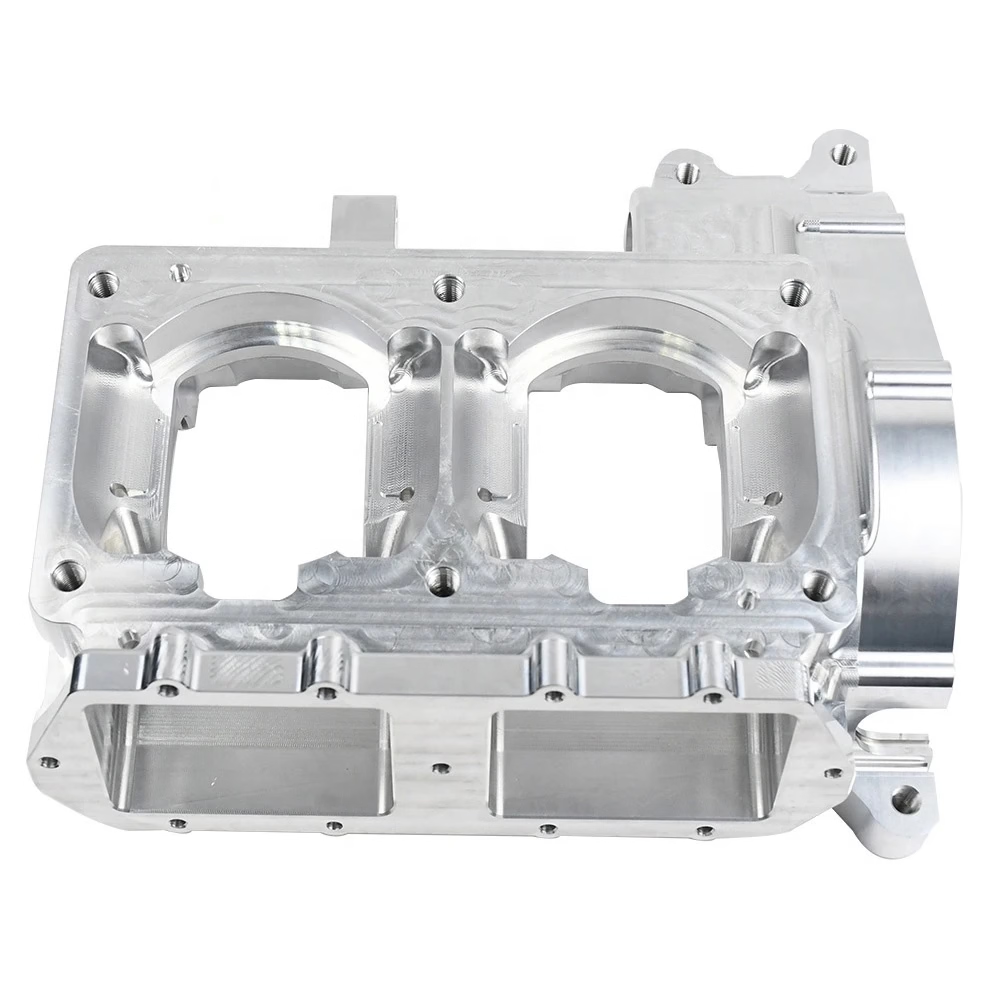
How a gear actually gets made
The list below is the sequence we run in Dongguan. Not every gear touches every step.
Blank prep and datum turning
Step 1 is the blank. For a shaft gear, we cut bar stock to length on a bandsaw and face both ends. For a disc gear, we saw plate or, at higher volumes, drop-forge a near-net blank so the teeth are not cut from solid. The blank decision drives everything downstream: a forged blank leaves less material for the hob, but you pay for tooling and you wait longer for first parts.
Step 2 is datum turning. A gear lives or dies by its bore and face runout. We turn the bore, one face, and a reference diameter in a single setup so the tooth-cutting operations have something true to hold. On a 27-tooth pinion with a 40 mm bore, we aim for ±0.005 mm on the bore and 0.01 mm total runout on the face. A gear cut from a soft, badly turned blank will show it later as noise.
- 1Saw and faceBar or plate cut to length, both ends square.
- 2Forge near-netHigher volumes, less hob stock, tooling cost up front.
- 3Turn the datumBore and face in one setup for true runout.
Hobbing, shaping and shaving
Step 3 is hobbing. A hob is a rotating cutter that generates the tooth form as the blank indexes. It is the fastest way to cut external spur and helical gears, and it handles a wide module range. Hobbing leaves a visible feed mark on the flank, so it is usually a pre-finishing operation. On our 4,000 mm maximum processing size, large ring gears are hobbed on a horizontal machine with the table indexed through the cut.
Step 4 is shaping. When a gear sits next to a shoulder, or the teeth are internal, a hob cannot reach. A pinion cutter reciprocates and generates the profile, so shaping reaches internal splines, cluster gears and parts with a close shoulder. Shaping is slower than hobbing, and the cutter cost is higher, but for an internal gear it is often the only practical route.
Step 5 is shaving. A rotary shaving cutter removes a few microns from the flank and corrects lead and profile errors left by hobbing. Shaving is a soft operation, so it runs before heat treatment. It buys you a quieter gear, and it is common on automotive transmission gears where noise matters. On a small batch, shaving may not pay for itself; on 10,000+ part runs, it usually does.
- 1HobbingExternal spur and helical, fast, leaves feed marks.
- 2ShapingInternal teeth, shoulders, cluster gears.
- 3ShavingSoft finishing, corrects lead and profile.
Which cutting route fits which gear
Pick the route from tooth type, shoulder clearance and volume.
| Gear feature | Typical route | Notes |
|---|---|---|
| External spur, open | Hob → shave → heat treat | Fastest soft route for volume. |
| External helical | Hob → shave → heat treat | Hob can cut helix in one pass. |
| Internal teeth | Shape → heat treat | Hob cannot reach inside. |
| Cluster / close shoulder | Shape → heat treat | Cutter clears the shoulder. |
| Large ring gear | Hob → heat treat → hard turn | Fits 4,000 mm capacity. |
| Prototype, one-off | Mill or wire EDM | No hob tooling cost. |
Heat treatment, hard turning and grinding
Step 6 is heat treatment. Case carburizing puts a hard skin on the flanks while the core stays tough. Through-hardening is used where the whole section needs to be hard. Heat treatment moves the part: a 100 mm gear can grow or warp by tens of microns, and the bore may no longer be round. That movement is why finishing steps come after, not before.
Step 7 is hard turning. Once the gear is hard, we turn the bore and faces again on a machine that can handle the hardness. This restores the datum that heat treatment disturbed, so the tooth flank and the bore share one axis. Hard turning replaces some grinding, and it is faster, but it cannot match ground flank quality on every profile.
Step 8 is grinding. For gears that need tight lead and profile after hardening, we grind the flanks. Grinding also fixes the bore and faces where the tolerance is tighter than hard turning can hold. On a medical or aerospace gear, grinding is often the last metal-cutting step before inspection.
- 1Case carburizeHard skin, tough core, part grows.
- 2Hard turnRestore bore and face datum after heat.
- 3GrindTight lead and profile on hard flanks.
Finishing, inspection and shipping
Step 9 is surface finishing. A gear may need black oxide, electroless nickel or bead blasting. Each one changes the flank by a micron or so, so it goes on after the final cut and before measurement. Laser marking for a part number goes on last; minimum character height is 1.5 mm so it stays readable after coating.
Step 10 is inspection. We check the bore, face runout, tooth thickness, lead and profile against the drawing. A raw material check runs at the start, in-process monitoring runs through the cuts, and final inspection signs off before the part leaves. Reports are available on request. 100% inspection before shipment is standard for gear work.
Step 11 is packing and shipping. Gears are oiled, wrapped and boxed so the flanks do not touch in transit. We ship parts in 3–5 days once production starts, and we can start production within 24 hours of a released order. If you send a drawing today, you get a quotation and a free DFM analysis within 12 hours.
- 1FinishBlack oxide, nickel, blast; marking last.
- 2InspectBore, runout, tooth thickness, lead, profile.
- 3ShipOiled, wrapped, boxed; 3–5 day ship.
Gear processing questions we hear
Do all 11 gear processing steps apply to every gear?
No. A soft, low-volume gear may go blank, turn, hob and inspect, which is four steps. A hardened transmission gear may run all 11.
The route depends on tooth type, hardness, volume and the tolerance on the drawing. Send the drawing and we will mark which steps your part needs.
When should a gear be ground instead of shaved?
Shaving runs soft, before heat treatment. Grinding runs after hardening, when the flank has to hold tight lead and profile and the part has already moved.
If the drawing calls for a hard flank with a tight profile tolerance, grinding is the route. If noise is the main concern and the gear stays soft, shaving is cheaper.
How much does heat treatment move a gear?
It depends on section size and material. A 100 mm case-carburized gear can move tens of microns, and the bore may lose roundness.
That is why we hard turn or grind after heat treatment. Finishing before heat treatment wastes the tolerance you just held.
Can you cut internal gear teeth?
Yes, by shaping. A pinion cutter reaches inside the bore where a hob cannot go.
Internal splines and internal gears are common on our shaping machines. Tell us the bore size and tooth count so we can confirm the cutter clears the shoulder.
What is the largest gear you can process?
Our maximum processing size is 4,000 mm, with a 4,000 × 400 × 150 mm travel on the large machines.
Large ring gears are hobbed and then hard turned. Smaller disc and shaft gears run on the 750 × 1,150 × 550 mm and 600 × 600 × 600 mm machines.
What materials can you cut gears from?
We machine 4140, 4340, 1045, 1018, 4130, 17-4PH, 303, 304, 316L, 440C and tool steel, plus 6061, 7075 and 2024 aluminum and C36000 brass.
The material choice sets the heat treatment route. 4140 and 4340 are common for hardened gears; 17-4PH is used where corrosion resistance matters.
Send a gear drawing, get a route and a quote
We review the drawing, mark the processing steps your gear needs, and send a quotation with a free DFM analysis within 12 hours.
12-hour quote100% inspectionNo minimum order









