
3D Printing Near Detroit: 7 Services to Cut Costs Fast
This guide is for engineers and buyers in Michigan sourcing prototypes and low-volume parts. It compares seven service models on process fit, material range, and the cost drivers that show up on the invoice. Read it to decide which supplier type matches your part before you request a quote.
Where the Money Actually Goes
Additive manufacturing removes tooling, but it does not remove cost. On a printed part the bill is built from machine time, material volume, support removal, post-processing, and shipping. For Detroit buyers the last item matters more than most suppliers admit: a part printed two states away still needs freight, and a part printed overseas still needs customs clearance.
Layer height drives most of the machine-time cost. Going from 0.2 mm to 0.1 mm roughly doubles the build time and does not improve a surface that will be machined anyway. If a face is going to be faced on a mill, print it coarse and leave stock. That single decision often cuts a prototype order by a third.
Material choice is the second lever. A resin prototype in a standard photopolymer is cheaper than a filled engineering resin, and both are cheaper than metal. Decide early whether the part needs to survive a fit check, a thermal cycle, or a functional test. Each step up costs more and is rarely needed on the first iteration.
The third lever is geometry. Large flat plates and tall thin walls are expensive to print because they warp and need supports. Redesigning a bracket so it prints in one orientation with minimal support is free engineering that pays back on every unit.
- 1Layer height0.2 mm for fit checks, 0.1 mm only when the surface is final.
- 2Build orientationFewer supports means less manual labor and less scrap.
- 3Post-processingSanding, dyeing, and vapor smoothing are line items, not free.
- 4FreightLocal pickup beats next-day air on bulky parts.
Choosing a Process Before Choosing a Supplier
SLA and DLP resin printers hold fine detail and produce smooth surfaces. They suit enclosure mockups, small fluid manifolds, and parts that need a clean cosmetic look. They do not suit load-bearing brackets, because most standard resins creep under sustained stress.
SLS prints in nylon and needs no support structures, so nested parts and living hinges are practical. The surface is grainy and slightly porous. For a Detroit automation shop building end-of-arm tooling, SLS nylon is often the right first answer because it survives repeated handling.
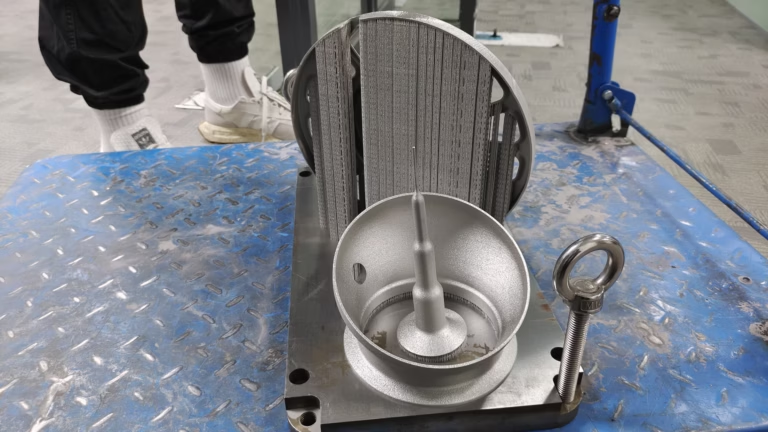
SLM and DMLS build metal parts from aluminium, stainless, titanium, and Inconel. They are worth the cost when the geometry cannot be machined, for example internal cooling channels or lattice structures. They are not worth it for a simple block, where a 5-axis mill is faster, cheaper, and holds a better tolerance.
The honest rule: if a part can be machined from bar stock in a few setups, print it only when you need speed or when the geometry is genuinely complex. Printing a simple part is a common way to spend more money for a worse result.
The Seven Service Models Side by Side
Match the supplier type to the part, not to the brand name.
| Service model | Best for | Typical limitation |
|---|---|---|
| Full-service shop (print + CNC + finishing) | Parts needing both additive and machined features | Requires one supplier to hold both capabilities |
| Instant-quote network | Simple parts with fast, comparable pricing | Process control varies across the shop network |
| Prototyping specialist | Rapid iteration on small, detailed parts | Higher unit cost at low volume |
| Procurement platform with DFM support | Teams needing documented design feedback | Quotes depend on partner shop availability |
| Low-cost metal printing with global sourcing | Metal prototypes on a tight budget | Longer transit and customs handling |
| Sheet and plate cutting service | Flat brackets, panels, and simple frames | Not a substitute for true 3D geometry |
| Enclosure fabricator | Rack panels, chassis, and integrated boxes | Narrow material and geometry range |
When Printing Should Hand Off to Machining
Most production parts are hybrid. A printed body with machined bores, a printed housing with a milled sealing face, a printed prototype that becomes a machined production part. The cost question is whether one supplier can do both steps, because each handoff adds a setup, a shipment, and a tolerance stack.
At GreatLight we run SLM metal printers, SLA and SLS resin printers, vacuum casting lines, and 127 high-precision CNC machines under one roof, including 16 simultaneous 5-axis centers. A printed blank can go straight to the mill for its critical features without leaving the building. Machining tolerances reach ±0.005 mm with finishes from Ra 1.6–3.2 μm as-machined down to Ra 0.2–0.8 μm when polished.
That combination changes the design conversation. Instead of asking whether to print or machine a part, you print the geometry that only printing can make and machine the surfaces that only machining can hold. For Detroit automotive and automation work, that is usually the cheapest path to a functional part.
The alternative is splitting the job across two vendors. It can work, but budget for the extra shipping and for the day you spend reconciling two inspection reports.
Questions That Change the Quote
Ask what the price includes before comparing numbers. Some quotes cover printing only. Others include support removal, tumbling, dyeing, and inspection. A cheaper quote that excludes post-processing is not cheaper once the parts arrive rough.
Ask about the material grade, not just the material family. Nylon is not one thing. Aluminium is not one thing. If the part carries load or sees heat, the specific grade and its condition matter more than the process name on the quote.
Ask how inspection is handled. A dimensional report on a first article is standard practice for anything that fits into an assembly. For regulated work, ask which quality system the shop runs. We hold ISO 9001:2015, IATF 16949:2016, ISO 13485:2016, and ISO 27001:2022, and every order ships after 100% inspection with reports on request.
Ask about lead time in terms of production start, not just delivery. A shop that can begin production within 24 hours after drawing approval is different from one that queues for a week. Our quotation and free DFM analysis come back within 12 hours, and parts normally ship in 3–5 days.
Finally, ask about order size. No minimum order quantity matters when you are iterating. We run from one prototype to 10,000+ part runs on the same drawing.
Questions Engineers Ask Before Ordering
Is 3D printing near Detroit cheaper than machining for a one-off part?
For a small complex part, usually yes, because there is no fixture and no programming time. For a simple prismatic part, no. A 5-axis mill cutting from bar stock is often faster and cheaper than printing the same block.
The deciding factor is geometry, not batch size at the one-off level.
Which materials can be printed and then machined?
Metal prints in aluminium, stainless steel, titanium alloys including TC4 (Ti-6Al-4V), and Inconel can be machined after building. Resin and nylon prints can be drilled, tapped, and trimmed, though the cut quality differs from solid stock.
For critical bores and sealing faces, print oversize and machine to final dimension.
How do I keep a printed prototype from warping?
Keep walls uniform, avoid large unsupported flats, and orient the part so the longest dimension lies flat on the build plate. Adding a small chamfer at the base helps release and reduces distortion.
If the part is a thin plate, print it thicker and machine it flat afterward.
Can GreatLight handle both the printed prototype and the production run?
Yes. We run 3D printing, vacuum casting, die casting, and CNC machining in the same facility, so the transition from prototype to production stays with one supplier and one quality record.
That removes a second first-article approval and the tolerance stack from a vendor handoff.
What file formats and information do you need for a quote?
A STEP or STL file plus a 2D drawing showing critical dimensions, tolerances, material grade, and finish. If you have a target quantity and a delivery city, include both.
We return a quotation and free DFM analysis within 12 hours. Uploads are secure and confidential, and an NDA is available on request.
How long does shipping to Detroit take?
Parts normally ship in 3–5 days after production starts. International express delivery from our Dongguan facility typically reaches Michigan within a few business days.
For bulky orders, ask for a freight comparison before you approve the shipment method.
Send the Drawing, Get a Real Number
Upload your STEP file and drawing. We review printability and machinability together, then return a quotation with DFM notes within 12 hours.
12-hour quoteNo MOQ100% inspectionNDA on request









