GreatLight CNC Machining Factory logo
CNC Machining
Rapid Prototyping
Materials
Industries
News
About GL

Get Instant Quote

SLS Nylon Additive Manufacturing

3D Rapid Prototyping in Nylon Polymer

We build functional nylon prototypes by SLS, then finish critical fits and bores on CNC to ±0.005 mm. From one part to a pilot run, quoted with DFM feedback in 12 hours.

PA12 and PA-GFOne part or a pilot run±0.005 mm on machined featuresParts ship in 3-5 daysISO 9001 / IATF 16949NDA on request
Rapid-3D-Printing-Services-jpg
3-5Days to ship a printed batch
0.1 mmTypical SLS layer thickness
150Technicians across 3 plants
12 hQuote and free DFM analysis
Where nylon prototypes go wrong

Four problems that show up in the first fit check

Most of these are visible before the part ever reaches assembly.

01

Does a large flat panel bow after cooling?

Thin nylon walls above 150 mm wide tend to curl when the build chamber cools unevenly. The part measures fine on the bench and then will not sit flush on the mating surface. A 0.4 mm bow across a 200 mm panel is enough to fail a gap check on a visible housing.

02

Are your bores and threads undersized?

SLS leaves a sintered skin inside small holes. A Ø4 mm bore can print at Ø3.7 mm, so a dowel or bearing will not seat by hand. Reaming or drilling after printing fixes it, but only if the print orientation left enough stock for the tool to follow.

03

Does the prototype snap at a living hinge?

Standard PA12 is tough but not unlimited. A 0.8 mm hinge cycled 200 times in a drop test may crack along the layer lines. Glass-filled nylon resists deflection better, yet it loses elongation and can crack sooner in a snap fit.

04

Is the surface too rough for a sealing face?

As-printed nylon sits around Ra 8-12 μm with visible powder grain. An O-ring groove printed at that finish will weep under 2 bar. Gaskets, seal faces, and sliding surfaces need machining or a smoothing step before they hold pressure.

How we build nylon prototypes

Print the shape, machine the fits

One workflow from powder bed to inspected part.

cnc-machining-pa-nylon
Process control

SLS orientation and nesting set the outcome

Every build starts with a print orientation review. We place long parts flat to reduce curl, angle cylindrical features to keep them round, and nest small parts so the powder bed stays thermally balanced. Layer thickness runs 0.1 mm for detail and 0.12 mm for larger housings where speed matters more than surface.

Build chamber temperature, cooling ramp, and powder refresh ratio are logged per run. Those three variables drive warpage and mechanical strength more than any machine setting on the spec sheet.

  • 1
    PA12, PA12-GF, PA11Unfilled nylon for toughness, glass-filled for stiffness and heat resistance
  • 2
    0.1-0.12 mm layersFiner layers for small features, coarser for large panels
  • 3
    Orientation firstPrint direction decided before the file is nested, not after a failure

Get Instant Quote

automotive-prototyping-manufacturing
Hybrid finishing

CNC finishing where the fit has to hold

Printed nylon is not a bearing fit. On our own 3-axis and 5-axis centers we ream dowel holes, face sealing surfaces, cut threads, and skim mating faces to ±0.005 mm. The printed body carries the geometry; the machined features carry the tolerance.

That combination suits parts with a complex shell and a few tight interfaces: a pump housing with a machined flange, a bracket with a press-fit bushing, a fixture with a locating bore. We machine after printing, so any shrinkage in the build gets corrected on the same setup.

  • 1
    ±0.005 mmAchievable on machined bores, faces, and shoulders
  • 2
    Ra 0.8-1.6 μmFor seal faces and sliding surfaces after finishing
  • 3
    Threads and insertsCut, not printed, so fasteners torque correctly
Choosing a route

When nylon printing beats other prototype routes

Use this to decide before you spend tooling money.

RequirementSLS nylonCNC from nylon stock
Complex internal channelsBuilt in one pieceNeeds splitting or drilling
Tolerance on fitsMachined after print±0.005 mm direct
Wall under 1.5 mmFine, no tool loadDeflection risk
Surface finish as-printedRa 8-12 μm, grainyRa 1.6-3.2 μm
Lead time for 20 parts3-5 days, nested together3-5 days, one setup each
Design changes per buildFree, no fixtureNew program each revision
What we run in-house

Prototype and production services

Additive parts, machined parts, and tooling under one roof.

01

Custom 3D Printing

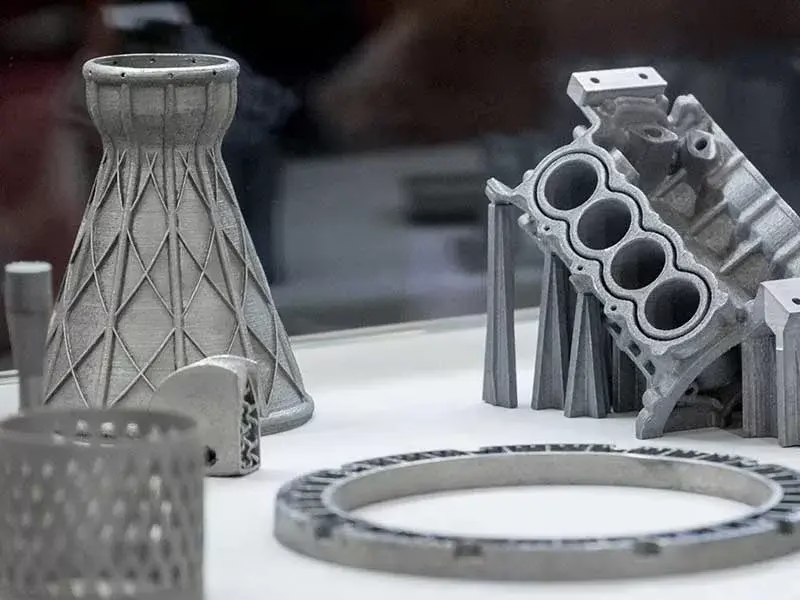
SLS nylon and polymer parts with orientation review, powder refresh control, and post-build cleaning. Suited to functional prototypes and small pilot runs.

02

Rapid Prototyping

One route for printed, machined, or cast prototypes. We help you pick the process from the tolerance and quantity, then hold that route through revisions.

03

5 Axis CNC Machining

16 simultaneous 5-axis centers for finishing printed bodies, cutting compound angles, and machining one-piece geometry that needs several faces.

04

CNC Milling & Turning

Mills, mill-turn centers, and lathes for metal and plastic parts. Up to 4,000 mm maximum processing size on the large-travel machines.

05

Vacuum Casting

Silicone tooling for 10-50 polyurethane parts when you want a production-like surface without a steel mold. Pairs well with an SLS master pattern.

06

Part Surface Finishing

Media blasting, tumbling, polishing, painting, and laser marking. Nylon parts can be dyed or smoothed before assembly.

Capability range

Process, material, and inspection scope

Numbers we hold to per part, not per marketing page.

ItemCapabilityNotes
Nylon materialsPA12, PA12-GF, PA11Unfilled and glass-filled
Layer thickness0.1 mm / 0.12 mmDetail or speed
Machined tolerance±0.005 mmOn reamed and faced features
Fine finishRa 0.2-0.8 μmPolished seal faces
Maximum part size4,000 mmLarge-travel machines
Inspection100% before shipmentReports on request
Why engineers send us the file

Six reasons this route holds up

The first three decide whether the part fits. The rest decide whether it ships on time.

2011

15 years in manufacturing

We started in machining and added additive equipment later, so printed parts are judged by machining standards. Three wholly-owned plants and 7,600 m² of floor space back that up.

0.1 mm

Layer control, not guesswork

Layer thickness is picked from the feature size and surface callout. Small snap fits and thin ribs get the finer setting; large housings get the faster one.

±0.005 mm

Machined fits after printing

Bores, faces, and threads are cut on CNC centers, not left as-sintered. That is how a nylon prototype holds a bearing or a dowel without shimming.

12 h

Quote with DFM notes

You get pricing and a short list of print-orientation and wall-thickness notes within 12 hours. Production can start within 24 hours of approval.

1 part

No minimum order quantity

A single geometry check and a 10,000-part run use the same quote path. Prototype revisions stay cheap because there is no tooling to re-cut.

4

Certified quality systems

ISO 9001:2015, IATF 16949:2016, ISO 13485:2016, and ISO 27001:2022. Uploads stay confidential and an NDA is available on request.

127High-precision CNC machines
99.99%Qualification rate
3Wholly-owned plants
<2%Historical late-delivery probability
Industry fit

What these sectors require, and what we deliver

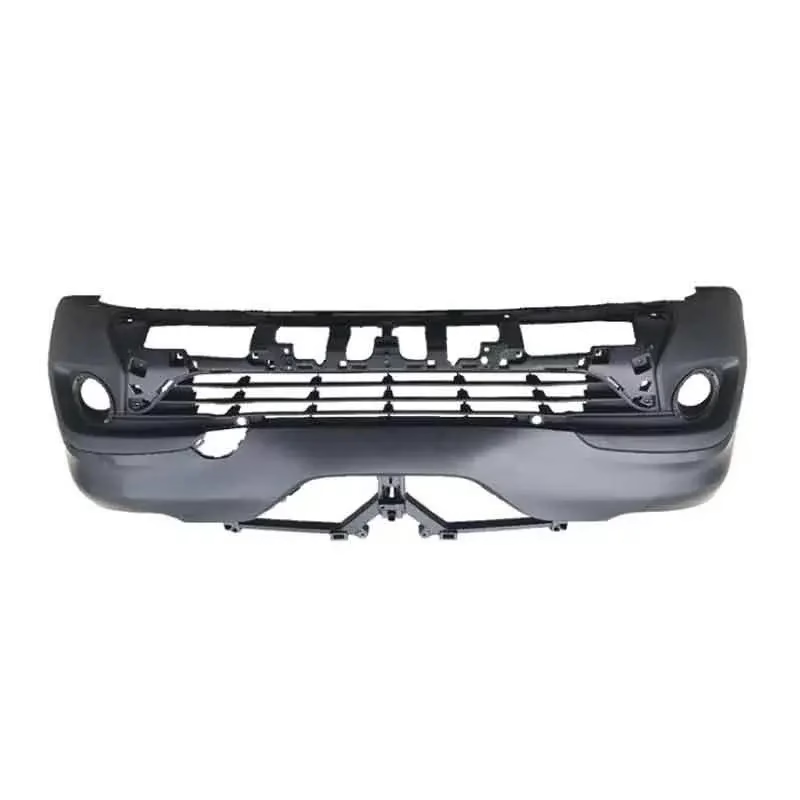
Automotive-front-bumper-plastic-rapid-prototyping-jpg

Automotive & EV

Bumper trim, ducts, and underhood brackets judged on gap and flush, not just shape.

  • PA12-GF
  • Machined mounting faces
  • Gap and flush check
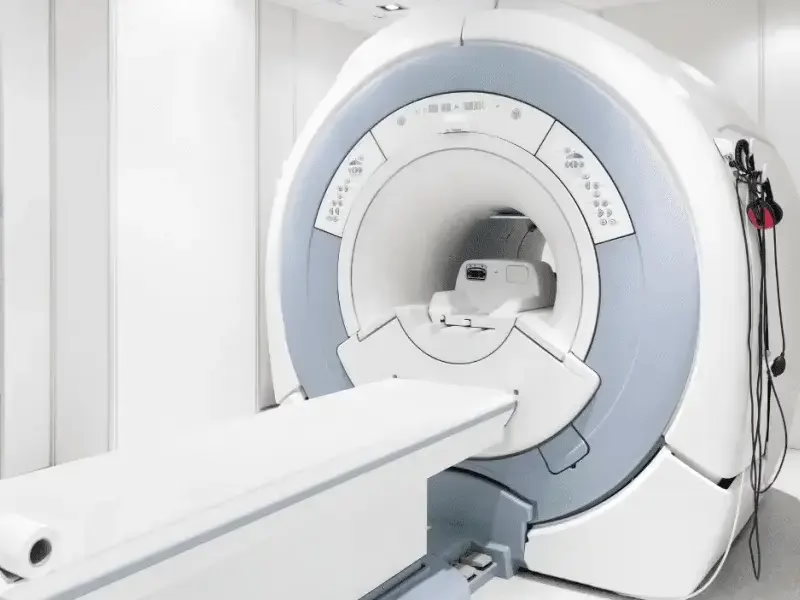
medical-devices-rapid-prototyping

Medical Devices

Housings and fluid-path parts where a smooth internal surface and clean edges matter.

  • ISO 13485:2016
  • Smoothed internal bores
  • 100% inspection
aerospace-prototyping

Aerospace

Ducting and bracketry prototypes that need repeatable hole positions across a batch.

  • ±0.005 mm on bores
  • Batch repeatability
  • Material traceability
rapid-tooling-services-1

Industrial Machinery

Guards, fixtures, and change parts where a printed body pairs with machined datum features.

  • Printed shell + CNC datums
  • Threaded inserts
  • One-off to pilot run
FAQs

Questions we get before the first build

How tight can an SLS nylon part actually hold?

As-sintered, expect roughly ±0.3 mm on a 100 mm dimension, and looser on long thin walls as shrinkage varies across the bed. That is fine for form and fit checks.

Where a fit has to hold, we machine the feature after printing. Bores, faces, and shoulders come off the CNC at ±0.005 mm, and the printed body keeps the complex geometry.

Which nylon should I pick, PA12 or glass-filled?

Plain PA12 is the default. It has good elongation, survives snap fits and drop tests, and takes dye well.

Choose PA12-GF when stiffness or heat deflection matters more than toughness. It holds shape under load, but it is more brittle, so living hinges and thin clips are a poor match.

Can you print living hinges and thin clips?

Yes, within limits. Keep the hinge section around 0.6-1.0 mm and orient it so the hinge axis crosses the layers instead of running along them.

If the part has to cycle thousands of times, a printed hinge is the wrong answer. We will say so and suggest a machined or molded route instead.

What lead time should I plan for?

Quotation and free DFM analysis come back within 12 hours. Production can start within 24 hours of approval, and parts typically ship in 3-5 days.

Orders that include CNC finishing on printed bodies still fall in that window because both operations run in the same plant.

Is there a minimum order quantity?

None. One prototype and a 10,000-part run go through the same quotation process.

That matters for 3D rapid prototyping work, because most projects start with a single geometry check and grow only after the design holds.

How do you handle my design files?

Uploads are kept secure and confidential. We can sign an NDA before you send files if your program requires it.

STEP and STL both work. Send the native CAD file as well when a critical feature needs explaining, and we will flag anything ambiguous in the DFM notes.

What surface finish should I expect on a printed part?

As-printed nylon shows a light powder grain, usually Ra 8-12 μm. Media blasting evens the look but does not remove layer steps on curved faces.

For a sealing face or a sliding surface, we machine or polish the area to Ra 0.8-1.6 μm. The rest of the part stays as-printed to keep cost down.

Can printed nylon parts go straight into a pilot production run?

For low-volume pilot builds, yes. SLS holds up to tens or low hundreds of units without tooling, and the design can still change between batches.

Past that volume, a molded or cast route usually wins on unit cost. We run vacuum casting and die casting in-house, so the switch stays with one supplier.

Send the file, get a quote in 12 hours

Upload your model and we return pricing plus DFM notes on orientation, wall thickness, and which fits should be machined. One part or a pilot run, no minimum order quantity.

12-hour quote100% inspectionNo minimum order quantityNDA on request

Trusted by engineers and manufacturers worldwide

Tesla Ford Motor Company BYD Auto Denso Magna International Boeing Airbus Medtronic KUKA FANUC