
40W Laser CNC: 5 Benefits That Change Engraving Productivity
This page covers the five things a 40W laser CNC actually changes on a production floor: spot size and repeatability, cycle time, material range, secondary operations, and traceability. It is written for process engineers and buyers who have to decide between laser marking, mechanical engraving, and chemical etching. By the end you should be able to tell which of your parts suit a 40W fiber source and which do not.
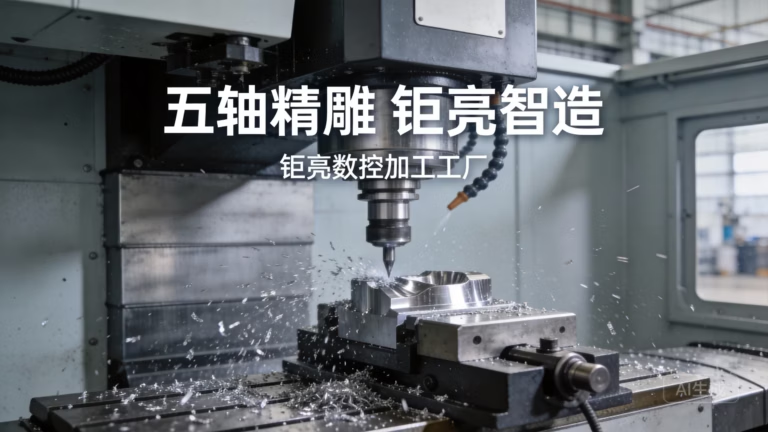
Where a 40W laser fits in a machining workflow
A 40W fiber laser is a marking and light-engraving tool. It is not a cutting machine, and it does not replace a spindle.
Spot size and repeatability that do not drift with tool wear
Mechanical engraving removes material with a cutter. The edge starts sharp and ends dull. On a 10,000 part run the first hundred marks and the last hundred marks do not look the same, and the depth changes as the tool wears. A focused laser has no cutting edge to wear out. The spot stays the same size and the energy density stays the same, so part 1 and part 10,000 come off the machine with the same line width and the same depth.
On our 40W fiber platform we hold ±0.005 mm on the machined features of the part, and the laser adds its own positional accuracy on top of that. For a serial number or a logo, what matters is edge definition and contrast. A tight spot keeps the character strokes clean below 2 mm, which is where mechanical engraving starts to smear. Minimum character height for legible laser marking is 1.5 mm, and we will not promise readable text below that.
Repeatability also depends on how the part is held. Laser marking is non-contact, so there is no cutting force pushing the workpiece around. Thin walls, small bosses, and parts already at final dimension are safe. That is a real advantage over a rotary engraver that can deflect a 0.8 mm wall.
- 1No tool wearSpot size and depth stay constant across the full run.
- 2No contact forceThin walls and finished surfaces are not deformed.
- 3Fixture mattersFocus height tolerance is what limits repeatability, not the laser.
Cycle time: where the seconds actually go
A galvo head moves the beam, not the table. That removes acceleration limits and tool changes from the cycle. For vector marking, feed rates run far above what a spindle can follow, and raster fill of a logo patch is usually the slowest operation on the part. A dense raster at 0.02 mm line spacing takes far longer than the vector outline around it.
The practical rule we use: vector paths for outlines, text, and barcodes; raster fill only where the customer wants a solid black patch. Switching a 20 mm × 20 mm filled logo to a hatched fill with wider line spacing can cut marking time substantially with no loss of contrast on anodized aluminium.
Depth is the other lever. Deep engraving to 0.2 mm takes multiple passes and dominates the cycle. If the print only needs to survive handling and cleaning, a single shallow pass is enough. Engineers often specify deep engraving out of habit when a surface mark would pass the rub test. Worth checking before the drawing is frozen.
- 1Vector over rasterOutlines and text mark in a fraction of the time.
- 2Depth drives passes0.2 mm deep engraving needs multiple passes.
- 3No tool changeJob runs in one setup without stopping the cycle.
Material range, and the materials that fight back
A 1064 nm fiber source couples well into metals. Anodized aluminium, stainless, carbon steel, tool steel, titanium, and plated surfaces all mark with good contrast. Anodized aluminium is the easiest case: the laser bleaches the dye layer and leaves a white or light mark with no material removal at all. Powder-coated metal behaves the same way.
Bare aluminium is the difficult one. It reflects most of the 1064 nm energy and conducts heat away fast, so marks come out faint and inconsistent. We usually solve it with a thin anodize or a plated layer, or by accepting a low-contrast mark and setting expectations up front. Copper and brass sit in the same family: reflective, thermally conductive, hard to mark cleanly without a coating or a deeper engraving pass.
Plastics are a separate discussion. POM, PC, and ABS can be marked by foaming or charring depending on the additive package, and results vary between resin lots. PEEK marks well. PMMA tends to craze if the pulse energy is too high. If the plastic part carries a functional mark, we ask for a sample of the actual molded material, not a generic datasheet.
- 1EasyAnodized aluminium, powder coat, stainless, titanium.
- 2HardBare aluminium, copper, brass, magnesium.
- 3Sample firstPlastic marking depends on the resin and its additives.
Laser marking versus mechanical engraving versus chemical etching
Use this when the print callout is still open and the process has not been fixed.
| Criterion | 40W laser marking | Mechanical engraving | Chemical etching |
|---|---|---|---|
| Contact force | None | Cuts into the part | None |
| Tool wear effect | None | Edge dulls over the run | Mask degrades |
| Minimum character height | 1.5 mm | Around 2 mm and up | Small, but needs artwork |
| Bare aluminium | Low contrast | Good depth | Needs mask and bath |
| Anodized aluminium | Excellent contrast | Breaks the anodize | Poor adhesion |
| Setup per part number | Minutes | Fixture and tool path | Mask artwork and bath |
| Consumables | Electricity | Cutters | Chemicals and waste |
| Good fit for | Serial numbers, logos, UDI, barcodes | Deep legends, functional depth | Thin sheet, flat panels |
Fewer secondary operations, fewer handoffs
Every extra operation adds a queue, a fixture, and a risk of damage. When the laser runs in the same shop as the machining, the marked part does not travel to a separate engraving vendor and back. That removes one packing step, one shipping leg, and one incoming inspection.
There is also a dimensional argument. If the print is applied after the final machining pass, the mark cannot disturb a critical surface. On a part with a sealing face or a bearing bore, we mark on a non-functional area after the finish cut, and the surface finish Ra 0.8–1.6 μm on the functional faces stays untouched.
Consolidation is not always the right answer. If the mark is a deep functional legend on a large casting, a dedicated engraving setup may still be cheaper. The check is simple: count the handoffs. Each one costs handling time and adds a chance of a scratch.
- 1One setupMachining and marking run in the same shop.
- 2No re-fixturingRemoves a second locating error on the print.
- 3Check the handoffsEach move adds handling cost and damage risk.
Traceability and control of the artwork file
A laser mark is programmed from a digital file. The same file that produces the mark can be version-controlled, and the parameters can be locked to a program number. That makes it easier to prove that the mark on the part came from the released revision, which matters for medical devices and automotive parts where the UDI or the lot code has to be traceable.
We keep uploads secure and confidential, and an NDA is available on request. Customer drawings and logos stay inside the job file. For buyers in regulated industries this is often the deciding factor, more than the marking speed itself.
Traceability also means records. We inspect before shipment: raw material check, in-process monitoring, and a final inspection, with reports on request. If a mark has to be verified by character height or contrast level, we write that into the inspection plan rather than leaving it to a visual check at the bench.
- 1Digital masterThe mark comes from a released file, not a physical stamp.
- 2Locked parametersProgram numbers tie the mark to the process settings.
- 3Inspection recordsReports available when the customer needs documented evidence.
Questions engineers ask before releasing the print
Can a 40W laser cut metal?
No. A 40W fiber source is built for marking and light engraving, not through-cutting. It will remove a thin surface layer on some metals, but it will not cut sheet.
If your part needs cutting, that is a separate process. We run sheet metal fabrication and CNC machining for that.
How deep can the engraving go?
Depth depends on material and how many passes you are willing to pay for. Shallow surface marks are a single pass. Deeper functional engraving needs multiple passes and adds cycle time quickly.
Tell us the depth on the drawing and we will say whether it is practical on the laser or better done with a cutter.
Why does the mark look faint on bare aluminium?
Bare aluminium reflects most of the 1064 nm energy and pulls heat away from the spot. The mark ends up low contrast.
Options are a thin anodize, a plated layer, or accepting a light mark. We usually test a sample before committing to the print.
What is the smallest readable text?
Minimum character height for legible laser marking is 1.5 mm. Below that the strokes start to merge.
Character height also depends on the font. A simple sans-serif holds up better than a serif at small sizes.
Does marking damage the machined surface?
It is non-contact, so there is no mechanical damage. The laser does alter the surface where it fires.
We place the mark on a non-functional area so sealing faces, bores, and bearing surfaces keep their finish and tolerance.
Can you mark parts from a customer-supplied file?
Yes. Send the artwork or the program file with the drawing. Uploads are secure and confidential, and an NDA is available on request.
We check character height, mark location, and contrast on a sample before the production run starts.
Send the drawing and we will tell you if the laser is the right process
Quotation and free DFM analysis within 12 hours. No minimum order quantity, from one prototype to 10,000+ parts.
12-hour quote100% inspectionNDA on request±0.005 mm tolerance









