
5 Essential Cybelec Modeva Features That Maximize Your Bending Precision and Profit
A control is not a screen bolted to a press brake. It decides bend order, corrects angle mid-stroke, and remembers how each material actually behaves. This page walks through the five Cybelec Modeva features that move part cost, and where each one stops helping.
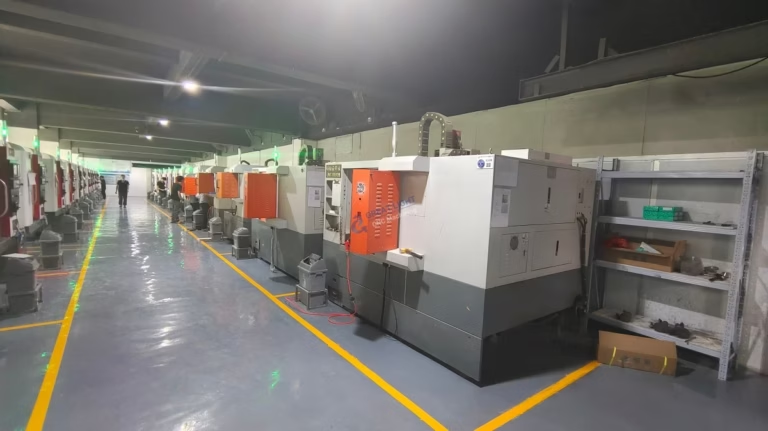
What a Cybelec Modeva control actually decides
A press brake repeats whatever the control tells it to do. The machine supplies tonnage and stroke. The control supplies geometry, sequence, and corrections. When a shop says bending is inconsistent, the fault usually sits in software logic, not in hydraulics.
Cybelec Modeva sits at the top of that logic chain. It reads the part model, picks a bend order, drives the axes, and then measures what came out. Each of the five features below is a different link in that loop. Skip one and the others lose accuracy.
The payoff is not cosmetic. Bend angle error on a 3 mm 304 bracket accumulates down a fold line. A 0.5° error at bend one can become 2° at bend four once tolerance stacks. That is the difference between a part that assembles and one that gets reworked.
This page is written for process engineers and buyers who need to judge whether a Modeva-equipped press brake is worth the capital, or whether a supplier's bending cell can hold their drawings. It is not a sales sheet for the control.
- 1Sequence logicOrder of bends, part flips, and tool changes
- 2Angle loopMeasure during stroke, correct before release
- 3Material dataStored springback and bend allowance per grade
- 4Offline prepProgram and simulate away from the machine
Automatic bend sequence and real-time angle correction
The sequence optimizer reads a 3D model, usually STEP or IGES, and works out a safe order of bends. It avoids collisions between the punch, the part, and the backgauge. It also decides when the part must be flipped and when a tool change is unavoidable. For a box with four sides and two hems, that reasoning takes an experienced operator several minutes per part. The control does it in seconds.
Real-time angle correction closes the loop. Laser sensors, such as the Cybelec AngleStar, read the actual angle while the punch is still in contact. The control adjusts the ram depth before the bend is released. Springback is measured, not guessed. A 2 mm stainless batch that behaves differently from the previous coil gets corrected on the first part instead of the tenth.
Together these two features cut setup iterations. Fewer trial bends means less scrap and less machine idle time. On a 20-part order, three saved test pieces matter. On a 2,000-part order, they decide the margin.
- 1Sequence optimizerReads STEP/IGES, avoids collisions, orders flips
- 2AngleStar loopLaser measures angle, ram depth adjusts mid-stroke
- 3Springback handlingCorrected per part, not per batch average
Intelligent material database and offline programming
The material database stores bend allowance, K-factor, and springback behavior per grade and thickness. A 6061-T6 aluminum sheet at 2 mm does not bend like 304 stainless at 2 mm, even with the same tooling. When the control knows the difference, the first bend lands closer to nominal. The database also lets a shop record what actually happened on past jobs and reuse it.
This matters for mixed shops. A supplier running automotive brackets, medical enclosures, and electronic chassis sees a different material every few hours. Without stored data, every changeover starts from zero.
Offline programming moves the setup off the machine. The programmer builds the job in an office seat, simulates the bend path in 3D, and checks for collisions before the tooling goes in. The press brake then receives a proven program. Machine time is spent forming metal, not waiting while someone types coordinates at the control.
For high-mix, low-volume work, this is the feature that decides throughput. A shop that programs offline can quote shorter lead times and hold them, because the machine is not the bottleneck at setup.
- 1Material databaseK-factor, springback, and bend allowance per grade
- 2Adaptive bendingUses stored data to set first-bend depth
- 3Offline programmingProgram and simulate away from the press brake
- 43D simulationCollision check before tooling is loaded
Reporting and data analytics on the control
Reporting turns the control into a record keeper. Each job logs actual angles, tonnage, cycle times, and deviations. When a batch drifts, the data shows where. An angle trend that walks from 89.8° to 90.4° across 400 parts points to tool wear or thermal growth, not operator error.
That record also feeds quoting. A shop that knows the real cycle time and scrap rate for a given part can price it without padding. Buyers benefit because the quote reflects measured cost, not a guess.
The limit is discipline. Reporting only helps if someone reads it. A shop that logs data and never reviews it has paid for a feature it does not use. This is the one Modeva function that depends entirely on management habit, not on machine capability.
- 1Job logsAngle, tonnage, cycle time, deviation per part
- 2Trend detectionSpots tool wear and thermal drift early
- 3Cost basisMeasured cycle time improves quoting accuracy
Which Cybelec Modeva features pay off for which job type
Match the feature to the order profile before committing capital.
| Feature | Pays off when | Weak fit when |
|---|---|---|
| Bend sequence optimizer | Parts with 4+ bends and hems | Single-bend flat parts |
| Real-time angle correction | Thin sheet, tight angle tolerance | Thick plate, loose tolerance |
| Material database | Mixed grades and thicknesses daily | One material, one thickness, fixed |
| Offline programming | High mix, low volume, short lead times | One part number running for months |
| Reporting and analytics | Repeat orders and cost tracking | One-off prototypes, no history |
| All five together | Job shop with varied work | Dedicated single-part cell |
Where the real gain sits
If your parts have four or more bends and your angles are held tighter than ±1°, the sequence optimizer and live angle loop are worth the capital on their own. If you run one material and one thickness for months at a time, the material database and offline programming add little and you should put the money into tooling instead.
Common questions on Cybelec Modeva features
Does real-time angle correction remove the need for trial bends?
It removes most of them. The first part still tells the control how this coil behaves, but the correction happens during that first stroke rather than after it.
On thin stainless or aluminum, one or two test pieces are usually enough. On thick plate with high springback, expect to confirm the first part before running the batch.
Can the material database be updated with our own bend data?
Yes. Stored values can be edited and new grades added. That is the point of the database: it records what your tooling and your material actually do, not a generic table.
Shops that log real results over a few months end up with first-bend accuracy that a default library cannot match.
Is offline programming worth it for low-volume work?
It depends on mix, not volume. If you change part numbers several times a day, offline programming keeps the press brake forming instead of sitting idle during setup.
If one part number runs for weeks, the setup cost is already amortized and the benefit shrinks.
How does the control handle a material batch that behaves differently from the last one?
The angle sensors measure the actual result and the control adjusts ram depth per part. A batch shift shows up as a correction, not as a scrap pile.
If the shift is large, the reporting log will show it, which tells you whether to check the coil or the tooling.
What part size can a Modeva-controlled press brake handle?
Control capability is not the limit; the machine frame and tooling are. At GreatLight we machine press brake tooling and formed parts up to 4,000 mm in the largest travel envelope.
For small brackets and enclosures, the compact envelopes of 500 × 310 × 200 mm cover most work.
Do reports from the control help with quoting?
They give you measured cycle time and real scrap rate for a part you have already run. That is a firmer basis than an estimate.
For a repeat order, the log beats a spreadsheet if someone actually reviews it.
Send your bending drawings for a process review
We quote and return a free DFM analysis within 12 hours, and production can start within 24 hours of approval.
12-hour quote100% inspectionNDA on request
More from the shop floor
We publish setup notes, tooling trials and inspection data from the factory floor.











