
5 Steel CNC Service Secrets Manufacturers Don’t Want You to Know
Written for engineers and buyers who source machined steel parts. It covers five things that stay off the quote sheet: hidden premiums, tolerance claims that do not survive production, padded lead times, outsourced finishing, and steel of unknown origin. Read it and you can tell which steel CNC service manufacturers are worth a second RFQ.
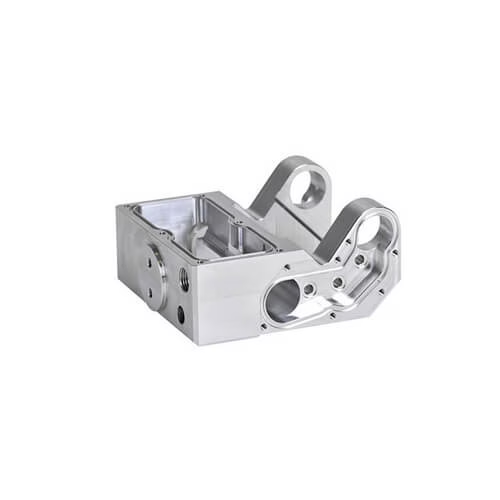
Five things the quote sheet does not show
Each section below names the problem, explains why it happens, and gives you a question to put in writing before you place a PO.
The hidden premium on a low steel price
A low number on a steel part rarely stays low. The gap gets recovered later: a soft-jaw set you did not know you needed, a fixture built after the PO was signed, an inspection report billed as an extra. None of it appears in the first quote, which is exactly the point.
Substitution is the other lever. 304 stainless can be swapped for a generic 18-8 grade. 4140 pre-hard can be replaced with a commercial alloy that machines faster and wears sooner. Without mill certificates and an in-house spectrometer, you will not see the difference until a fatigue crack shows up months later.
Tooling charges deserve a hard look. Custom collets, form tools and dedicated fixtures are real costs, but they should be visible as separate line items. When they are buried in the machining rate, you cannot tell whether you are paying for tooling once or on every part.
The fix is simple. Demand a line-item breakdown that names the steel grade and its certificate, lists tooling as its own line, and states whether post-processing is done in-house. A shop that owns the whole chain can quote an honest all-in number. One that does not will keep adding.
Tolerance claims versus shop-floor reality
Every supplier advertises tight numbers. ±0.005 mm appears on almost every steel CNC service page you will read. The useful question is not what the machine can do on a warm-up test, but what the process holds across a full batch on a Friday afternoon.
Achievable tolerance depends on the feature, not the shop. A Ø20 mm bore in 1018 turned on a mill-turn center is routine. The same callout on a 400 mm thin-wall 316L housing is a different job, because thermal growth and tool deflection dominate. Geometry, wall thickness and material hardness set the floor.
Surface finish follows the same logic. Ra 0.2–0.8 μm needs a stable setup and a finishing pass that adds cycle time. If a quote promises that finish on a deep pocket in 4140 at a low unit price, ask which machine and which tool path.
Before you commit, send one representative part and request a first-article inspection report. Capability studies on your actual geometry beat any brochure claim.
- 1Feature firstJudge tolerance by feature type, not by a single shop-wide number.
- 2Batch behaviorAsk how the process holds position over a full run, not on one part.
- 3Prove itOne first-article report on your geometry settles the argument.
What drives real tolerance and cost on steel parts
Use this as a rough screen when a quote looks unusually cheap for the callouts on your drawing.
| Part feature | Typical achievable tolerance | What pushes cost up |
|---|---|---|
| Turned Ø20–80 mm shaft in 1018 | ±0.005 mm | Hardness above 40 HRC |
| Milled pocket in 4140 pre-hard | ±0.01 mm | Deep pocket, long reach tool |
| Thin-wall 316L housing | ±0.02 mm | Wall under 2 mm, heat growth |
| Large 4,000 mm frame weldment | ±0.05 mm | Fixture time, re-clamping |
| Bore with Ra 0.8–1.6 μm | Finish pass adds time | Manual polish removed |
| Bore with Ra 0.2–0.8 μm | Special tooling | Slow spindle, small stepover |
Lead times are padded, and sometimes negotiable
Quoted lead times often include a buffer that has nothing to do with your part. A shop running at 60 percent capacity quotes six weeks because it can, not because the work takes six weeks. That buffer protects the supplier and costs you inventory.
Ask what actually drives the schedule. Raw stock availability matters most. 4140 and 17-4PH in common sizes sit on the shelf at most distributors, while a 4,000 mm 4340 bar may need a mill order. Tooling is second: a new fixture adds two to four days before the first chip is cut.
The honest answer separates stock time, setup time and machine time. A supplier that can start production within 24 hours and ship in 3–5 days is telling you the stock is already there and the fixture is standard. That is a capacity signal, not a sales line.
Test it with a small order first. If the first shipment lands on the promised day, the next quote is probably real too.
Finishing is often outsourced, and you pay twice
Passivation, black oxide, electroless nickel and anodizing are frequently sent to a third party. Each handoff adds a markup, a shipping leg and a new way for the schedule to slip. The part can also be lost or reworked at the finisher, where your print is not the priority.
The technical risk is contamination and masking. A passivation line that also runs carbon steel will leave free iron on 316L unless it is controlled. Masking mistakes on a hardcoat anodized surface are not repairable; the part is scrap.
In-house finishing keeps the sequence under one roof. Bead blasting before passivation, a controlled rinse, then laser marking at 1.5 mm minimum character height can all run against the same traveler. When something goes wrong, one team owns it.
Not every finish belongs in-house. Gold plating or specialized coatings may still go out. The point is to know which ones do, and to see that in the quote.
Where the steel came from matters more than the brand
The machine brand on the floor tells you little. The origin of the steel tells you a lot. Certified 316L from a known mill behaves predictably in machining and in service. Uncertified stock from an unknown source can carry the wrong chemistry and still pass a visual check.
Traceability is the difference. A mill certificate ties the heat number to the chemistry and the mechanical properties. Without it, you have no path back if a part fails in the field. For medical and automotive work, that path is not optional.
This is also where a 15-year-old shop differs from a broker. Three wholly-owned plants and 127 CNC machines mean stock is bought in volume and held, not sourced per job. Standard grades such as 303, 304, 316L, 4140 and 17-4PH are on hand with paperwork attached.
Ask for the certificate before the parts ship, not after. It should match the grade, the heat number and the quantity on the packing list.
Common questions from engineers sourcing steel parts
Can you hold ±0.005 mm on stainless steel parts?
Yes, on features where the geometry allows it. Turned and milled features on 303, 304 and 316L in stable setups routinely hold ±0.005 mm. Thin walls, deep pockets and long reach tools move the practical limit to ±0.01–0.02 mm.
We confirm the achievable tolerance during DFM review, before you commit to a PO. If a callout is not realistic for the geometry, we say so and propose an alternative.
Do you provide material certificates with steel parts?
Yes. Mill certificates are available on request and tie the heat number to the grade and mechanical properties. Inspection reports covering raw material check, in-process monitoring and final inspection can ship with the order.
For medical and automotive programs we keep the documentation aligned with ISO 13485 and IATF 16949 requirements.
Is post-processing done in-house or subcontracted?
Most finishes run in-house: bead blasting, tumbling, brushing, polishing, black oxide, powder coating, anodizing and laser marking. That keeps the schedule and the quality under one traveler.
Specialty plating such as gold or silver may go to a qualified partner. When it does, we tell you in the quote so you can price the risk.
What is the smallest order you accept?
There is no minimum order quantity. One prototype and a 10,000-part run go through the same process, though unit economics differ.
For first orders we recommend a small batch to confirm the process, then scale. That is cheaper than discovering a fixture problem at full volume.
How fast can you quote and ship steel parts?
Quotation and a free DFM analysis come back within 12 hours. Production can start within 24 hours once the order is released and stock is confirmed.
Standard parts ship in 3–5 days. Historical late-delivery probability is below 2 percent.
Can you sign an NDA before we share drawings?
Yes. An NDA is available on request, and uploads are handled as secure and confidential. We can sign your document or provide ours.
Drawings, CAD files and inspection data stay restricted to the team working on your job.
Send a drawing and get a straight answer
Upload your steel part and we will return a quote with a free DFM analysis inside 12 hours. You will see the grade, the tolerance we can hold and whether finishing runs in-house.
12-hour quoteNo MOQ100% inspectionNDA on request









