
Prototype Machining Services: 7 Levers That Slash Cost and Speed Up Development
A prototype shop sees the same cost drivers on every RFQ: features that cannot be cut, setups that repeat, material chosen for the production part instead of the test part. This page walks through seven of them in the order they usually appear on a drawing. Written for design engineers and sourcing engineers who need to judge where the money and the calendar days actually go.
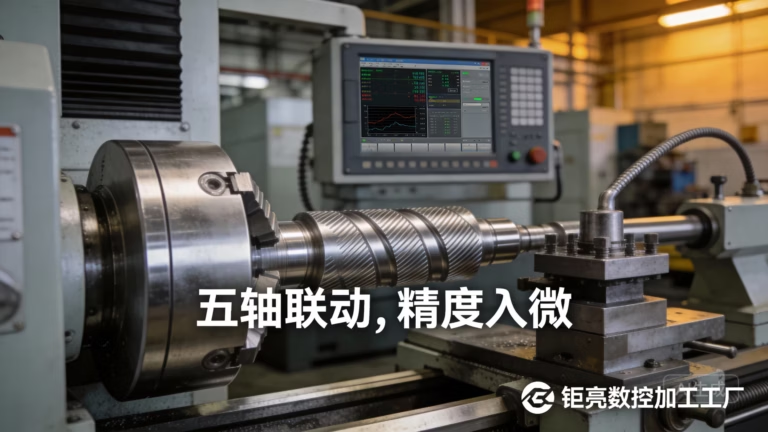
Cost is decided before the spindle turns
The quote is mostly a report on decisions already made in CAD.
DFM first, before anyone quotes the part
A prototype drawing is usually a production drawing with the tolerances left on. That is where the cost hides. Deep pockets with a 3 mm corner radius, a 0.4 mm floor on a cavity, tapped holes on a sloped face, a true position callout on a cosmetic surface: each one adds a tool, a setup or a hand operation. None of them make the prototype test better.
Most of these features exist for reasons that no longer apply at the first build. The part needs to fit an assembly once, prove a mechanism, or sit in a test rig. It does not need a production surface finish on a face nobody measures. Tell the shop which dimensions are functional and which are reference, and the quote usually drops before any metal is cut.
We return DFM feedback with the quotation, within 12 hours. That feedback lists the features we would change, the tolerance bands we would loosen, and the fixtures we can skip if a datum moves. You decide what to accept. The point is that the decision happens on screen, not on the shop floor after the first part is scrapped.
Setup count drives the price more than cycle time
Machining time is visible. Setup time is not, but it is usually the larger number on a small batch. Every new face that must be gripped, indicated and zeroed adds fixturing, and every new angle the tool cannot reach in the current orientation adds another one. A part that looks cheap on a cycle-time estimate can carry five setups.
Simultaneous 5-axis work removes most of that. The tool approaches the workpiece from any direction in one setup, so undercuts, contoured pockets and intersecting bores can be reached without re-fixturing. On a 3-axis machine the same geometry means multiple orientations, extra soft jaws and a stack of tolerance buildup between them.
The trade-off is real. Five-axis programming takes longer and the machine rate is higher, so the break-even sits somewhere around three or four distinct orientations. Below that, 3-axis with good fixtures wins. Above it, 5-axis wins on both calendar days and total cost. Our shop runs 16 simultaneous 5-axis centers, 12 four-axis mills and 27 three-axis machines, which means we can quote the cheaper route instead of forcing one platform.
Prototype material selection by test requirement
Pick the material from the test you are running, not from the production BOM.
| Test requirement | Typical choice | Why it fits |
|---|---|---|
| Fit and clearance checks | 6061-T6 aluminium | Machines fast, stable dimensions, low cost per part |
| Load-bearing bracket | 7075 aluminium | Higher strength, still single-setup machinable |
| Wear surface, sliding | 4140 steel, 17-4PH | Hardens and holds a bearing surface |
| Corrosion exposure | 316L stainless | Handles wash-down and salt spray |
| High-temp engine bay | Inconel, TC4 titanium | Holds strength where aluminium softens |
| Snap fits, housings | ABS, PC, POM | Cheap, fast, close to moulded behaviour |
| RF or dielectric | PEEK, PMMA | Predictable electrical properties |
Batch size and the point of diminishing returns
One-off prototypes are the most expensive way to buy a machined part. Programming, workholding and tool setup are spread across a single unit. Run three to five pieces and the per-part cost falls sharply, because the setup is amortised and the operator has already proven the process.
There is a second reason to run more than one. If a dimension is drifting, or a thread galls, or a finish looks wrong under the inspection lamp, you find it on part two instead of after the design review. Two extra pieces often cost less than one extra week.
Past a certain quantity the curve flattens and the calculation changes. If you need 50 identical housings, the honest question is whether machining is still the right process or whether vacuum casting, die casting or sheet metal will do the job. We quote all of them and say so when another route is cheaper. There is no minimum order quantity, so a single piece and a 10,000-part run both go through the same intake.
Surface finish: call out the finish, not a habit
A blanket Ra 0.4 μm note on every face is one of the most common ways to add cost without adding value. Fine finishes need slower feeds, smaller stepovers, extra tool changes and often a separate polishing operation. They also slow inspection, because a fine finish invites measurement of things that do not matter.
Divide the part into functional and cosmetic zones and specify each. Sealing faces, bearing bores and sliding surfaces need the tight number. Internal structural faces, mounting pads and anything hidden inside an assembly do not. In our shop, Ra 1.6–3.2 μm comes off the machine as-machined, Ra 0.8–1.6 μm is a normal controlled cut, and Ra 0.2–0.8 μm is a deliberate finishing pass with the time that implies.
Anodising, bead blasting and powder coating change the dimension slightly too, so they belong in the same conversation. Bead blasting will hide tool marks on a cosmetic cover and let you keep a coarser cut. Hardcoat anodising builds a few micrometres per surface, which matters on a Ø 6 mm pin that has to slide into a bore.
Stage the build instead of freezing the design
A waterfall prototype freezes the design, cuts a full set of parts, and only then finds the problem. The money was already spent on the wrong geometry. Staged prototyping does the opposite: prove the risky feature first, in the cheapest form that answers the question, and only commit to a full machined set once that answer is in.
In practice that often means a machined coupon or a single bracket before the whole housing, a 3D printed mock-up for a fit check where surface finish does not matter, then a full CNC set for the functional test. Each stage has a clear pass or fail question. If it fails, you have lost days instead of weeks.
This is where early supplier involvement pays. Bring the shop in while the geometry is still soft and the fixture design, the datum scheme and the process route can all be chosen around a build sequence rather than patched onto a finished design. The DFM feedback is worth more at concept stage than at drawing release.
Keep the inspection plan in proportion to the risk
Full CMM reports on every dimension of a first-article prototype are sometimes required and sometimes just expensive insurance. If the part is going into a safety-critical assembly, or the drawing carries tight true position and profile callouts, then yes, measure it properly and keep the report. If it is a fit-check bracket, a pair of calipers on the critical few dimensions answers the question.
What should never be skipped is the process side: raw material check, in-process monitoring, and a final inspection before shipment. That is how a shop catches a drifting bore on part three rather than shipping it. Reports are available on request, and we hold ±0.005 mm on the features that matter.
Ask for the inspection scope up front and agree on which dimensions are reported. It is a small conversation that removes a large line item from the quote, and it keeps the measurement effort where a failure would actually hurt.
What engineers ask before the first cut
Can I get DFM feedback before I commit to an order?
Yes. Send the model and we return a quotation with a free DFM analysis within 12 hours. The feedback names the features that add setups or hand work, the tolerances we would loosen, and any process route that costs less.
You decide what to accept. Nothing is machined until you approve the route.
How do I know whether 5-axis is worth the higher rate for my part?
Count the distinct tool orientations the geometry needs. One or two, and 3-axis with good fixtures is usually cheaper. Three or more, and simultaneous 5-axis normally wins on total cost because the setups and the tolerance stack between them disappear.
Send the model and we will quote both routes rather than push one.
Is there a minimum order quantity for prototypes?
No. We machine from one piece up to 10,000-part runs on the same intake. Single pieces cost more per part because setup is not shared, so three to five is often the efficient number for a first build.
Which materials can you machine for a prototype?
Aluminium grades including 6061, 7075 and 6082; stainless including 303, 316L and 17-4PH; steels including 1018, 4140 and 4340; copper and brass; titanium TA1, TA2 and TC4; Inconel and magnesium alloys; and plastics including ABS, PC, POM, PEEK and carbon fibre.
If the production part is a casting or a moulding, we will say so when another process gives you a cheaper prototype.
How fast can parts ship after I approve the quotation?
Production can start within 24 hours of approval. Typical parts ship in 3–5 days depending on geometry, finishes and quantity. Finishes such as anodising or plating add a step, so tell us early if they are on the drawing.
What happens to my drawings and models?
Uploads are secure and confidential. We sign an NDA on request, and access to customer files is limited to the engineers and machinists working on the job.
Send the model, get a route and a number back
Upload your CAD file and we return a quotation with DFM feedback within 12 hours. No minimum order quantity, 100% inspection before shipment, NDA on request.
12-hour quote100% inspectionNDA on request1 part to 10,000+









