
7 Essential Tips for Choosing Custom CNC Machine Builders
This guide is for design engineers and sourcing leads who have to pick a machining partner and live with the result. It covers seven checks that separate suppliers who hold ±0.005 mm at volume from suppliers who only hold it on the sample. Read it once before you send out the next RFQ package.
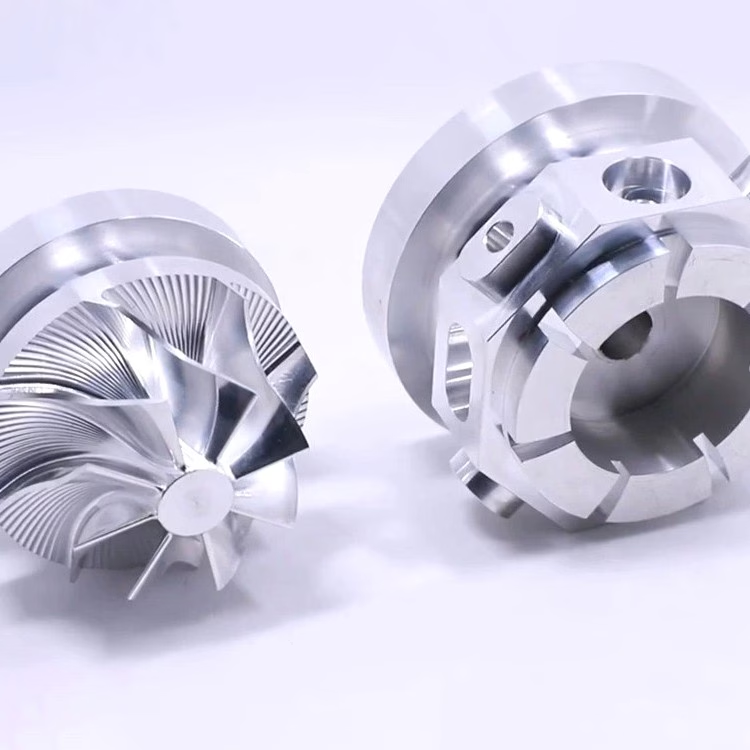
What the seven checks actually screen for
Every tip below maps to something you can verify with a document, a machine list, or a phone call.
Ask for tolerance proof, not tolerance claims
Any quote can print ±0.005 mm. Holding it across 10,000 parts is a different problem. The number depends on spindle thermal growth, tool wear, fixture rigidity, and how often the machine gets calibrated. When you evaluate a candidate for choosing custom cnc machine work, ask which measurement instruments sit on the floor: CMM, optical comparator, surface roughness tester, height gauge. Then ask who signs the inspection report and whether you can see a sample of it.
A useful test is to send one part with a tight true-position callout and one with a loose one. Compare how the two are quoted. If both come back with the same generic machining note, the shop is not reading the drawing. A supplier that flags the tight callout, proposes a datum scheme, and names the machine it will run on has already shown more than a tolerance line on paper.
Be careful with blanket claims. A shop that says it holds ±0.005 mm on every feature on every material is describing a best case, not a process. Real capability is per-feature, per-material, and per-geometry. Ask for the qualification rate on similar parts instead.
GreatLight inspects 100% of parts before shipment and can supply raw material checks, in-process monitoring records, and final inspection reports on request.
- 1Verifiable numbersAsk for the measurement method behind ±0.005 mm, not the claim itself.
- 2Per-feature limitsTolerance depends on geometry, material, and how the part is held.
- 3Report sampleA real inspection report names instruments, operators, and dates.
Look at the machine mix, not the machine count
A fleet of 200 three-axis mills cannot make a 5-axis impeller. What matters is whether the builder owns the right categories for your part family. For choosing custom cnc machine partners, ask for a breakdown by axis count, work envelope, and spindle type. Then match it against your drawings.
Envelope is the first filter. A part that needs 4,000 mm of travel will not fit on a 500 mm table, no matter how accurate that table is. Our largest travel is 4,000 × 400 × 150 mm on a gantry-style machine, which suits long extrusions and frame rails. Medium parts run on 750 × 1,150 × 550 mm or 600 × 600 × 600 mm centers, and compact work goes on 500 × 500 × 450 mm or 500 × 310 × 200 mm machines.
Axis count is the second filter. Undercuts, compound angles, and contoured surfaces usually need simultaneous 5-axis motion. A 3+2 setup can reach the same features on some parts, but it adds setups and fixture error. We run 16 simultaneous 5-axis centers, 16 mill-turn centers, 12 four-axis mills, and 27 three-axis machines, plus a Ø400 mm rotary table for cylindrical work.
Ask how the machines are maintained. Spindle hours, ballbar checks, and leveling schedules tell you whether the envelope you were quoted will still be there in six months.
- 1Envelope firstMatch maximum travel to your largest part before anything else.
- 2Axis count secondSimultaneous 5-axis removes setups that 3+2 setups cannot.
- 3Maintenance recordSpindle hours and calibration logs predict long-run drift.
Check what the certifications actually control
Certificates on a wall mean little by themselves. What matters is which procedure the certificate governs and whether that procedure touches your part. ISO 9001:2015 covers general quality management. IATF 16949:2016 adds automotive-specific error-proofing, traceability, and scrap control. ISO 13485:2016 governs medical device manufacturing, including validation and clean handling. ISO 27001:2022 protects the CAD files you upload.
For choosing custom cnc machine suppliers in regulated fields, ask for the scope statement on the certificate, not just the number. A certificate that covers machining but not surface finishing will not help if your part is anodized before it ships. Check whether the finishing step is inside or outside the audited scope.
The practical payoff shows up in documentation. An IATF-audited shop keeps lot traceability, tool-change records, and nonconformance logs as a matter of routine. When a customer audit lands, those records exist already. When a part fails in the field, you can trace it back to a heat number and a machine.
GreatLight holds ISO 9001:2015, IATF 16949:2016, ISO 13485:2016, and ISO 27001:2022. We use them as working systems rather than display items.
- 1Read the scopeA certificate only covers the processes listed on it.
- 2Match the industryIATF for automotive, ISO 13485 for medical, ISO 27001 for IP.
- 3Ask for recordsTraceability and nonconformance logs show whether the system runs.
Full-process chains compared with split sourcing
Handing a part between three vendors adds three queues, three sets of paperwork, and three chances for damage.
| Stage | Split sourcing | Single full-process chain |
|---|---|---|
| Machining | Vendor A quotes, runs, ships | Same shop runs the part |
| Finishing | Vendor B queues after arrival | Anodizing, plating, coating in-house |
| Tolerance stack-up | Re-datum at each hand-off | One datum scheme end to end |
| Scheduling | Three calendars to align | One production schedule |
| Packaging | Repacked twice | Packed once, after final inspection |
| Traceability | Records split across vendors | One lot record per part |
| Typical risk | Damage and delay at each transfer | Internal transfer under one roof |
Test the engineering support before you place the order
Sales quotes tell you the price. Engineering answers tell you whether the part can be made at that price. Send a drawing with a known manufacturability problem and see what comes back. Good DFM feedback names the specific feature, explains why it is hard, and proposes an alternative. It does not say the part is fine and then raise the price later.
The response time matters too. We return a quotation and free DFM analysis within 12 hours, and production can start within 24 hours of approval. That speed only helps if the feedback is real. Look for comments on wall thickness, tool reach, minimum internal radius, thread depth, and datum selection.
Ask who owns the process after the quote. If the sales engineer disappears and a planner you have never met takes over, expect surprises. The better arrangement is a named engineer who stays with the part from DFM through first article and into production.
For choosing custom cnc machine builders, treat the first DFM reply as a sample of the whole relationship. If it is vague, the rest will be too.
- 1Send a hard partA thin wall or deep pocket reveals how the shop thinks.
- 2Look for specificsNamed features and proposed fixes beat general reassurance.
- 3Named contactOne engineer from DFM to first article reduces hand-off loss.
Pressure-test the lead time, not the promise
Lead time commitments are easy to make and hard to keep. Ask what happens when a tool breaks, a material lot fails incoming inspection, or a machine goes down. A builder with spare capacity and multiple plants has more room to recover than one running at full load on a single shift.
We quote a 12-hour response, a 24-hour production start, and shipment in 3–5 days, with historical late-delivery probability below 2%. Those numbers assume material is in stock or arrives on schedule. If your alloy is unusual, ask about stocking or expedited mill delivery before you commit to a date.
Certifications and quality systems affect lead time more than people expect. If every part requires a full CMM report and a signed first article, add time for that. If the shop has a documented in-process check, less rework happens and the schedule holds.
Get the lead time in writing with the assumptions listed. A date without assumptions is a guess.
- 1Ask about capacitySpare machine hours absorb the unexpected.
- 2List assumptionsMaterial availability and inspection level drive the date.
- 3Check the recordHistorical on-time performance beats a verbal promise.
Verify communication and project management
Most late projects are not machining problems. They are communication problems. A drawing revision that never reached the floor, a finish callout buried in a note, a quantity change confirmed by phone. During supplier evaluation, ask how revisions are controlled and who confirms receipt.
A working system looks like this: an upload portal with access control, written confirmation of every revision, a single point of contact for the project, and photos or inspection data at key milestones. Nothing exotic, but it has to be routine. We keep uploads secure and confidential, and an NDA is available on request.
Time zone helps or hurts depending on your schedule. A Dongguan and Singapore footprint covers both Asian and European working hours, which shortens the feedback loop on urgent changes. Ask when your contact is online and how fast they reply during your shift.
Run one small order first. A prototype or a 10-piece run shows you the real communication pattern before you commit a production volume.
- 1Revision controlWritten confirmation of every change, every time.
- 2Single contactOne person accountable for the whole project.
- 3Pilot orderA small run exposes the real workflow before volume.
Questions engineers ask before choosing a builder
What tolerance can we realistically expect on a production run?
We work to ±0.005 mm on critical features when the geometry, material, and fixturing support it. That is a capability, not a blanket guarantee on every dimension.
Features with long tool reach, thin walls, or difficult datums will be looser. We flag those during DFM so the drawing and the process agree before cutting starts.
Do you handle finishing, or do we need a second vendor?
Finishing runs in the same process chain. Anodizing (clear, color, hardcoat, conductive), electroless nickel, zinc, silver and gold plating, powder coating, black oxide, bead blasting, tumbling, brushing, polishing, and laser marking are all available.
Keeping finishing in-house removes the re-datum and repacking steps that cause tolerance stack-up and cosmetic damage.
How do you protect our CAD files and IP?
Uploads are secure and confidential, and we hold ISO 27001:2022 for information security management. An NDA is available on request through our NDA page.
Access to customer files is limited to the people who need them for quoting and programming.
What is the minimum order quantity?
There is no minimum. We run from a single prototype to 10,000+ part production volumes.
For a first order, a small pilot run is often the cheapest way to test communication, inspection reporting, and finish quality.
Which materials can you machine?
Aluminum (6061, 6061-T6, 2024, 5052, 5083, 6063, 6082, 7075, ADC12), stainless (303, 304, 316, 316L, 420, 430, 431, 440C, 17-4PH), steel (1018, 1045, 4130, 4140, 4340, A36, tool steel), copper and brass (C101, C103, C110, beryllium copper, C27400, C28000, C36000), titanium and special alloys (TA1, TA2, TC4, Inconel, magnesium AZ31B and AZ91D), and plastics including ABS, PC, PMMA, POM, PA, PEEK, PP, HDPE, and carbon fiber.
If your alloy is not on the list, ask before quoting. Availability drives lead time more than machining does.
How do we start an evaluation?
Send the drawing package through the quote page. You get a quotation and a free DFM analysis within 12 hours, and production can begin within 24 hours of approval.
If the project needs a technical discussion first, the contact page reaches an engineer rather than a call center.
Send the drawing and get a real answer
Upload your CAD files and we will return a quotation plus free DFM analysis within 12 hours. Ask for an inspection report sample if you need one.
12-hour quote100% inspectionNDA on requestNo minimum order









