
7 Essential Tips for Nylon CNC Machining to Cut Costs and Boost Precision
Nylon machines fast, but it moves, grabs tools and changes size after the cut. This guide is for engineers and buyers who need repeatable parts in PA6, PA66, PA12 or glass-filled grades. Read it and you can judge which tolerances are realistic, where scrap comes from, and what to specify before the first chip.
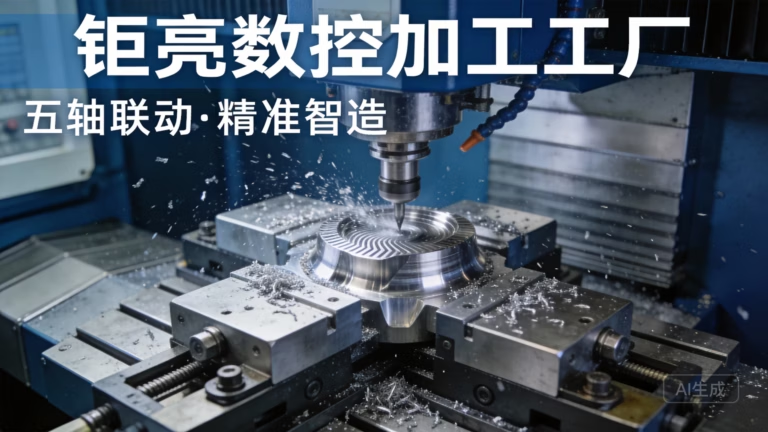
Seven decisions that set the cost and the tolerance
Each section below covers one variable you control before and during the cut. Skipping any of them shows up later as scrap, rework or a part that measures differently the next morning.
Dry the stock before it reaches the spindle
Nylon is hygroscopic. A PA6 bar sitting in a humid shop picks up moisture through the skin and holds it. Cut that bar and the heat at the tool tip turns trapped water into steam. You get bubbles in the chip, a cloudy surface, and a bore that shrinks a few hundredths of a millimeter after cooling. On a tight part, that is a reject.
Dry stock in a dehumidifying oven at 80–90 °C for 4–6 hours. Thick sections need the longer end of that range. We keep dried blanks in sealed containers with desiccant and take them out one at a time. Machining a wet blank costs more than the drying step: extra finishing passes, extra inspection, and sometimes a new blank.
- 1Thin wall, small part4 hours at 80–90 °C is usually enough for sections under 20 mm.
- 2Thick bar or plateRun the full 6 hours; moisture in the core takes longer to leave.
- 3After dryingSeal it. A dried blank in open air starts reabsorbing within hours.
Tool geometry and coating: sharp, polished, and generous in rake
Unfilled nylon is soft and gummy. It does not break into clean chips the way brass does; it wants to weld to the cutting edge and form a built-up edge. That built-up edge is what ruins surface finish and pulls wall thickness around. The fix is a sharp, polished edge with a high positive rake, typically 10–15°, so the material shears instead of being pushed.
Glass-filled and mineral-filled grades are different. They are abrasive and will wear a standard uncoated carbide insert in a short run. For those, use a diamond-like carbon (DLC) coating or a polished PCD insert, and keep the edge sharp. Dull tools on filled nylon mean heat, and heat means size change.
Two flutes is a good default for slotting and contouring in nylon because chip clearance matters more than edge strength. For finishing passes on unfilled grades, a single-flute cutter gives more room for chips and less rubbing.
Starting parameters by nylon grade
Values below are shop starting points for rigid setups. Adjust after the first part is measured, not before.
| Grade | Surface speed | Feed per tooth | Tooling note |
|---|---|---|---|
| PA6 unfilled | 300–500 m/min | 0.10–0.20 mm | Sharp polished edge, 2 flutes |
| PA66 unfilled | 300–500 m/min | 0.10–0.20 mm | Similar to PA6, watch heat |
| PA12 | 250–450 m/min | 0.08–0.18 mm | Lower moisture pickup, still dry it |
| PA6-GF30 | 150–250 m/min | 0.05–0.12 mm | DLC or PCD, expect edge wear |
| PA66-MD (moly) | 150–250 m/min | 0.05–0.12 mm | Abrasive, check edge every part |
Cut parameters built around heat, not around the feed table
Nylon has a low thermal conductivity, roughly a few hundred times lower than aluminium. Heat from the cut has nowhere to go except into the tool and the part. The part grows, the tool wears, and the finish degrades. So the parameter question is not how fast the cutter can go, it is how fast you can go before the part gets hot.
Run high surface speed with a moderate feed per tooth. Too light a feed rubs the material and generates more heat than a proper cut. Too heavy a feed on a thin wall deflects the part and you cut oversize. On walls under 3 mm, take lighter radial engagement and more axial passes rather than one deep pass.
Air blast beats flood coolant for most nylon jobs. Coolant adds moisture and leaves residue in porous grades. A strong air blast clears chips and pulls heat off the tool at the same time. If a job runs hot, pause between roughing and finishing so the part can return to room temperature before the finish cut sets the final size.
Chip control and part design both decide whether the job runs clean
Nylon chips are long, stringy and light, and they wrap around the tool if you let them. Recutting a chip is the fastest way to a torn surface. Use air blast aimed at the cut, peck drilling with full retract on deep holes, and program a retract on every pass where a string can form. On deep pockets, a short dwell with the spindle running and air on clears the nest before the next pass.
Design choices matter just as much. Sharp internal corners concentrate stress and are hard to cut without chatter. Add a corner radius where the function allows it. Avoid deep, narrow slots; they force a long, thin tool into a chip trap. Keep wall thickness as uniform as the part allows, because thick-to-thin transitions cool at different rates and pull the part out of flat.
Threads in nylon should be coarse and cut, not formed, unless the load is light. Fine threads in a soft material strip easily. For press fits, remember that nylon moves with humidity; a fit that holds in a dry shop may loosen in a damp one. Leave more interference than you would on aluminium, or specify a mechanical retention feature instead.
- 1Corner radiiAdd them where function allows; sharp corners chatter and crack.
- 2Wall thicknessKeep it uniform; thick-to-thin transitions warp after cutting.
- 3Deep slotsAvoid them, or expect a smaller tool and slower feed.
- 4ThreadsCoarse cut threads hold better than fine formed threads.
Stress relief, then a partner who controls the whole process
A nylon part can measure in tolerance off the machine and be out of tolerance the next day. Residual stress from roughing relaxes slowly and the part creeps. For critical tolerances, rough the part oversize, anneal it, then take the finishing cuts. Annealing also helps parts that will see heat in service, because it stabilizes the material before it ever reaches the customer.
The last tip is not a cutting parameter. It is who does the work. A shop that dries its own stock, machines on 5-axis centers, anneals in-house and inspects before shipment removes three handoffs where nylon parts typically go wrong. At GreatLight we run 127 CNC machines across three plants in Dongguan and Singapore, with 16 simultaneous 5-axis centers and a maximum processing size of 4,000 mm.
For nylon jobs we quote with a free DFM review inside 12 hours, and production can start within 24 hours. Parts normally ship in 3–5 days. If a tolerance is unrealistic for the grade, we say so at the quotation stage rather than after the first article.
Questions engineers ask before the first nylon cut
What tolerance can I realistically hold on a machined nylon part?
For unfilled nylon on a stable setup, ±0.05 mm on a dimension measured in the same conditions as the cut is a fair target. Below that, humidity and temperature dominate and the measurement becomes the problem.
If the part needs tighter than that, tell us at the quotation stage. We can discuss annealing and a controlled-condition final cut, but the tolerance has to be justified by the function.
Do I need to dry nylon before machining if the bar just came out of a sealed bag?
Sealed bag stock is usually closer to dry, but not always dry enough. Storage and shipping conditions vary, and a few hours in a humid shop is enough to change the skin.
We dry before cutting as a rule. The cost is a few hours of oven time; the cost of skipping it is a run of cloudy parts with moving bores.
Should I use coolant when machining nylon?
Mostly no. Air blast handles chip evacuation and heat well, and it does not add moisture to the part or leave residue in porous grades.
Coolant can help on deep-hole drilling where chip evacuation is difficult, but then the part needs drying before final measurement.
Why did my glass-filled nylon part wear out the tool so fast?
Glass and mineral fillers are abrasive. An uncoated carbide edge will dull quickly, and a dull edge generates heat, which then changes the part size.
Use DLC-coated or PCD tooling, keep the edge sharp, and check edge condition between parts rather than at the end of the run.
Will a machined nylon part change size after it ships?
It can. Nylon takes up moisture from the air, so a dry part in a dry climate will grow slightly in a humid one. The change is small but real.
For fits that matter, design with that movement in mind or ask us about annealing and a moisture-conditioned final state.
Can you machine nylon prototypes and small runs?
Yes. There is no minimum order quantity, so a single prototype is fine and so is a run of 10,000+ parts.
Uploads stay confidential, and we can sign an NDA on request before drawings change hands.
Send us the nylon part and the tolerance that matters
Upload a drawing and we return a quotation with a free DFM review within 12 hours. If a tolerance will not hold in your chosen grade, you hear it before the run, not after.
12-hour quoteNo minimum order100% inspection before shipmentNDA on request









