
7 Secrets to Master Your CNC 3040 Router and Avoid Costly Mistakes
A CNC 3040 router is a light benchtop machine, and most ruined parts come from setup, not from the controller. This guide is for engineers and makers running one in a garage or a prototype shop. Read it and you can tell which jobs the machine will hold tolerance on, and which ones belong on a bigger mill.
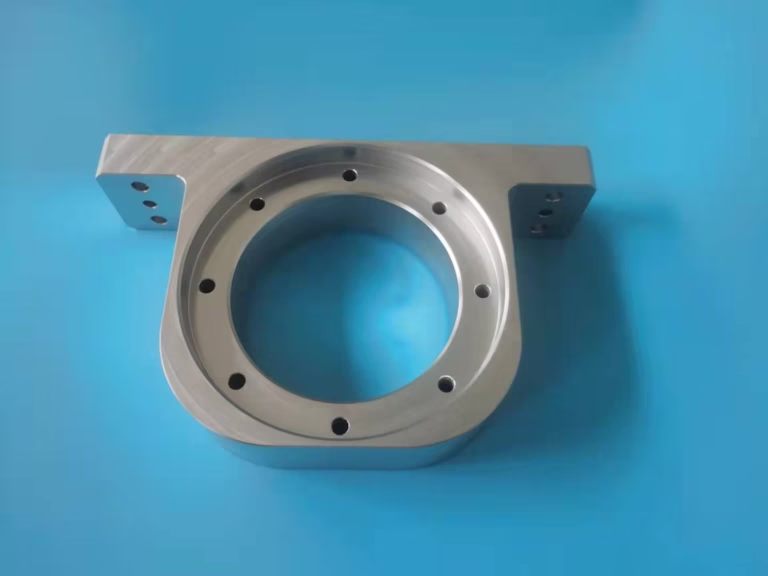
What this machine can and cannot do
Seven setup rules, in the order you should apply them.
Tram the spindle and face the spoil board
The frame of a 3040-class router is aluminum extrusion or light steel. It flexes, and it does not arrive square. Before you cut a real part, check that the spindle axis is perpendicular to the XY plane. A dial indicator mounted in a swing arm shows the runout across a known flat surface, and the spindle mounts get shimmed until the reading holds within 0.01 mm across the work envelope. Skipping this step shows up later as steps between passes and one edge of a pocket cut deeper than the other.
The table itself is rarely flat. Fix that by letting the machine cut its own reference surface. Chuck a wide fly cutter or a large straight bit and take a 0.1 mm skim across the full spoil board. The result is a plane that matches the machine, not the supplier's shipping crate. Every Z-zero you set after this is measured from that plane.
Two checks matter before the skim. Confirm the bit is sharp, because a dull fly cutter tears the board instead of shaving it. Then confirm your Z-zero method, because the skim removes material and shifts the reference. If the board is MDF, expect to repeat the skim every few months. Humidity moves it.
- 1Target runout0.01 mm or better across the full table sweep.
- 2Skim depth0.1 mm per pass, light and even.
- 3RecheckAfter any crash, moved machine, or season change.
Work-holding decides whether the part survives
A part that shifts 0.1 mm is scrap. It can also snap the cutter and throw the workpiece. Small routers have weak clamps and a small table, so the holding method has to match the part geometry. For flat plate, low-profile step clamps at four corners plus two mid-span clamps usually beat double-sided tape. Tape creeps under side load.
For thin sheet and parts you cannot clamp through, vacuum or a fixture plate with superglue and activator works well. The bond releases with heat or acetone. Profile cuts that free the part need tabs, typically 0.5 mm thick and 3 mm wide, or the part lifts on the last pass.
For second operations and small parts, a machined soft-jaw vise or a dedicated fixture pays for itself. Cut the pocket to the actual part outline, not the nominal one. On a light machine, the vise also adds mass, which reduces chatter.
Never hold a part by one edge and cut the opposite end. The overhang turns into a tuning fork. Support the work under the cut, or reduce the depth of cut until it stops ringing.
Work-holding methods and where they fit
Pick by part geometry and how much side load the cut puts in.
| Method | Best for | Watch out for |
|---|---|---|
| Step clamps | Flat plate 6 mm and thicker | Clamp marks on the top face |
| Double-sided tape | Thin sheet, light finishing passes | Creep under side load and heat |
| Superglue fixture | Small parts, full profile cuts | Needs heat or solvent to release |
| Vacuum table | Large flat panels | Loses grip on warped stock |
| Soft-jaw vise | Second operations, small blocks | Jaw flex on light machines |
| Tabs and bridges | Parts cut free from a sheet | Sanding where the tab was |
Read the tool path before you press start
CAM defaults are written for industrial machines with rigid frames and 10 kW spindles. A 3040 has a fraction of that stiffness. The default stepdown of half the tool diameter will chatter, rub, and burn the cutter. Halve it, then check the result before raising it again.
Climb milling gives a better surface on most materials, but a light frame can pull the cutter into the work if the backlash is large. Conventional milling is the safer first cut on a machine with worn leadscrews or loose gibs. Run a test coupon and compare the two finishes.
Entry matters more than most people expect. Plunging straight down with a flat end mill loads the center of the tool, which has no cutting edge. Use a ramp or helical entry. For pockets, a trochoidal path keeps the radial engagement low and spreads the wear along the flute.
Finally, simulate with the stock model on, not just the tool path. Gouges from a wrong tool length offset are the single most common crash on a benchtop router, and they are visible in the simulation.
Feeds and speeds that respect a light frame
Chip load is the number that matters, not spindle RPM. Chip load equals feed rate divided by (RPM times number of flutes). For a 3 mm two-flute carbide end mill in aluminum, a starting chip load of 0.02–0.03 mm per tooth keeps the cutter slicing instead of rubbing. Rubbing generates heat and work-hardens the edge.
A router spindle runs fast, often 12,000–24,000 RPM. That is good for small tools and bad for large ones, because surface speed climbs quickly. A 6 mm cutter at 20,000 RPM is already at the top of the range for aluminum. Drop the RPM or run a larger machine.
Depth of cut and width of cut trade against each other. On a light machine, keep radial engagement low, around 10–25 % of the cutter diameter, and you can take a deeper axial pass. This is the basis of high-efficiency milling and it suits flexible frames because the side force stays small.
Listen to the cut. A steady hum means the parameters are close. A high-pitched squeal means chatter, and the fix is less radial engagement, not more RPM.
Conservative starting parameters for a 3040 router
Verify on a test coupon before running the real part.
| Material | Tool | RPM | Feed |
|---|---|---|---|
| Aluminum 6061 | 3 mm 2-flute carbide | 16,000 | 900 mm/min |
| Aluminum 6061 | 6 mm 3-flute carbide | 12,000 | 1,200 mm/min |
| ABS / PMMA | 3 mm 2-flute upcut | 18,000 | 1,500 mm/min |
| POM (Delrin) | 4 mm 2-flute | 14,000 | 1,100 mm/min |
| Hardwood | 6 mm 2-flute upcut | 14,000 | 1,800 mm/min |
| Carbon fibre | 3 mm diamond-cut | 14,000 | 700 mm/min |
Chip evacuation is the real cooling system
Cutting tools fail from heat far more often than from wear. Chips carry that heat away, but only if they leave the cut. In a deep pocket, recut chips grind against the wall and the tool, and the temperature climbs fast.
Air blast beats flood coolant on most benchtop routers. It clears chips, needs no pump, and does not soak the MDF spoil board. Aim the nozzle at the cut, not at the spindle. A shop vacuum with a shoe helps on sheet goods, but it cannot reach the bottom of a deep pocket.
Compressed air alone will not clear a narrow slot. Use a peck cycle on deep slots, or widen the entry so chips have somewhere to go. On plastics, a mist of air and a small amount of lubricant stops the chip from welding back onto the cutter.
Check the cut after every few passes. If you see a pile of fine powder instead of distinct chips, the feed is too low or the RPM is too high. Powder means rubbing.
Not every material belongs on this machine
Aluminum cuts well on a 3040 router, especially 6061 and 6082. Brass machines cleanly and leaves a good finish. Plastics like ABS, POM, and PMMA are easy, though they need sharp tools and air to stop chip welding. Carbon fibre cuts but is abrasive, so expect short tool life and plan for dust extraction and PPE.
Steel is where the machine stops. Mild steel and stainless need low surface speed, high force, and flood coolant. A router spindle cannot deliver the torque at the low RPM these materials want. Titanium and Inconel are further out of reach. If a job calls for those, it needs a real machining center.
Stock condition matters as much as the alloy. Cast or extruded plate moves when you remove material from one side. Rough both sides, let the part rest, then finish. On thin plate, expect the part to bow after profiling. Climb-mill the last pass so the burr lands on the side you can deburr.
When a part needs ±0.005 mm and Ra 0.8 μm, a benchtop router will not hold it over a production run. That is the point where the job moves to a shop with 3-axis, 4-axis, or 5-axis capacity and a metrology room.
Know when to move the job off the bench
The 3040 earns its keep on one-offs, fixtures, engravings, and soft-material prototypes. It stops being economical when parts need tight tolerances, hard materials, or repeatable volume. At that point, setup time and scrap cost more than a supplier quote.
Move the job when any of these appear. Two or more parts fail inspection. The material is steel, titanium, or Inconel. The tolerance band drops below ±0.05 mm. The run is longer than a handful of pieces. Or the part needs a surface finish better than Ra 1.6 μm as machined.
A production shop handles the same job with stable fixturing, in-process monitoring, and a final inspection report. That includes 100% inspection before shipment and reports on request. The DFM feedback at quoting often removes features that were expensive to cut on the bench and cheap to change on a drawing.
For a hybrid workflow, keep the router for the quick iteration and send the validated design out for the run. The drawing carries the tolerance and finish callouts, and the prototype proves the geometry fits.
Common questions about the CNC 3040 router
How flat does the spoil board need to be?
Flat to within about 0.05 mm across the area you use. Face it with a fly cutter and recheck after any season change if the board is MDF.
If you only use part of the table, skim that region and set your Z-zero from it.
Can a 3040 router cut aluminum reliably?
Yes, for 6061, 6082, and similar alloys, with a two- or three-flute carbide cutter and an air blast. Keep radial engagement low and chip load steady.
Deep pockets and thin walls are where it struggles. Reduce depth of cut and support the part.
Why does my cutter break on the first plunge?
Straight plunging loads the center of a flat end mill, which has no cutting edge. Use a ramp or helical entry instead.
Check the tool length offset too. A wrong offset drives the cutter into the stock at rapid speed.
Air blast or flood coolant on a benchtop router?
Air blast for wood, plastics, and aluminum. It clears chips without soaking the spoil board.
Flood coolant only makes sense if the machine has a full enclosure and a drain. Most 3040 frames do not.
What tolerances are realistic on this class of machine?
Around ±0.05 mm on a well-trammed machine with light cuts and stable work-holding. The frame and leadscrews set the limit.
Below that, the part needs a rigid machine and a controlled thermal environment.
When should I send the part to a machine shop instead?
When the material is steel, titanium, or Inconel, when the tolerance is tighter than ±0.05 mm, or when the run is more than a few pieces.
A shop quote often beats the cost of bench setup, scrap, and rework on those jobs.
Send the part that outgrew the bench
Upload your drawing and we return a quote with DFM feedback within 12 hours.
12-hour quote±0.005 mm100% inspection









