
A Company Considering Buying a CNC Machine: What to Check Before You Commit
This page is for engineering and operations teams weighing in-house machining against outsourcing. It covers the cost drivers that rarely make the spreadsheet, the capability limits you inherit with a machine, and the part profiles that justify ownership. Read it and you can judge which path fits your volume, geometry, and tolerance band.
The question behind the question
A company considering buying a CNC machine usually frames it as a purchase decision. Should we buy a VMC, a lathe with live tooling, a 5-axis? That framing hides the actual decision. What you need is a reliable path to finished, inspected parts that meet print, on schedule. Ownership is one way to get there. It is not the only one, and it is rarely the cheapest at first.
Bring the work in-house and you control the schedule. Setup changes happen when you say so. First articles come off the machine the same afternoon. Those are real gains, especially during design iteration. The costs sit elsewhere: the spindle hour you pay for whether the machine runs or not, the programmer you have to hire before the first chip, and the scrap you eat while a new process settles.
On a per-part basis, ownership wins when volume is high and steady and the part family does not change much. A shop running one bracket at 20,000 pieces a year on a dedicated cell knows its cost per piece to the cent. Most product companies do not look like that. Their mix shifts, quantities are lumpy, and the geometry keeps moving. That is when a partner becomes the cheaper option, even at a higher hourly rate.
What the spreadsheet usually leaves out
Machine price is the easy number. The hard ones are around it. Tooling alone can run 5 to 15 percent of the machine cost per year once you count holders, inserts, drills, and the reamers you keep buying because the tolerance is tight. A 5-axis needs more of everything: more holders, more programming time, more simulation seats.
Floor space is a fixed cost too. A machine needs a footprint, a foundation, and clearance for loading. Add a chip conveyor, a coolant system, and a way to move material in and parts out. Precision work also wants stable temperature. If the shop swings 10 °C between morning and afternoon, your ±0.005 mm parts will not hold, and you will chase the number all day.
Then there is the labor you cannot avoid. Someone has to program, set up, run, and inspect. That is at least two people for one machine across two shifts, and a third if you want lights-out running. Skilled CNC programmers are not cheap, and the good ones leave if the work gets boring. A shop that runs one part family forever loses them.
Finally, count the ramp. Buying a machine is a project: install, power, level, prove out, qualify. Weeks pass before the first saleable part ships. If a program is waiting on that part, the delay costs more than the machine saves.
- 1ConsumablesTooling, coolant, filters, and inserts scale with run time, not with machine price.
- 2ProgrammingCAM seats, post-processors, and simulation add software cost before the first cut.
- 3InspectionCMMs and profilometers cost as much as a second machine if the tolerance is tight.
- 4Ramp timeInstall, prove-out, and process qualification consume weeks of engineering attention.
When ownership fits, and when it does not
Use this as a starting filter before you talk to any machine dealer.
| Situation | Buy in-house | Outsource |
|---|---|---|
| Annual volume, one part family | Above 10,000 pieces, stable for 2+ years | Under 5,000 pieces or uncertain demand |
| Geometry change rate | Rare revisions, frozen design | Frequent revisions or new variants |
| Tolerance band | Wide open, Ra 1.6–3.2 μm is fine | ±0.005 mm or Ra 0.2–0.8 μm required |
| Material range | One or two alloys, easy to cut | Titanium, Inconel, hardened tool steel |
| Part size mix | Fits one work envelope | Spans 200 mm to 4,000 mm |
| Engineering bandwidth | Team can absorb programming and setup | Team is committed to product design |
| Capital access | Cash or credit is available and idle | Capital is better spent on tooling or launch |
| Compliance load | You can carry ISO 9001 and IATF audits | You prefer to inherit certified processes |
The capability you inherit with the machine
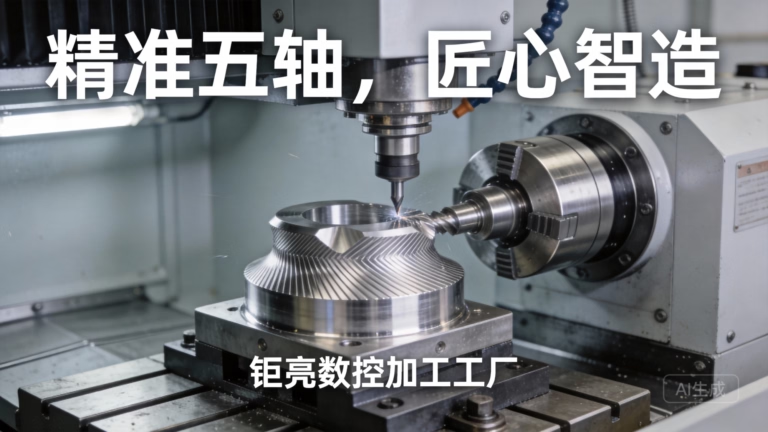
Every machine has a fixed envelope. A 3-axis mill with 500 × 500 × 450 mm travels will not touch a 4,000 mm frame, and no amount of clever fixturing changes that. Axis count matters too. A 3-axis can make a complex part in multiple setups, but each setup adds positioning error and labor. A 5-axis cuts the same part in one or two setups, which is why tight-tolerance, multi-face geometry usually lands on a 5-axis center.
Spindle and torque set the material ceiling. Aluminum cuts fast on almost anything. Titanium and Inconel do not. They need low spindle speeds, high torque, rigid tooling, and a lot of coolant. A machine bought for aluminum will struggle on a Ti-6Al-4V bracket, and the surface finish will show it.
Then there is the metrology side. If your print calls out ±0.005 mm, you need a CMM, a controlled room, and someone who knows how to interpret the data. That is a second investment, often overlooked. Without it, you are producing parts you cannot verify, which is worse than not producing them at all.
The last limit is flexibility. A purchased machine does exactly what it was specified for. A new project with a different work envelope, axis count, or material might mean another capital request. A partner with 127 machines across three plants can move the work to the right cell without a board meeting.
- 1Work envelopeTravel and table size cap the largest part you can make.
- 2Axis countMore axes means fewer setups and tighter positional accuracy.
- 3Spindle torqueHard alloys need low speed and high torque, not high RPM.
- 4MetrologyA CMM and climate control are part of the real cost.
A short path to the decision
Start with the part list, not the machine brochure. Sort by annual volume, tolerance band, material, and size. If one or two parts dominate the volume and the design is frozen, ownership is worth modeling in detail. If the list is long and mixed, outsourcing will almost always be cheaper once you count the fixed costs.
Run the numbers on a three-year horizon. Include the machine, tooling, programming, inspection, floor space, power, and the engineering hours to ramp. Then compare that to a quoted piece price at your actual volumes. The gap is usually bigger than people expect, and it usually favors the partner.
Keep one thing in mind. The goal is not to own a machine. The goal is to ship good parts and grow the business. If a partner can do that with tighter tolerances and faster turns, the capital is better spent elsewhere. We see this every week: teams that outsourced early and put their engineers on product design ship faster than teams that spent a year building a machine shop.
If you are still unsure, send us the drawings. We will run a free DFM analysis and quote within 12 hours, and you can compare that number to your internal estimate. No minimum order quantity, from one prototype to 10,000+ part runs.
Questions engineers ask before they buy
How many parts per year justify buying a CNC machine?
There is no universal number, but the break-even usually sits above 10,000 pieces per year for a single stable part family on a dedicated cell. Below that, fixed costs dominate and outsourcing wins.
The calculation changes with part complexity. A simple bracket at 10,000 pieces may still be cheaper to outsource if the tolerance is loose. A complex 5-axis part at 3,000 pieces may justify ownership if the design is frozen.
What tolerance can we realistically hold in-house on a new machine?
A new machine can hold ±0.005 mm on a good day, but only with a controlled room, a warm-up routine, and a CMM to verify. Without those, expect ±0.025 mm and a lot of scrap.
The machine is only one variable. Tooling, fixturing, thermal drift, and operator skill all move the number. Budget for all of them, not just the spindle.
How long does it take to ramp a new CNC machine to production?
Plan on 4 to 12 weeks from delivery to the first saleable part. That includes installation, power, leveling, programming, prove-out, and process qualification.
If the part is safety-critical or regulated, add qualification time. Medical and automotive programs can take months before the process is signed off.
Can we buy a used machine to reduce the cost?
Used machines can work for simple, loose-tolerance work. The risk is hidden wear: spindle runout, ball screw backlash, and a control that no longer has support.
Factor in a full rebuild, a new control, and a fresh calibration before you compare the price to a new machine. The gap often closes faster than expected.
What should we do while we decide?
Keep the project moving. Outsource the current build, send us the drawings, and use the quoted piece price as your baseline. That number is the true cost you are trying to beat.
Meanwhile, track your actual volumes and revision rates for a few months. That data will make the buy-or-outsource call much clearer than any machine brochure.
Do we need ISO certifications to machine parts in-house?
Not always, but your customers may require them for automotive, medical, or aerospace work. Carrying ISO 9001 and IATF 16949 means audits, documentation, and a quality system that runs whether you are busy or not.
If that overhead is not core to your business, inheriting a certified partner's system is often the simpler path.
Get a baseline quote before you sign for a machine
Send your drawings and we will return a quote and free DFM analysis within 12 hours. No minimum order quantity, from one prototype to 10,000+ part runs.
12-hour quote±0.005 mm tolerance100% inspectionNDA on request









