
Accelerate CNC Processing Services Without Losing Tolerance
This page explains where machining speed actually comes from: setup count, DFM changes, material availability, and inspection flow. It is written for design engineers and buyers who need parts fast but cannot accept looser tolerances. You will see which parts fit a 3–5 day route and which ones do not.
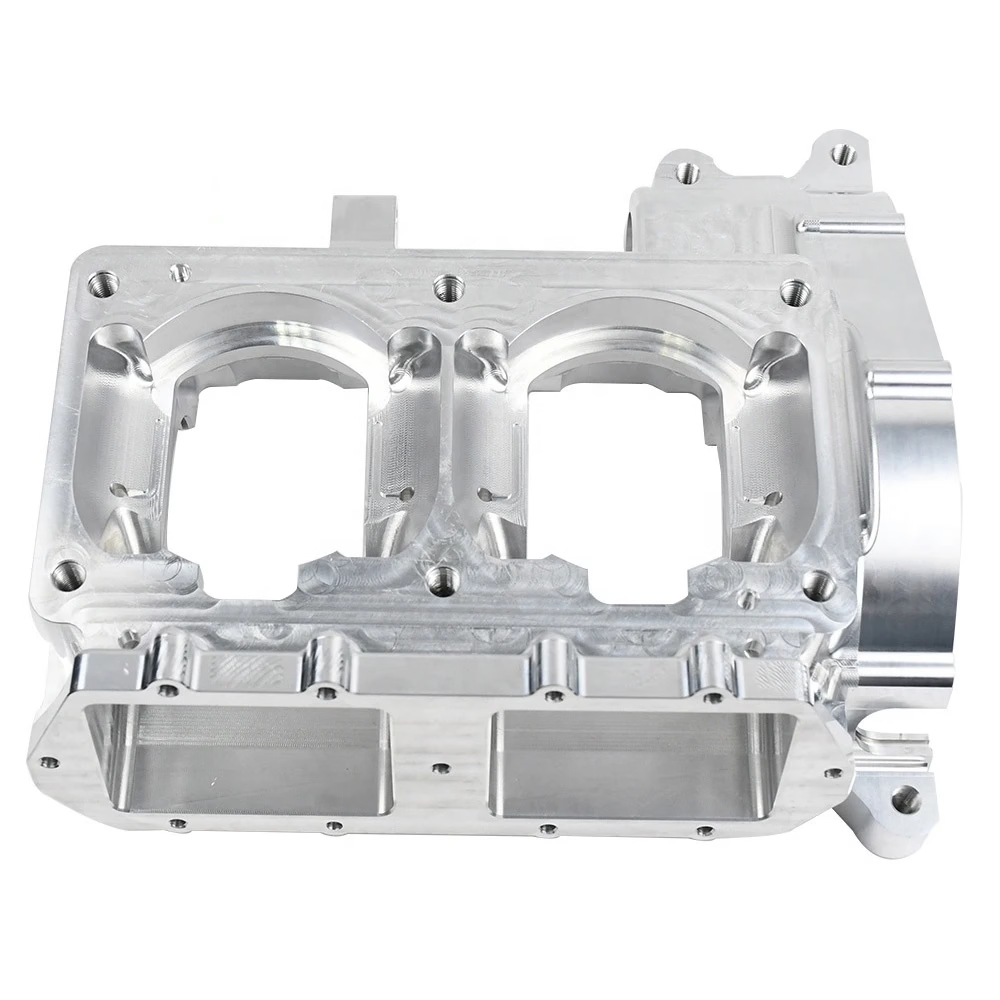
What "faster" means on a CNC quote
Speed is a sequence of removed delays, not a single machine setting.
Fewer setups is the biggest lever
Most of the calendar time on a machined part is not spindle time. It is waiting for a fixture, waiting for a second operation, waiting for the part to cool before it can be measured. A part that needs four setups spends three extra rounds in queue. A part that needs one setup goes straight from the machine to inspection.
That is why the first question on a rush job is not "how fast can you cut" but "how many times does this part have to be re-clamped". Our 16 simultaneous 5-axis machining centers cut five faces in a single clamping. No re-fixturing between operations, so there is no re-datum error and no queue time between ops.
Five-axis work is not automatically faster. On a simple bracket with one critical bore, a three-axis machine with a good fixture often wins because programming and setup are simpler. Five-axis pays off when the part has angled faces, deep pockets on multiple sides, or features that would need more than three setups otherwise.
We quote both routes when the geometry allows it. You get cycle time, setup count, and tolerance risk side by side, then decide which one fits your deadline.
Design changes that buy back days
A free DFM analysis comes back with the quote, usually within 12 hours. It is not a checklist. It is a list of specific edits with a stated effect on setup count or tool access.
Typical wins we flag: a corner radius that is smaller than the cutter can reach, an undercut that forces a second operation, a thread callout that needs a special tap, a pocket depth that exceeds a standard tool's reach. Widening a radius or relaxing a non-critical tolerance can remove an entire operation.
Ten minutes of drawing edits can cut cycle time in half on the right part. It can also do nothing. On a part with one critical datum and generous tolerances elsewhere, the design is already machinable and we leave it alone.
We tell you when an edit changes function. If a radius is there for stress reasons, or a tolerance is there for a bearing fit, we keep it and quote the slower route instead.
Material choice and stock availability
Material is a schedule risk more often than a machining risk. A specialty alloy that has to be ordered can add days before the spindle ever turns. We hold in-house stock of common aluminium, stainless, steel, copper, brass, titanium, and engineering plastics so production can start within 24 hours on standard grades.
Machinability varies enough that the same part in two materials is two different jobs. Aluminium 6061 and 7075 run clean and fast. Stainless 316L work-hardens, so feeds and speeds need care or the tool rubs. Titanium Ti-6Al-4V and Inconel generate heat at the cutting edge and need lower speeds, more coolant, and more tool changes.
When you consider swapping an alloy, we will say what the swap costs in cycle time, tool wear, and finish. Moving from 17-4PH to 316L or from PEEK to POM changes the cutting strategy, not just the price line.
The rule of thumb: if the material is in our rack, it does not wait. If it is not, we quote the lead time for the mill delivery honestly instead of padding the schedule.
Capability and lead-time reference
Figures below are what we can hold as standard, not best-case samples.
| Item | Figure | Note |
|---|---|---|
| Tolerance | ±0.005 mm (±0.0002 in) | On critical features, with in-process checks |
| Finish, fine | Ra 0.2–0.8 μm | Adds a finishing pass |
| Finish, high | Ra 0.8–1.6 μm | Common for sealing faces |
| Finish, as machined | Ra 1.6–3.2 μm | Fastest route |
| Max part size | 4,000 mm | Largest travel on our large mills |
| Quote + DFM | Within 12 hours | Free analysis with the quote |
| Production start | Within 24 hours | On stocked materials |
| Shipping | 3–5 days | After first-article approval |
Lights-out hours and where they stop
Robotic loading and in-process monitoring let some jobs run unattended overnight. That is where a 3–5 day delivery window comes from on repeat work: the machine keeps cutting while the shop is empty.
Unattended running only works on jobs that are already proven. A first-off part needs an operator watching the first cuts, checking the datum, and listening for chatter. We do not leave an unproven process alone to save a night.
Tool wear is the limit. Long unattended runs need tool-life monitoring or a tool that will not fail mid-cycle. On hard alloys, we shorten the unattended window and run more attended shifts rather than risk a scrapped near-finished part.
Every part gets 100% inspection before shipment, with raw material checks, in-process monitoring, and a final report on request. Speed does not remove that step. It is why our historical late-delivery probability sits below 2%.
When a fast route is the wrong route
Rush machining is not the right answer for every part. A few cases where we will tell you to slow down.
Thin-wall parts and long slender features deflect under cutting force. Adding speed means adding passes and stress relief, so the honest lead time grows.
Parts with tight flatness or parallelism over a long span need stress relief between roughing and finishing. Skipping it saves two days and loses the geometry.
Cosmetic parts with a Class A surface need hand finishing and inspection that cannot be compressed. We quote the finish time as a separate line so you can see what it costs.
Questions engineers ask before a rush job
How fast can you actually quote and start?
Quotation and a free DFM analysis come back within 12 hours.
Production can start within 24 hours when the material is in our in-house stock and the first-article check passes.
Does a rush job cost me tolerance?
No. We hold ±0.005 mm on critical features and inspect 100% of parts before shipment.
What changes on a rush job is which route we pick, not the tolerance we accept. If a feature cannot be held on the fast route, we say so before cutting.
Do you have a minimum order quantity?
No minimum. We run from one prototype to 10,000+ part runs.
One-off prototypes go through the same DFM review as production orders.
What do you need from me to start?
A 3D model or 2D drawing with tolerances, the material and finish callout, and the quantity.
Tell us which features are functional and which are cosmetic. That decides where we spend cycle time.
Can you keep my design confidential?
Uploads are secure and confidential, and we sign an NDA on request.
Nothing from your files is shared outside the team quoting and machining the part.
Which parts do not fit the fast route?
Thin-wall and long slender parts, and geometry that needs stress relief between roughing and finishing.
Heavy cosmetic finishing on Class A surfaces also adds fixed time that cannot be compressed.
Send the drawing, get a route and a date
Upload your files and we will return a quote, a DFM analysis, and a realistic lead time within 12 hours.
12-hour quote100% inspectionNo MOQNDA on request









