
Advanced CNC Machining in Grandville, MI: What Five Axes Actually Buy You
A working guide for engineers and buyers in West Michigan who need complex metal and plastic parts. It covers how many setups a part really needs, which tolerances hold on which machine, and when three axes are still the cheaper answer. Read it before you release a drawing for quote.
How to read this guide
Five sections, roughly in the order a part moves through a shop: geometry, setup count, tolerance, material, then cost and lead time.
When a part truly needs five axes
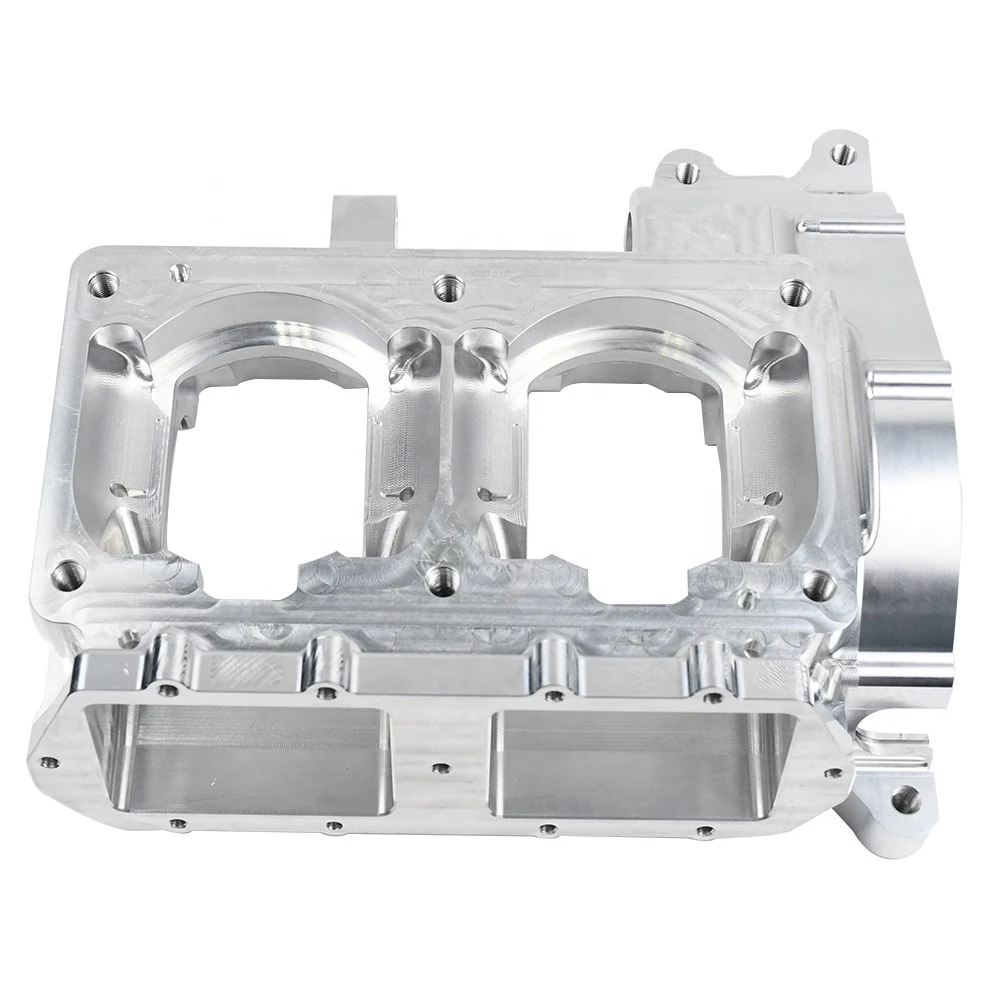
Tool access decides the machine, not part size. A housing with undercut pockets, angled bolt pads, or blending radii that meet at odd angles will not clear a three-axis cutter from one direction. That geometry is where five axes earn their cost.
The common signals are clear. Deep cavities with draft on more than two faces, ports drilled at compound angles, thin ribs that would deflect if repositioned, and sealing faces that must stay flat while a curved profile is cut nearby. Any of these usually means the part needs the tool to tilt.
Not every complex-looking part qualifies. A boxy bracket with a few angled holes can often run on a three-axis mill with a sine plate or a fourth-axis trunnion, and the result is just as good. The question is whether a second setup adds error you cannot live with.
Turbine blades, impellers, medical bone plates, and EV motor housings sit at the hard end. So do molds with deep, contoured cores. Those parts get programmed as one continuous toolpath, and the surface stays consistent because the part never moves between operations.
- 1Undercuts and compound anglesSigns the tool must tilt to reach the feature.
- 2Thin walls and ribsRepositioning risks chatter and distortion.
- 3Sealing and mating facesBest cut in one setup to hold flatness.
- 4Contoured cores and cavitiesContinuous toolpath keeps surface blend even.
Fewer setups, fewer places to lose accuracy
Every time a part leaves the vise, error creeps in. Reclamping shifts datum by a few microns, and those microns stack on top of the tolerance already spent. Five-axis work cuts most parts in one or two setups, which removes that stacking.
A simultaneous five-axis center moves the tool and the table together. The cutting point stays normal to the surface, so scallops stay shallow and tool load stays even. On a three-axis machine, the same surface needs a ball cutter stepping over in many passes.
On a three-axis machine, the same surface needs a ball cutter stepping over in many passes, which takes longer and leaves a rougher finish.
Setup reduction also changes fixturing. Soft jaws, vacuum plates, and dedicated tombstones still have a place, but a five-axis part often holds on a single Ø400 mm rotary table with minimal workholding. That matters for parts with no flat face to clamp.
What holds on which machine
Figures below reflect GreatLight shop capability, not a general industry guarantee.
| Machine | Typical holding tolerance | Surface finish | Best for |
|---|---|---|---|
| 3-axis mill | ±0.01 mm | Ra 1.6–3.2 μm | Prismatic parts, one face |
| 4-axis mill | ±0.01 mm | Ra 0.8–1.6 μm | Cylindrical features, wrap cuts |
| 5-axis simultaneous | ±0.005 mm | Ra 0.2–0.8 μm | Contoured and angled geometry |
| Mill-turn center | ±0.005 mm | Ra 0.8–1.6 μm | Shafts with milled flats |
| Large 5-axis | ±0.005 mm | Ra 0.8–1.6 μm | Parts up to 4,000 mm |
Matching alloy to the cut
Aluminum moves fast and cuts clean. Grades like 6061-T6, 7075, and 6082 run well on five-axis centers because the tool can take deeper passes without chatter. Hardcoat anodizing holds well on 6061 and 7075 when the surface is cut evenly.
Stainless and titanium behave differently. Grades 304, 316L, and 17-4PH work-harden if the cutter rubs instead of cuts, so feeds and speeds need to stay aggressive with good coolant flow. Titanium Ti-6Al-4V and Inconel generate heat at the edge and run at low surface speed.
Tool steel and hardened alloys need the rigidity a five-axis center provides. When the part is already hard, the machine has to absorb vibration rather than pass it into the wall. That is where a heavier spindle and a damped fixture shift the outcome.
Plastics and composites add their own rules. PEEK, POM, and carbon fiber need sharp cutters, high spindle speed, and dust extraction. A part that mixes an aluminum body with a carbon fiber insert can often be machined in sequence on the same center.
- 1Aluminum 6061 / 7075Fast cuts, good anodizing and hardcoat results.
- 2Stainless 304 / 17-4PHWork-hardens if the cutter rubs, keep feeds firm.
- 3Titanium and InconelHeat at the edge, run low surface speed.
- 4PEEK and carbon fiberSharp tools, high speed, dust control.
Where five-axis pays and where it does not
Five-axis programming takes longer up front. Toolpaths are verified in simulation, and the first part is often cut in a softer material or on a test block. That cost is fixed, so it spreads across the run. One prototype carries all of it.
The math flips on parts with tight angular relationships or many features on different faces. Fewer setups mean less handling, less inspection, and fewer scrapped parts. Once the toolpath is proven, the machine runs complex geometry at a steady rate with little operator input.
Simple parts should stay simple. A flat plate with through-holes and one pocket is cheaper on a three-axis mill, and the tolerance will be just as good. Sending it to a five-axis center adds programming time for no gain.
For runs from one part to 10,000 and up, the decision is usually about total cost, not unit cycle time. Quotation and DFM analysis come back within 12 hours, production can start within 24 hours, and parts ship in 3–5 days. Uploads stay confidential, and an NDA is available on request.
Questions engineers ask before quoting
Is five-axis machining only for prototypes and small batches?
No. Modern simultaneous five-axis centers are built for production. Once the toolpath is proven, the machine repeats the same motion with minimal intervention.
The economics depend on geometry, not batch size. Complex parts often cost less per unit at volume because setup and inspection time drop.
How many setups should I expect for a typical five-axis part?
Most parts are cut in one or two setups. A part with features on all six faces may need two, with the second operation reaching the base face.
Fewer setups reduce datum shifts. If a drawing allows a single setup, the achievable tolerance is usually tighter.
Can five-axis hold ±0.005 mm on every feature?
±0.005 mm is our shop tolerance and applies to well-supported features with stable fixturing and moderate material removal.
Thin walls, deep pockets, and hard alloys can push achievable limits. We flag those features during DFM review before production.
What part sizes can you machine?
Maximum processing size is 4,000 mm, with travels of 4,000 × 400 × 150 mm on the large platform.
Medium platforms run 750 × 1,150 × 550 mm and 600 × 600 × 600 mm. Compact platforms cover 500 × 500 × 450 mm and 500 × 310 × 200 mm.
Do you machine plastics and composites as well as metals?
We machine ABS, PC, PMMA, POM, PA, PEEK, PP, HDPE, and carbon fiber alongside aluminum, stainless, steel, copper, brass, titanium, and magnesium.
Plastic and composite parts need dedicated cutters and dust control, which we run on the same five-axis platforms.
How do you handle my drawings and CAD files?
Uploads are secure and confidential. We can sign an NDA before you send files.
Files stay tied to your project. We do not share them outside the quoting and production team.
Send a drawing, get a setup plan back
We review the geometry, pick the machine, and return a quote with DFM notes within 12 hours.
12-hour quoteDFM included100% inspectionNDA on request









