
Advantages of CNC Machining for Customized Parts Production
This page explains what CNC machining actually gives you when parts are customized rather than catalog items. It is written for design engineers and sourcing teams comparing processes. By the end you can judge whether a part belongs on a mill, a lathe, or somewhere else entirely.
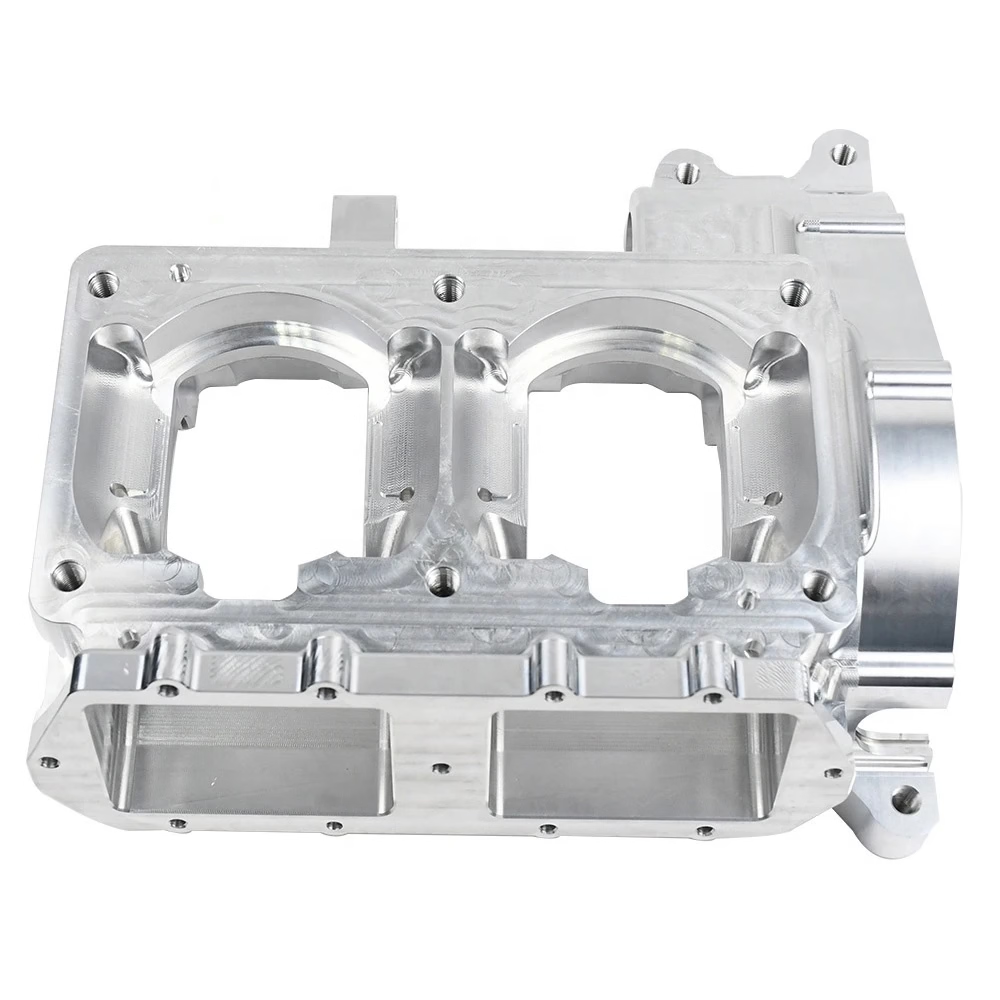
What customized parts production really means
Customized does not mean one-off. It means the geometry, tolerance and finish come from your drawing, not from a tooling catalog.
Why subtractive machining fits customized geometry
CNC machining removes material from a solid blank under program control. There is no mold, no die and no pattern to cut first. When a part is customized, this matters because the design is still moving. You can change a pocket depth, add a threaded hole or shift a datum on Tuesday and cut the new revision on Wednesday. The only artifact that has to change is the CAM program.
The second advantage is geometric freedom. A three-axis mill cuts what the tool can reach from above. Add a fourth or fifth axis and the tool approaches the part from angles that would otherwise need two or three separate fixtures. Undercuts, angled ports, compound faces and contoured slots become single-setup features. Fewer setups means fewer datum shifts, and datum shifts are where tolerance stack-up comes from.
Machining is also material-agnostic in a way that casting and molding are not. The same program that runs 6061 aluminium can run 316L stainless or Ti-6Al-4V with different speeds, feeds and tools. That flexibility is useful during prototyping, when the final alloy may not be locked yet.
- 1No tooling costDesign changes cost programming time, not a new mold.
- 2Multi-axis access5-axis centers reach faces that 3-axis setups cannot.
- 3Alloy swapsSame geometry runs in aluminium, steel, titanium or plastics.
Tolerance, repeatability and what drives both
Tolerance is the first thing engineers ask about, and it is the first place a quote can go wrong. At GreatLight we hold ±0.005 mm (±0.0002 in) on machined features when the drawing and the material support it. That number is not automatic across every dimension on every part. It depends on feature accessibility, wall thickness, material stiffness and how the part is held.
Repeatability is the quieter advantage. Once a program is proven, part 2 and part 200 come off the machine the same way, provided the blank and the fixture are consistent. That is why customized parts production usually starts with a first article and a dimensional report, then moves into a run. The first article is where you find out whether the tolerances you drew are the tolerances the process can hold.
Surface finish follows a similar logic. As-machined surfaces land around Ra 1.6–3.2 μm. A finer pass gets you to Ra 0.8–1.6 μm, and lapping or polishing can reach Ra 0.2–0.8 μm on the right geometry. Tight finish and tight tolerance together cost more than either one alone, because the finishing pass has to be slow and the tool has to stay sharp.
Process fit for customized parts
Where CNC machining wins, and where it does not.
| Process | Best for | Watch out for |
|---|---|---|
| 3-axis CNC | Prismatic parts, plate work, open pockets | Undercuts need extra setups |
| 4-axis CNC | Shafts, housings with side holes | Rotary positioning adds setup time |
| 5-axis CNC | Contoured faces, angled ports, deep cavities | Programming and fixture cost is higher |
| CNC turning | Round parts, threads, bores, Ø400 mm and under | Off-axis features need a mill-turn |
| Die casting | High volume, thin walls, one alloy | Tooling cost only pays back at volume |
| 3D printing | Concept shapes, internal channels | Weaker material properties |
Where customization pays off, and where it does not
Customized parts make sense when the geometry carries function. A bracket with a mounting pattern that has to match an existing frame, a manifold with internal passages, a heat sink with fin spacing tied to airflow. In these cases the part is not interchangeable, and machining lets you build exactly what the assembly needs without a tooling commitment.
The economics change with volume. Below a few hundred parts, machining usually beats casting and molding because there is no tool to amortize. Above that, a casting or a molded part can be cheaper per unit, though it locks the design and the alloy. A common path is to machine the prototype, validate it, then move to casting with the machined part as the reference. We do both, so the transition stays in one supply chain.
Some features are simply not worth machining. Very deep small-diameter holes, sharp internal corners and thin unsupported walls will drive cost up fast or fail outright. If a corner can carry a radius, give it one. If a wall can be thicker, thicken it. These are small drawing changes with a large effect on cycle time.
- 1Add corner radiiA standard end mill radius avoids slow EDM work.
- 2Keep depth-to-diameter saneDeep small holes need long tools that deflect.
- 3Define datumsClear datums reduce setup ambiguity and scrap risk.
- 4Call out critical dims onlyOver-tolerancing drives inspection cost with no gain.
Material choice and finishing for custom runs
Customized parts rarely use exotic material for its own sake. The alloy follows the load case, the corrosion environment and the weight target. Aluminium 6061-T6 and 7075 cover most structural brackets and housings. Stainless 303 and 304 machine cleanly for food and medical fixtures, while 17-4PH brings strength and corrosion resistance together. Titanium TC4 (Ti-6Al-4V) and Inconel show up in aerospace and energy parts where temperature and strength rule.
Plastics behave differently. POM and PA are stable and machine well for wear parts and insulators. PEEK holds up at high temperature and in chemical contact but costs more and cuts slowly. Carbon fibre composites machine with heavy tool wear, so the toolpath and the cutter grade matter as much as the geometry.
Finishing is where a machined part becomes a product. Anodizing in clear, colour or hardcoat protects aluminium and changes appearance. Electroless nickel adds wear resistance and a uniform coating on complex shapes. Bead blasting, tumbling and brushing remove tool marks before plating, and laser marking handles part numbers and traceability down to a 1.5 mm character height. Pick the finish before you finalize tolerances, because plating and coating add thickness.
From drawing to first article
A customized parts job starts with a 3D model and a 2D drawing that agree with each other. When they disagree, the drawing usually wins for inspection and the model wins for toolpath, so the mismatch has to be resolved early. Send both, plus the material, finish, quantity and any critical dimension. We return a quotation and a free DFM analysis within 12 hours.
The DFM review is where most of the cost is saved. We flag features that will need a special tool, a fifth-axis setup or a fixture that does not exist yet. We also flag tolerances that are tighter than the function requires. A dimension held at ±0.005 mm when ±0.05 mm would do can add real cost across a run of parts.
Once the drawing is settled, production can start within 24 hours for most jobs, and parts ship in 3–5 days. Every part is inspected before shipment, with raw material checks, in-process monitoring and a final inspection. Reports are available on request. From one prototype to a 10,000+ part run, the same process controls apply, and uploads stay confidential with an NDA available on request.
Questions engineers ask before ordering
What is the smallest quantity for a customized CNC part?
There is no minimum order quantity. We run single prototypes and full production lots from the same process.
For a one-off, expect the programming and setup time to dominate the cost. That share drops as quantity rises.
How do I know my tolerances are achievable?
Send the drawing with the critical dimensions marked. We review the geometry, material and fixturing before quoting.
If a tolerance is tighter than the process can hold, we say so and propose an alternative rather than quoting a number we cannot meet.
Can you machine a part that has already been cast or forged?
Yes. We machine castings, forgings and extruded blanks to final dimensions.
Send the blank condition and stock allowance so we can plan the first cut and the datum.
When does 5-axis machining make sense over multiple 3-axis setups?
When the part has angled faces, contoured ports or features on several sides that would each need a separate fixture on a 3-axis machine.
One 5-axis setup removes the datum shifts between operations, which usually tightens the tolerance stack.
What surface finishes can you apply after machining?
Anodizing in clear, colour, hardcoat and conductive versions; electroless nickel, zinc, silver and gold plating; powder coating and black oxide; bead blasting, tumbling, brushing and polishing; laser marking and engraving.
Tell us the finish before finalizing tolerances, because coatings add thickness.
How is my design data handled?
Uploads are secure and confidential. We do not share customer files or use them as examples without written permission.
An NDA is available on request for projects that need one before files move.
Send your drawing and get a real manufacturing answer
Upload a 3D model and 2D drawing. We return a quotation and a free DFM analysis within 12 hours.
12-hour quoteFree DFM analysis100% inspectionNo MOQ









