
Advantages of CNC Machining Parts
This page is for design engineers and sourcing staff who need to know what CNC machining actually delivers before they release a drawing. We cover tolerance, repeatability, material range, finishes and the cases where CNC is the wrong call. By the end you should be able to judge whether a part belongs on a mill or somewhere else.
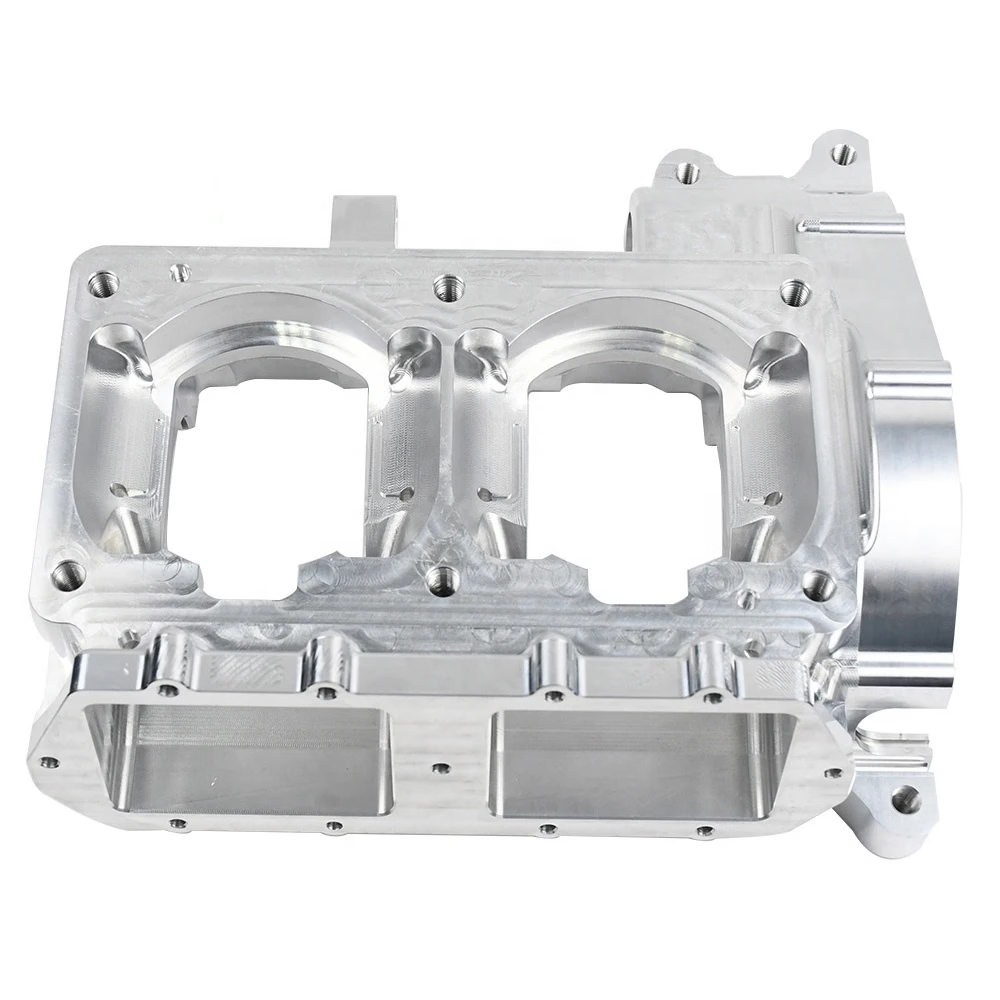
What CNC machining does well, and where it does not
Four properties decide most programs: dimensional control, repeatability, material choice and surface finish. The rest follows.
Dimensional control you can put on a drawing
CNC machining holds size because the tool path comes from a program, not from a hand on a wheel. A good process window gets us to ±0.005 mm (±0.0002 in) on critical features such as bearing bores, spigots, and mating faces. We work from your CAD file and the callouts on the print, then check the first article before the run continues.
Not every dimension needs that treatment. Holding a tight band on a non-functional surface only adds cycle time and cost. Send us the drawing and we will flag the callouts that need a different process, or a looser band that still works. This is the whole point of the free DFM analysis we run before quoting.
Roundness, perpendicularity and position tolerance matter as much as size. A bore can sit at nominal diameter and still fail to seat if it is oval or off-axis. Our machines run with probing and in-process checks, so geometry stays inside the tolerance zone, not just the diameter callout.
- 1Critical featuresBearing bores, sealing faces, dowel holes, and press fits.
- 2Typical band±0.005 mm on turned and milled features.
- 3Surface controlRa 0.2–0.8 μm for fine finishes, Ra 1.6–3.2 μm as machined.
- 4InspectionFirst article, in-process monitoring, and final check before shipment.
The same part, run after run
Once a program is proven, every cycle repeats it. Part 1 and part 500 come off the machine within the same tolerance band, which is why CNC suits both a single prototype and a 10,000-piece order. The setup carries the accuracy, not the operator's attention on that shift.
Repeatability also means you can scale without redesigning the process. A fixture that holds a prototype can often hold the production run, so the transition from one part to many adds cost in material and cycle time, not in new tooling. That is one of the practical advantages of CNC machining parts when a design is still moving.
Where repeatability breaks down is tool wear on long runs of hard material. We track tool life and change on schedule, then re-check the first part after each change. A worn cutter will drift a bore, and catching that early is cheaper than scrapping a batch.
Material range and how it changes the cut
CNC covers most metals and engineering plastics. Aluminum 6061 and 7075 cut fast and hold a good finish. Stainless 303 and 304 machine well, while 316L and 17-4PH need slower speeds and more attention to work hardening. Titanium TC4 (Ti-6Al-4V) and Inconel take longer again, with tighter tool-life control.
Plastics behave differently. POM and PEEK hold dimensions well; ABS and PP are softer and can burr or melt at the edge. Feed and speed have to be set for the material, not copied from a metal job. Surface finish follows the same logic: a polished aluminum part is straightforward, a polished PEEK part is not.
Choosing the material is a design decision as much as a machining one. Strength, corrosion resistance, weight and cost all pull in different directions. Tell us the service conditions and we will suggest a grade that machines to your tolerance without a surprise on the second order.
How common materials behave on the machine
A quick guide to what to expect. Actual results depend on geometry and tolerance.
| Material | Machinability | Typical finish | Watch for |
|---|---|---|---|
| Aluminum 6061-T6 | Easy | Ra 0.8–1.6 μm | Thin walls deflect |
| Aluminum 7075 | Moderate | Ra 0.8–1.6 μm | Less corrosion resistance |
| Stainless 303 | Easy | Ra 0.8–1.6 μm | Limited weldability |
| Stainless 316L | Moderate | Ra 1.6–3.2 μm | Work hardening |
| Steel 4140 | Moderate | Ra 1.6–3.2 μm | Heat treat after cut |
| Titanium TC4 | Difficult | Ra 0.8–1.6 μm | Tool wear, heat |
| Inconel | Difficult | Ra 1.6–3.2 μm | Very slow speeds |
| POM | Easy | Ra 0.8–1.6 μm | Chips wrap the tool |
| PEEK | Moderate | Ra 1.6–3.2 μm | Cost, stress relief |
Complex shapes in one setup
Five-axis work lets us cut undercuts, angled faces and contoured pockets without moving the part to a second machine. Fewer setups means fewer chances for a datum to shift, and that shows up in the tolerance stack. For a part with features on four or five sides, this is often the deciding factor.
Mill-turn centers take it further: turning and milling in the same cycle, so a shaft with cross-drilled holes and a milled flat keeps one datum from start to finish. Parts up to 4,000 mm in length can be handled on the larger machines, with a Ø400 mm rotary table for round features.
The limit is reach and rigidity, not imagination. A deep, narrow pocket needs a long tool, and a long tool bends. When a feature sits far from the spindle or needs a cutter that is too slender, the cut will chatter no matter how good the program is. That is a geometry problem, and it is better found at the DFM stage than on the machine.
Where CNC pays back, and where it does not
Tooling is cheap compared with molding or casting. There is no mold to cut, so a design change between prototype and production costs a new program, not a new tool. For low and mid volumes, that is the main economic argument for CNC.
Cycle time is the real cost driver. A complex five-axis part can run for hours, and the price reflects machine time, not part count. Simple prismatic parts cut fast and stay cheap at volume. High-volume simple parts often move to casting or stamping for that reason.
We quote and return a free DFM analysis within 12 hours, and production can start within 24 hours of a released order. Parts typically ship in 3–5 days. Those numbers assume the drawing is final and the material is in stock; a change mid-run resets the clock.
When CNC is the wrong process
CNC removes material, so it wastes stock. A part that is mostly a shell, or one with deep internal cavities, is cheaper as a casting or an injection-molded piece. Machining it from solid means paying to cut away metal you will never use.
Very high volumes of a simple shape favor a dedicated process. Stamping, die casting and forging all beat CNC on unit cost once the tooling is amortized. The crossover point depends on geometry, but it is usually in the tens of thousands for simple parts.
Some features simply cannot be machined. A closed internal channel with no access for a cutter needs a different route, often a casting with a machined sealing face. If a design has one of these, tell us early and we will say so before the quote, not after.
Common questions
What tolerance can CNC machining parts actually hold?
On critical features we work to ±0.005 mm (±0.0002 in). That applies to turned and milled dimensions where the setup and tool allow it.
Not every callout needs that band. We review the drawing and tell you which features justify a tight tolerance and which can be opened up to save cycle time.
Is there a minimum order quantity?
No. We run from a single prototype up to 10,000+ part runs on the same process.
The setup cost is the same whether you order one or one hundred, so the first part carries most of the tooling and programming effort.
How fast can I get parts?
Quotation and free DFM analysis come back within 12 hours. Production can start within 24 hours of a released order, and parts typically ship in 3–5 days.
Those times assume final drawings and available material. A design change after the run starts will move the schedule.
Which materials do you machine most often?
Aluminum 6061-T6 and 7075, stainless 303 and 316L, steel 4140, and engineering plastics such as POM and PEEK.
Titanium TC4 and Inconel are also machined, with longer cycle times and closer tool-life control.
Can you hold tight tolerances on plastic parts?
Yes, within limits. POM and PEEK hold dimensions well. Softer plastics like ABS and PP move more with temperature and can burr at the edge.
For tight plastic work we often rough, let the part relax, then finish. That adds a step but keeps the final size stable.
How do you handle confidential drawings?
Uploads are secure and confidential. We can sign an NDA on request before any files change hands.
Only the engineers who quote and program the part see the data. It is not shared outside the job.
Send a drawing and get a real answer
We review the geometry, flag the features that matter, and quote within 12 hours. No MOQ, no obligation.
12-hour quoteFree DFM analysis100% inspectionNDA on request









