
Affordable CNC Factory Review: What Engineers Should Check
This is a review framework for low-cost CNC suppliers, not a ranking. It covers what drives price, which machine specs decide part quality, and where a cheap quote quietly fails. Written for design engineers and buyers sourcing brackets, housings and prototypes from overseas shops.
How to read this review
Price is the last thing to check, not the first. Start with the geometry you need to hold, then work back to the machines that can hold it.
Why one quote is half the price of another
Two suppliers can quote the same STEP file 40 percent apart and both be honest. The gap usually sits in three places: how many setups the part needs, how much of the tolerance band the shop is willing to use, and how the work is scheduled around other jobs. A six-sided part that can be cut in one five-axis setup costs far less than the same part cut across four three-axis setups, because setup time is billed whether chips are flying or not.
Tolerance is the second lever. Holding ±0.005 mm on a 200 mm aluminum housing needs a temperature-stable shop, sharp tooling and in-process probing. Holding ±0.1 mm on the same housing needs none of that. When a price looks too low, ask which tolerance the shop assumed. Many cheap quotes quietly assume a looser band than the drawing states.
Volume changes the math again. Above roughly 500 parts, fixture cost per piece drops and the shop may invest in a dedicated setup. Below 50 parts, that investment never pays back, so setup dominates the price. Neither pattern is a red flag. What matters is whether the supplier explains which one your job falls into.
The machine list tells you what the shop can actually hold
Ask for the machine list before you ask for a price. Three numbers matter: travel in X, Y and Z, spindle speed, and how many axes move at once. A part that fits the envelope on paper can still be unmachinable if the tool cannot reach the pocket floor or the fixture leaves no clearance for the holder.
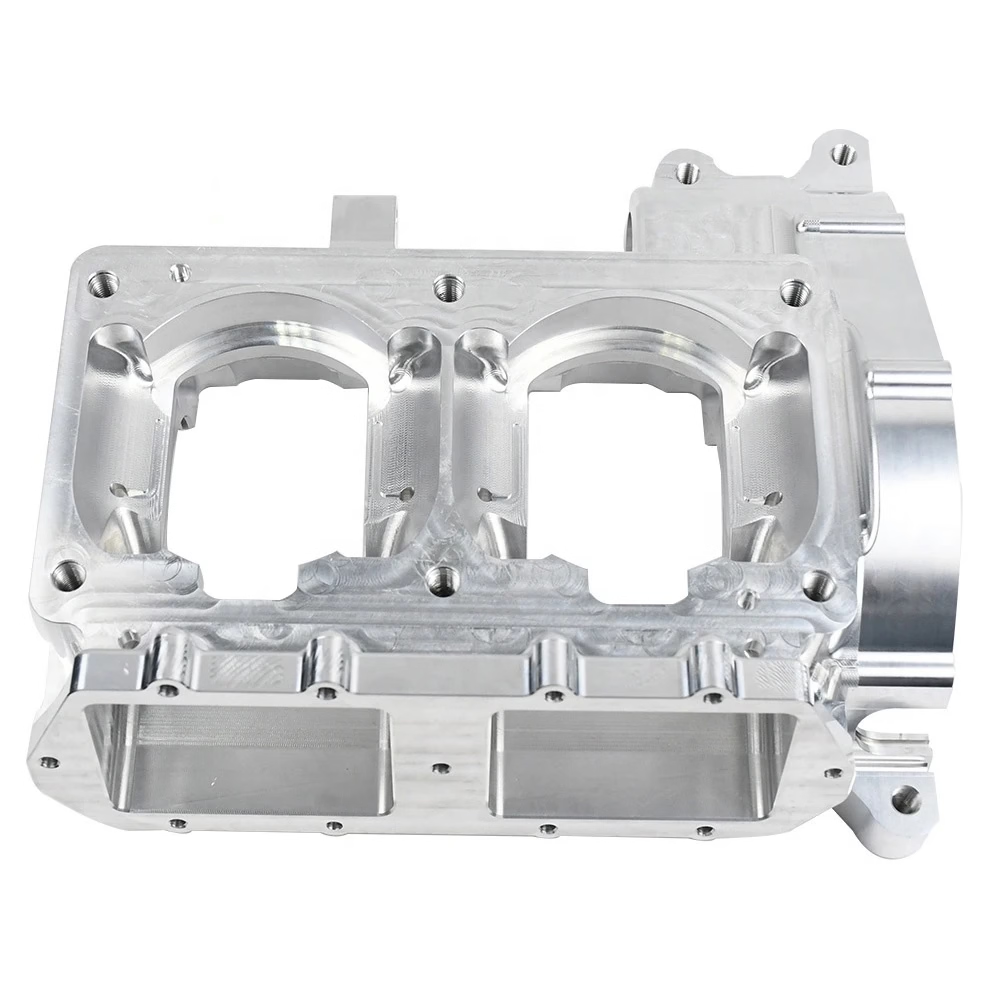
Simultaneous five-axis matters when a part has compound angles, deep contoured pockets, or features that would need four separate fixturings on a three-axis machine. Each refixture adds position error and labor. For flat plates and simple shafts, a three-axis mill with a good vise is cheaper and just as accurate.
Spindle speed decides surface finish and tool life more than most buyers expect. Aluminum cuts well at high rpm with small stepovers. Titanium and Inconel need lower speeds, rigid holders and flood coolant, and they punish light machines. If a supplier quotes Inconel on the same equipment they use for plastic prototypes, the price may be right but the result will not be.
Shop size is not the same as capability. A 15-person shop with four well-maintained five-axis centers can out-machine a 200-person shop running old equipment. Look at machine age, probing, and whether the shop does its own inspection, not headcount.
Which process fits which part
Match the part to the process before you compare quotes.
| Part type | Best fit | Why |
|---|---|---|
| Flat plate, simple holes | Three-axis milling | One setup, no compound angles, lowest cost |
| Four-sided housing | Four-axis with rotary table | Fewer setups than three-axis, tighter hole-to-hole position |
| Compound-angle bracket | Simultaneous five-axis | Single setup, no refixture error |
| Shaft with cross holes | Mill-turn center | Turning and milling in one chuck, better concentricity |
| Thin-wall prototype | Five-axis, light passes | Lower cutting force, less deflection |
| Titanium impeller | Five-axis, rigid setup | Contours and low machinability together |
| Soft plastic cover | Three-axis, high rpm | Cheap to cut, tolerance rarely critical |
| Large frame, 4,000 mm | Five-axis, long travel | Handles full length without repositioning |
Material choice changes the price more than the machine
Aluminum 6061 cuts fast, holds ±0.005 mm easily, and takes anodizing or bead blasting without drama. It is the default for prototypes and most brackets. Moving to 7075 buys strength but costs more in tooling wear and slower feeds. Stainless 304 and 316 are common in food and medical work; both work-harden, so the shop must keep the tool moving and never dwell.
Titanium TC4 and Inconel sit at the other end. Cut speeds drop to a fraction of aluminum, tool life shortens, and a small error scraps an expensive blank. Shops that quote these grades regularly usually show it in their tooling and coolant setup. If a low quote arrives for Inconel, ask how they plan to hold the tolerance and finish before you accept it.
Plastics are the cheapest to machine and the easiest to get wrong. ABS and POM cut clean at high rpm, but PEEK and carbon fiber need sharp tooling and dust control. Thin plastic walls deflect under clamping pressure, so light passes and soft jaws matter more than spindle power.
When an affordable shop is the wrong choice
Low-cost suppliers work well for simple geometry, loose-to-moderate tolerance, and materials that cut predictably. They stop working when the part carries tight tolerance across many features, when the material is hard to machine, or when the drawing requires documented inspection for a regulated industry. Aerospace and medical parts usually need traceability the buyer cannot see in a price sheet.
The other failure point is communication. A shop that cannot read a GD&T callout or answer a DFM question in plain terms will produce parts that pass their own inspection and fail yours. Send a drawing with a real datum scheme and see how they respond. That reply tells you more than any certificate photo.
For anything above 10,000 parts, or where a single rejected lot stops a line, the cost of a bad batch outweighs the savings on the quote. In those cases a factory with in-process monitoring, a documented quality system and a named engineer on the account is cheaper in total.
Frequently asked questions
How do I compare quotes from different factories fairly?
Send the same revision of the drawing and state the tolerance band in writing. Ask each supplier to confirm the number of setups, the machines used, and whether inspection reports are included.
When the answers differ, the price difference usually follows. Compare total cost, not unit price.
Does a lower price mean lower tolerance?
Not automatically, but tight tolerance costs money in time and tooling. A ±0.005 mm callout on many features will always price higher than ±0.1 mm on the same part.
Ask the supplier which features they planned to hold tight and which they treated as loose.
What materials can an affordable factory machine?
Aluminum grades 6061, 2024, 5052, 6063, 6082 and 7075, stainless 303, 304, 316 and 17-4PH, steels such as 1018, 1045 and 4140, brass C36000, titanium TC4, and plastics including ABS, POM, PEEK and PC.
Availability of the grade matters as much as the price. Confirm stock before committing.
How many parts do I need before a factory takes the job seriously?
A capable shop will run a single prototype. Below 50 parts, setup dominates the cost, so expect higher unit prices.
Above 500 parts, fixture investment spreads out and the unit price drops.
What should I check before placing the first order?
Ask for the machine list, the tolerance they can hold on your material, the inspection method, and how they handle a nonconformance. A shop that answers these clearly is usually the safer choice.
If confidentiality matters, request an NDA before you upload the drawings.
Can a cheap shop handle surface finishing?
Anodizing, powder coating, bead blasting and laser marking are common and often done in-house or nearby. Plating and hardcoat usually go out.
Outsourced finishing adds transit time and one more place for a scratch to happen. Ask who owns the finish if it fails.
Send a drawing and get a real answer
We review your file, flag DFM issues and return a quote with the tolerance and setup plan in writing. No minimum order, from one prototype to 10,000+ parts.
12-hour quote with free DFM100% inspection before shipmentNDA on request









