
Affordable CNC Parts Manufacturer Services
A working engineer's guide to what actually drives the price of a machined part. This page is for designers and buyers who need tight tolerances without paying for operations the part does not need. By the end you can read a quote line by line and know which cost is geometry, which is material, and which is inspection.
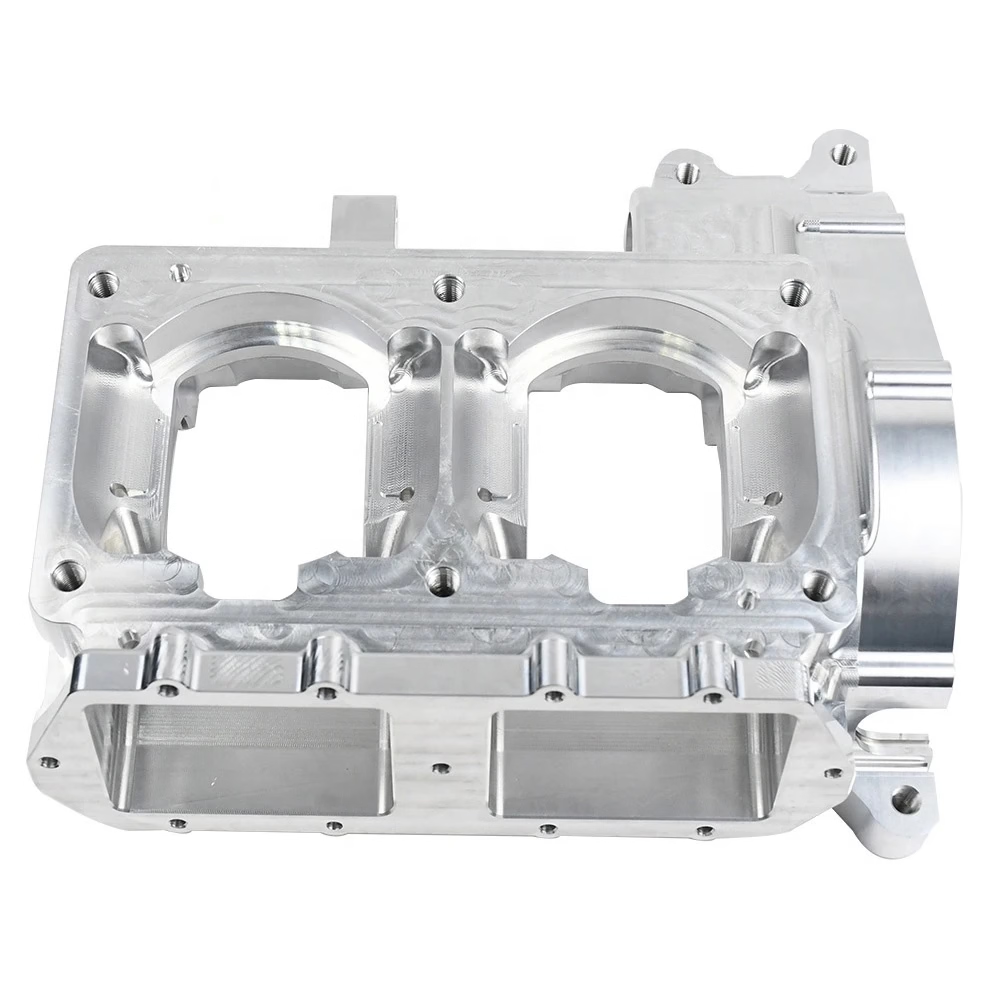
What makes CNC parts affordable
Low price and low total cost are not the same thing. This page separates the two.
Where the money actually goes
A CNC quote is mostly machine time plus setup plus material plus inspection. On a simple bracket, material and setup can dominate. On a complex housing, machine time and fixturing take over. When a supplier quotes far below everyone else, one of those four lines has usually been cut, and you find out which one when the parts arrive.
Machine time is set by how much metal the cutter has to remove and how many times the part is re-fixtured. Every extra setup adds a datum, adds an operator decision, and adds stack-up error. A part machined in two setups is not just slower than one machined in one setup; it is harder to hold at ±0.005 mm.
Setup cost is amortized across the batch. That is why the same part at 1 piece and at 500 pieces can differ by a factor of three or more. If you are prototyping, you are paying for a fixture that will only be used a few times. If you are in production, that fixture cost is nearly free per part.
Material is the least flexible cost. A 7075 aluminium block costs more than 6061. Titanium and Inconel cost more again, and they also slow the spindle down and wear tools faster. Choosing a material by habit rather than by function is one of the most common avoidable costs we see.
- 1Machine timeDriven by stock removal, tool changes, and surface finish targets.
- 2Setup countEach re-fixture adds cost and error. Design for one or two setups.
- 3Material6061 versus 7075 can change part cost by 20–40%.
- 4InspectionA CMM report on every dimension is real labor, not paperwork.
When five-axis lowers the price
Five-axis is usually described as a capability upgrade. On the right part it is also a cost reduction. A part with features on three or four faces normally needs three or four setups on a three-axis mill, plus a fixture for each. A simultaneous five-axis center can reach those faces with the part clamped once.
The savings come from setup elimination, not from faster cutting. Cycle time per feature is often similar. What disappears is the queue between operations, the re-clamping error, and the fixture design hours. On a low-volume run of a complex part, that is where the money is.
Five-axis is the wrong choice when the part is a flat plate with holes on one face. A three-axis machine will hold tolerance just as well and cost less per hour. We run 27 three-axis machines for exactly that reason. The honest answer to 'should this be five-axis' is often no.
Angle accuracy matters too. A five-axis part with true-position callouts on angled holes can be verified without a custom checking fixture, because the setup datums match the drawing datums. That reduces inspection cost as well.
Which machine suits which part
Match the part geometry to the machine before you compare quotes.
| Part type | Best machine | Why | Typical tolerance |
|---|---|---|---|
| Flat plate, holes one face | 3-axis | One setup, no rotary motion needed | ±0.005 mm |
| Shaft with cross holes | 4-axis or mill-turn | Rotary indexing between features | ±0.005 mm |
| Housing, features on 4 faces | 5-axis | One clamping, datums stay aligned | ±0.005 mm |
| Impeller, contoured blades | 5-axis simultaneous | Tool stays normal to surface | ±0.005 mm |
| Long beam, 4,000 mm | Large gantry | Travel 4,000 × 400 × 150 mm | ±0.005 mm |
| Small precision insert | Compact VMC | Travel 500 × 310 × 200 mm | ±0.005 mm |
Do not pay for tolerance you cannot use
±0.005 mm is our standard capability, and it is the right call on bearing bores, mating pilots, and seal faces. It is the wrong call on a clearance hole that sits under a washer. Every dimension tightened beyond what the assembly needs adds inspection time and raises the scrap risk.
A practical rule: tolerance the dimensions that set fit and function, and leave the rest at general tolerance. If a drawing shows ±0.005 mm on all dimensions across a 400 mm part, the shop has to hold the tightest callout on every feature, and the price reflects that even though the assembly does not need it.
Surface finish works the same way. Ra 1.6–3.2 μm as-machined is fine for most structural parts. Sealing faces and sliding surfaces may need Ra 0.8–1.6 μm, and optical or bearing surfaces can go to Ra 0.2–0.8 μm. Each step down in Ra adds a finishing pass or a secondary operation.
When a feature is genuinely tight, tell us why. Knowing that a bore is a bearing seat rather than a clearance hole lets us choose the boring strategy, the tool, and the inspection method correctly the first time.
- 1As-machinedRa 1.6–3.2 μm. Default for brackets, plates, and covers.
- 2FineRa 0.8–1.6 μm. Sealing faces, sliding surfaces, mating pilots.
- 3PrecisionRa 0.2–0.8 μm. Bearings and optical interfaces. Adds a pass.
Material choice is a cost decision
6061-T6 aluminium is the default for prototypes and many production parts. It machines fast, holds tolerance well, and takes anodizing cleanly. 7075 offers higher strength but costs more and is less weldable. If the part is not strength-critical, 6061 usually wins on total cost.
Stainless 303 is the free-machining grade and cuts quickly. 304 and 316 are tougher and slower, and 316L is often specified for medical and marine parts because of corrosion resistance. The price difference between 303 and 316 on the same part can be significant, so specify the grade the environment requires, not the one that sounds safest.
Titanium and Inconel are where cost climbs fast. Ti-6Al-4V (TC4) is machinable with the right tooling and coolant, but it runs at lower cutting speeds and generates more tool wear. Inconel is slower still. Use these only when temperature, weight, or corrosion demand them.
Plastics are not automatically cheap. PEEK and carbon fibre composite cost more than many aluminium grades, and they bring their own machining issues such as heat buildup and delamination. POM and ABS remain the practical low-cost options for functional prototypes.
Material cost and machining behavior
Relative comparison for the same part geometry.
| Material | Relative cost | Machinability | Good for |
|---|---|---|---|
| 6061-T6 aluminium | Low | Excellent | General parts, prototypes, housings |
| 7075 aluminium | Medium | Good | High-strength aerospace brackets |
| 303 stainless | Medium | Very good | Shafts, fittings, fasteners |
| 316L stainless | Medium-high | Fair | Medical, marine, chemical exposure |
| Ti-6Al-4V | High | Difficult | Weight-critical aerospace parts |
| Inconel | Very high | Difficult | High-temperature engine components |
| POM (Delrin) | Low | Excellent | Wear parts, insulators, jigs |
| PEEK | High | Fair | High-temperature or chemical seals |
Inspection, lead time, and what a quote should show
Cheap parts that fail incoming inspection are the most expensive parts you can buy. We inspect 100% of parts before shipment, with raw material checks, in-process monitoring, and a final inspection. Inspection reports are available on request. For regulated work, our quality system is certified to ISO 9001:2015, IATF 16949:2016, ISO 13485:2016, and ISO 27001:2022.
Lead time is part of cost. Quotation and a free DFM analysis come back within 12 hours, production can begin within 24 hours, and parts ship in 3–5 days. Our historical late-delivery probability is below 2%. A slower supplier with a lower unit price can still cost more if it delays your build.
Setup and fixturing scale with volume, so there is no minimum order quantity. We run from one prototype to 10,000+ part runs. For a first article, the DFM report usually saves more than the machining discount would: it flags thin walls, deep pockets, and unreachable features before the chips fly.
Confidentiality is a cost item too. Uploads are secure and confidential, and an NDA is available on request. If your design is not protected, a low quote is not a bargain. Ask what happens to your files before you send them.
Questions engineers ask before ordering
How do I know a low quote is not cutting quality?
Ask which operations are included. A quote that omits deburring, final inspection, or a specified finish is not comparable to one that includes them.
Ask for the tolerance and finish on the drawing to be confirmed in writing. If the quote does not mention ±0.005 mm or the Ra value, clarify before ordering.
Is five-axis always more expensive per hour?
Yes, the machine rate is higher. But on a complex part it can replace three or four setups and the fixtures those setups need.
For a part with features on many faces, total cost often drops. For a flat plate, three-axis is cheaper and just as accurate.
What is the smallest quantity you will run?
There is no minimum order quantity. We machine from one prototype to 10,000+ part runs.
Prototype pricing carries the fixture cost on a small batch, so unit price falls as quantity rises.
Can you hold ±0.005 mm on a large part?
Our standard tolerance is ±0.005 mm, and we machine parts up to 4,000 mm on large gantry machines.
On long parts, temperature and clamping strategy matter as much as the machine. Tell us the critical dimensions so we can plan the setup.
Do you provide inspection reports?
Yes, on request. Every part is inspected before shipment, with raw material checks, in-process monitoring, and final inspection.
For high-volume or regulated programs we can agree on a sampling and reporting plan up front.
How fast can I get a quote and parts?
Quotation and a free DFM analysis are returned within 12 hours. Production can start within 24 hours, and parts ship in 3–5 days.
Send a STEP file and a 2D drawing with the critical dimensions marked. That shortens the back-and-forth.
Send your drawing, get a costed DFM
Upload a STEP file and we return a quotation plus a free DFM analysis within 12 hours. No minimum order quantity.
12-hour quoteNo MOQ±0.005 mmNDA on request









