
Affordable CNC Processing Services: Where the Cost Actually Comes From
This page is for design engineers and sourcing staff who need machined parts at a workable price without losing tolerance. It breaks down what drives cost in CNC work, which parts suit 5-axis and which do not, and how to read a quote instead of just comparing totals. By the end you should be able to say whether your part is being priced for the process it actually needs.
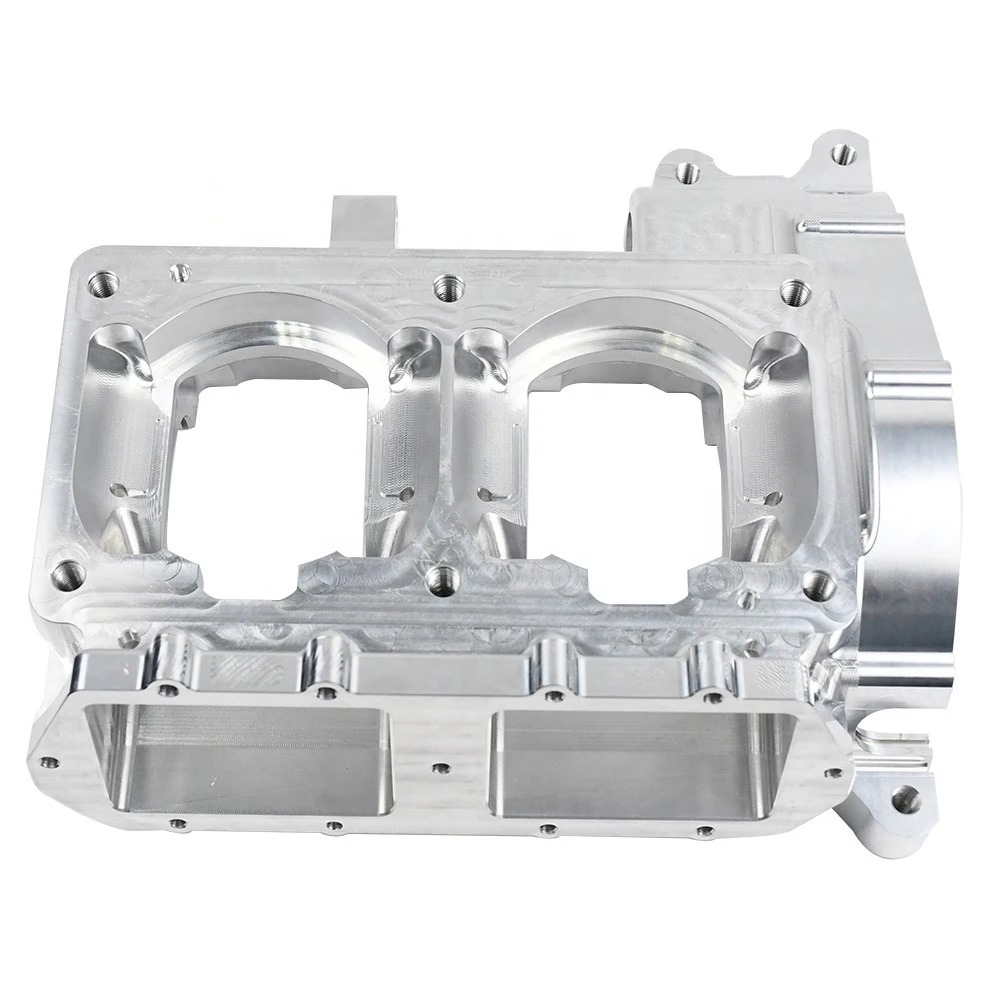
What makes CNC processing affordable
Price per part is a result, not an input. Here is the order in which the cost is built.
Five things that set the price of a machined part
A quote for machined parts is the sum of a few measurable inputs: setup time, cycle time, material, finishing, and inspection. Nothing else moves the number much. Setup is charged once per operation, so a part that needs three fixtures in three machines pays that cost three times. Cycle time is the cutting itself, and it depends on how much metal has to leave the blank and how hard the material is.
Material is often quoted as a line item, but the real cost is the drop. If a part is machined from a 100 × 100 × 50 mm block and the finished shape fits in a 60 × 60 × 30 mm envelope, you are paying for chips. Near-net blanks, castings, or extrusion stock reduce that gap. On aluminium this matters less; on 17-4PH or titanium the drop can exceed the machining cost.
Finishing and inspection sit at the end and are easy to under-budget. Anodizing a small batch, laser marking each part, and issuing a full dimensional report add steps that are not on the machine. They are still worth it when the drawing calls for them, but they should be quoted separately so you can see what each one costs.
- 1Setup countEach new fixture or machine orientation adds fixed cost regardless of quantity.
- 2Material dropStock size versus finished envelope decides how much you pay for chips.
- 3Cycle timeDriven by removal volume, material hardness, and tool reach.
- 4Finishing and inspectionQuoted per part; keep them visible instead of bundled.
When 5-axis lowers the bill instead of raising it
Five-axis gets a reputation for being expensive, and per machine hour it is. The saving comes from consolidation. A part with features on four faces normally needs three or four setups on a 3-axis mill, plus a fixture for each. On a simultaneous 5-axis center with a Ø400 mm rotary table, the same part can often be cut in one setup. Fewer setups means less handling, fewer datum transfers, and a smaller stack of tolerance error.
The break-even is a judgement call. If your part is a flat plate with holes on one face, 3-axis is cheaper and faster. If it has angled ports, compound curves, or tight true position between features on different faces, 5-axis usually wins on total cost even though the hourly rate is higher. We run 16 simultaneous 5-axis machining centers alongside 27 three-axis machines, so the recommendation is based on the geometry rather than on which machine is free.
Mill-turn centers handle another common case: parts that are turned and milled in the same cycle. A shaft with cross-holes and flats is a single setup on a mill-turn center instead of two machines and two fixtures. For runs above a few dozen pieces, that difference shows up clearly in the unit price.
Matching the process to the part
Use this as a first filter before requesting a quote.
| Part geometry | Suggested process | Why |
|---|---|---|
| Flat plate, holes on one face | 3-axis mill | One setup, short cycle, lowest hourly rate |
| Prismatic part, features on 4+ faces | 5-axis simultaneous | One setup replaces three or four fixtures |
| Shaft with cross-holes and flats | Mill-turn center | Turning and milling in a single cycle |
| Large frame, 4,000 mm long | 3-axis with 4,000 × 400 × 150 mm travel | Fits the long-travel machine, avoids splicing |
| Thin wall under 1 mm | 5-axis, low radial engagement | Better tool access, less chatter and rework |
| Prototype, one piece | 3-axis or 5-axis, as geometry requires | No tooling investment either way |
Batch size, tooling, and the point where cost drops
Per-part cost falls as quantity rises, but not in a straight line. The first drop comes when setup is amortized over more parts. The second, larger drop comes when a dedicated fixture or a soft jaw set is worth building. Below roughly 20 pieces, that tooling usually costs more than it saves. Above a few hundred, it almost always pays back.
Our shop has no minimum order quantity, so a single prototype and a 10,000-part run both go through the same quoting process. That does not mean they are priced the same way. A one-off is quoted for engineering attention and manual setup. A production run is quoted for fixture design, tool life, and inspection sampling. Comparing the two unit prices tells you very little.
For quantities where machining is no longer competitive, die casting and vacuum casting are worth a look. Die casting needs tooling, so it suits higher volumes with a stable design. Vacuum casting sits between the two and works well for bridge quantities in urethane. We quote all three, which means the recommendation is not tied to keeping work on a mill.
Where tight tolerance is worth paying for
Not every dimension needs ±0.005 mm. Holding that on a single bore is routine; holding it across a 400 mm part with a stack of features is a different job that needs temperature control and more inspection time. The sensible approach is to tolerance only what the function requires: mating bores, bearing seats, sealing faces, and alignment features. Everything else can sit at ±0.1 mm and cost far less to verify.
Surface finish follows a similar logic. As-machined at Ra 1.6–3.2 μm covers most brackets and housings. Ra 0.8–1.6 μm suits sliding contacts and visible covers. Ra 0.2–0.8 μm is for sealing faces and optical mounts, and it is usually reached by a finishing pass or a secondary operation rather than by slowing the whole cycle. Ask for the finish on the callout, not on the whole part.
We inspect 100% of parts before shipment and can supply reports on request. If a drawing has a tight tolerance that is not needed, the DFM note we return with the quote will flag it. Cutting an unnecessary tolerance is often the fastest way to reduce the price without touching the process.
How to read a quote and compare it fairly
Two quotes for the same part often differ because they assume different things. One may be priced for 3-axis with three setups, the other for 5-axis in one. One may include material certification, the other may not. Before comparing totals, check what is inside: material grade and stock form, number of setups, finishing, inspection level, and packaging.
Lead time is part of the price too. A quote that assumes a standard material stocked locally will be cheaper than one that has to order a special grade. We return a quotation and a free DFM analysis within 12 hours, and production can start within 24 hours once the drawing is released. Parts typically ship in 3–5 days. Those numbers depend on material availability and finishing, so treat them as a plan rather than a promise.
Confidentiality is handled the same way at any volume. Uploads are secure, and an NDA is available on request. If your drawings cannot leave your building without one, say so at the start so it is in place before files move.
Questions engineers ask before quoting
Is 5-axis always more expensive per part?
No. The hourly rate is higher, but the part may need only one setup instead of three or four. On parts with features on several faces, the total usually comes out lower on 5-axis.
On simple flat parts with holes on one face, 3-axis is cheaper. The geometry decides it.
What is the smallest quantity you will run?
One piece. There is no minimum order quantity, and a single prototype is quoted as a normal job.
Unit price at quantity one reflects setup and engineering time, so it is not comparable to a production run price.
Which materials keep the cost down?
Aluminium grades such as 6061, 6061-T6, and 6082 machine quickly and are widely stocked, so both material and cycle time stay low.
Stainless 303 and 304 are also common. Titanium, Inconel, and 17-4PH cut slower and cost more per part.
Can I get a price without sending a full drawing?
A STEP file plus a 2D drawing with tolerances and finish callouts gives the most accurate number.
If the drawing is not ready, send the model and note the critical features. We will quote with stated assumptions.
How do finishing operations affect the quote?
They are quoted as separate line items: anodizing, plating, powder coating, bead blasting, and laser marking each add cost and lead time.
Laser marking needs a minimum character height of 1.5 mm to stay legible.
What tolerances can you hold?
Down to ±0.005 mm (±0.0002 in) where the function requires it.
Holding that across a large part with a stack of features takes more inspection time, so it is quoted only where the drawing calls for it.
Send a drawing and get a costed answer
Upload your model and drawing. We return a quotation and a free DFM analysis within 12 hours, with the setups and finishing shown as separate lines.
12-hour quoteFree DFM analysis100% inspection before shipment









