
After So Many Years of Machining, Do You Know Trochoidal Milling?
Trochoidal milling is not a new trick. It is a tool path that trades radial engagement for arc length. This page explains how the path works, which slots and pockets suit it, and where the same path will cost you cycle time. Written for machinists, CAM programmers and process engineers who already run a mill.
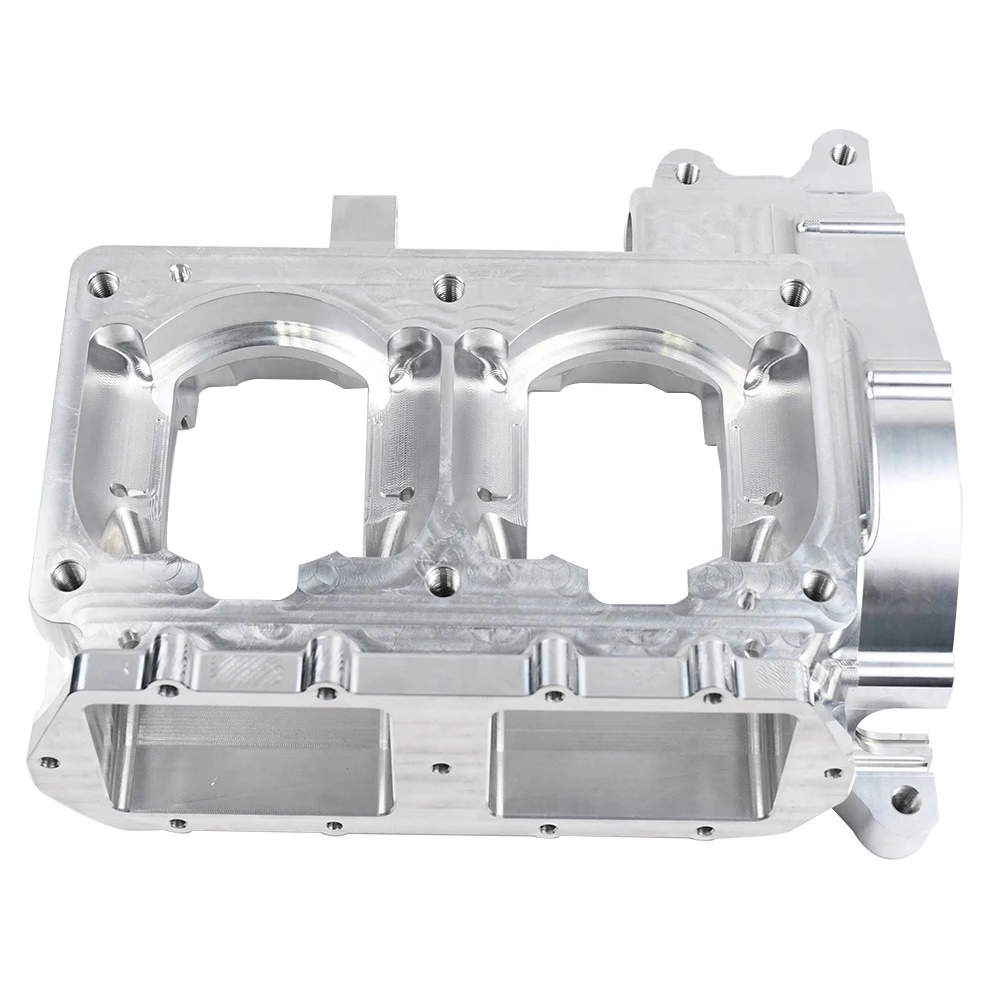
What Trochoidal Milling Actually Does
A conventional slot cut drives the cutter straight down the middle. The tool enters with a full 180° wrap, so half the flute length is buried in the material at the same time. Heat has nowhere to go and the chip has nowhere to curl. Most broken 6 mm end mills in aluminium or 304 stainless die in exactly that cut.
The trochoidal path changes the engagement. The tool travels along a small circle while the circle itself advances down the slot. The cutter sweeps an arc of 20° to 60° of the workpiece at any moment, never the full slot width. Each tooth takes a short, thick chip and then leaves the cut for most of the revolution.
The trade shows up the moment you watch the numbers. Radial engagement stays low, so heat leaves with the chip instead of soaking into the tool and the part. Axial depth of cut goes the other way. A cutter that would take 2 mm in a straight slot can run 1×D or more in a trochoidal pass.
Programmers who came up on straight-line pocketing often skip this path because it looks slower on screen. The arc moves are longer, and the feed rate looks low next to a full-width cut. On the machine the picture flips. The tool survives, the spindle load stays flat, and the part comes off with less bow.
Tool Selection and Cutting Parameters
Tool choice drives everything here. A variable-helix, variable-pitch carbide end mill with a relieved neck is the usual pick. The neck clearance lets the tool reach deeper without rubbing the wall behind the flutes, which is the failure mode in a deep trochoidal pass. Coatings help in steel and stainless; AlTiN and AlCrN hold up at the surface speeds this path produces.
Radial engagement sets the chip load. Keep it between 8% and 15% of the cutter diameter for most work, and let the CAM step-over control the arc width. Feed per tooth then rises well above a conventional slot value. In 6061 aluminium, a 10 mm cutter might run 0.10 mm per tooth at 12% radial engagement; in 304 stainless the same cutter drops to roughly 0.04 mm per tooth.
Axial depth is where the method earns its keep. Running 1×D to 2×D axial depth with a light radial bite spreads wear along the flute instead of concentrating it at the tip. The result is a more even tool life and fewer mid-run changes. Coolant should reach the cut, but through-spindle air blast often works better than flood in aluminium because it clears chips from the deep pocket.
Rigidity still matters. A long, thin cutter in a weak holder will chatter no matter how clever the path is. Shorten the gauge length where you can, and check runout at the tool tip before the first part. Runout above 0.01 mm turns one flute into the only flute that cuts.
Conventional Slotting vs Trochoidal Milling
Typical ranges for a 10 mm carbide end mill. Actual values depend on the machine, holder and material.
| Parameter | Conventional slot | Trochoidal pass |
|---|---|---|
| Radial engagement | 50–100% of Ø | 8–15% of Ø |
| Axial depth | 0.5×D or less | 1×D to 2×D |
| Chip thickness | Thin, varies | Thick and even |
| Heat path | Into tool and part | Out with the chip |
| Tool life (steel) | Short, tip wear | Longer, spread wear |
| Cycle time | Fast in shallow slots | Faster once depth grows |
| Best fit | Shallow, open pockets | Deep slots, hard alloys |
When the Path Pays Off, and When It Does Not
Deep slots in hard material are the clear win. A 40 mm deep, 12 mm wide slot in 17-4PH stainless is painful with a straight plunge. With a trochoidal path the cutter works its way down in light arcs and the load stays steady. The same logic applies to narrow ribs and deep pockets where chip evacuation is the real limit.
Thin-walled parts also benefit. Low radial engagement means lower cutting force pushing against the wall, so the part deflects less and finishes closer to nominal. On a 1.5 mm wall in aluminium, that difference shows up as a flat wall instead of a bowed one.
The method loses when the slot is shallow and open. Cutting a 3 mm deep groove 20 mm wide with arcs adds travel distance for no thermal benefit. A straight pass with a larger cutter is faster. The same goes for roughing a big open pocket where a face mill or a high-feed cutter moves more metal per minute.
Hardened tool steel above 50 HRC is a gray area. The path works, but cutter cost climbs and the arc moves need a rigid machine to hold tolerance. For one-off parts in that range, conventional roughing plus a finishing pass is often the cheaper route.
Short runs of simple geometry rarely justify the programming time. A CAM template for trochoidal roughing takes a while to tune. Once it is tuned, though, it gets reused on every deep-slot job in the shop.
Tolerances, Inspection and Machine Choice
Tolerance on a trochoidal pass depends more on the machine and the wall stiffness than on the path itself. Our 5-axis centers hold ±0.005 mm on finishing passes, and the light radial load makes that easier to repeat than a heavy slot cut. Surface finish on a trochoidal roughing pass lands around Ra 1.6–3.2 μm. A separate finishing pass brings it to Ra 0.8–1.6 μm, or Ra 0.2–0.8 μm on medical and optical work.
Chip evacuation is the hidden variable. Recutting chips is what kills tools in deep pockets. Air blast, through-tool coolant, or a short peck cycle every few arcs all help. Watch the chip shape: a proper trochoidal chip is a comma, not dust.
Machine choice follows the part. A 4,000 × 400 × 150 mm travel machine handles long extruded profiles where the slot runs the full length. Compact 500 × 500 × 450 mm centers are fine for smaller pockets. A Ø400 mm rotary table lets a 4-axis setup cut arcs on several faces without re-fixturing, which cuts the error stack.
Programming matters as much as hardware. Most CAM packages now include a trochoidal or dynamic roughing option. The default step-over is usually too aggressive for small cutters. Reduce it, raise the feed per tooth, and test on scrap before the first production part.
Common Questions
Does trochoidal milling need a special end mill?
Not strictly, but a variable-helix carbide cutter with a relieved neck makes the path reliable. The neck clearance prevents the shank from rubbing the slot wall in deep passes.
A standard square end mill will cut, though you may have to reduce axial depth to keep the tool from chattering.
How much radial engagement should I use?
Start between 8% and 15% of the cutter diameter. Below 8% the chip gets thin and rubs; above 15% the heat and load climb fast.
Adjust from there based on spindle load and chip color. In aluminium, a light straw chip is a good sign.
Is it faster than conventional slotting?
In deep slots, yes. Once axial depth passes roughly 1×D, the reduced number of passes usually wins on total cycle time.
In shallow, wide grooves a straight pass with a bigger cutter is still faster. The path adds travel distance without a thermal payoff.
Which materials suit it best?
Stainless 304 and 316, 17-4PH, titanium Ti-6Al-4V and Inconel all benefit because the low engagement keeps heat out of the cut.
Aluminium and brass work well too, mostly for chip evacuation in deep pockets rather than for tool life.
Can I hold tight tolerances with this path?
Yes, with a rigid setup. Light radial engagement lowers cutting force, so wall deflection drops and finishing passes repeat better.
We hold ±0.005 mm on finishing passes, and we run 100% inspection before shipment with reports on request.
Does the CAM software matter?
It does. You need a tool path that controls arc width and step-over directly, not a generic pocket routine.
Most modern CAM packages include a dynamic or trochoidal roughing option. Expect to tune the defaults for your cutter and material.
Send Us Your Deep-Slot Part
Tell us the material, slot depth and tolerance. We will come back with a process plan and a quote.
12-hour quote100% inspectionNDA on request









