
Aluminum CNC Processing Guide
This guide explains how aluminum behaves under the cutter, which alloys and tools hold up, and what tolerances and finishes are realistic. It is written for design engineers and buyers who need to decide whether a part should be machined from aluminum, and how to specify it so the first run comes back correct.
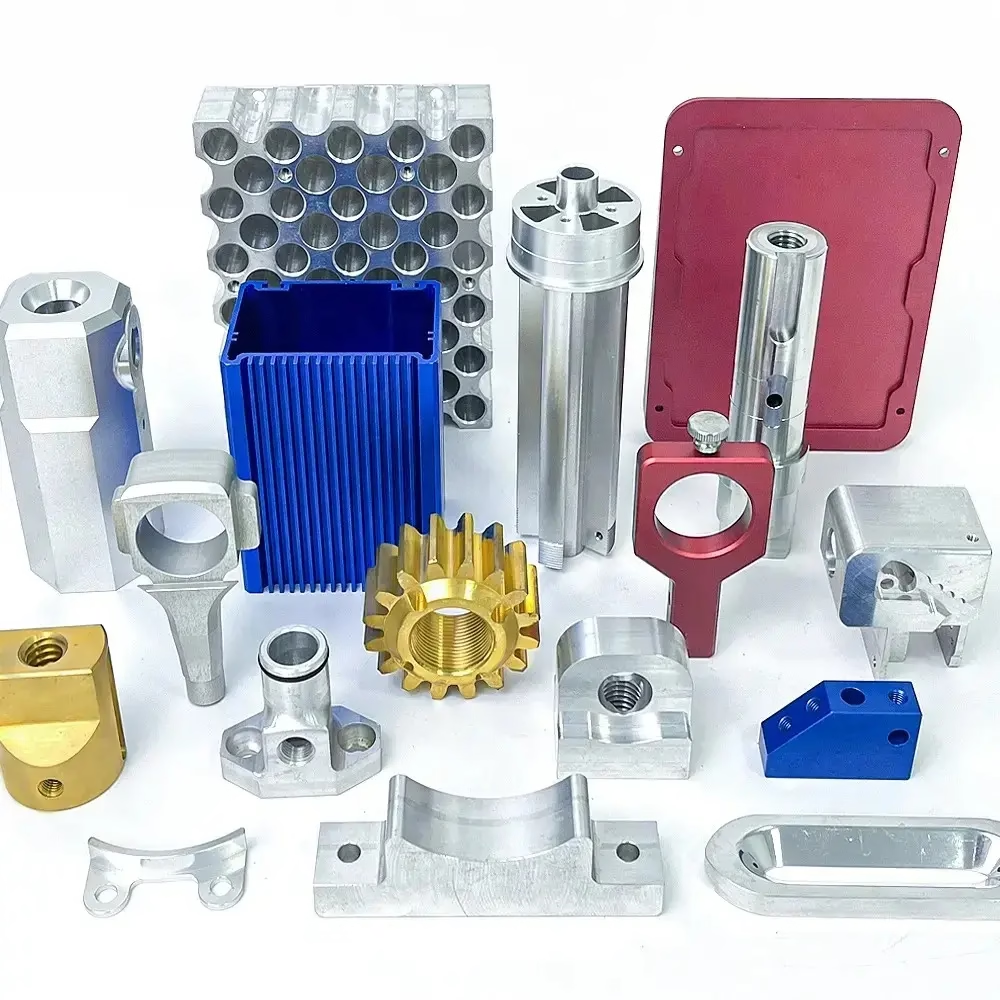
What Aluminum CNC Processing Actually Involves
Cutting aluminum is fast and forgiving compared with steel, but the same properties that make it easy to cut also cause the problems engineers run into: heat, burrs, and thin-wall deflection.
Choosing the Right Aluminum Alloy
Most aluminum parts fall into one of four alloy families, and the choice drives strength, corrosion behavior, and how the part machines. 6061 and 6061-T6 are the default for structural brackets, housings, and fixtures. They weld and anodize well, hold tight tolerances, and machine to a clean surface without drama. If you need a part that looks good straight off the machine, 6061 is usually the safe call.
Grade 2024 and 7075 are the high-strength options. 7075-T6 reaches roughly the strength of some steels while staying light, so it suits aerospace fittings, bicycle components, and stressed brackets. The trade-off is machinability and corrosion resistance: 7075 cuts cleanly but is less forgiving of poor tool paths, and 2024 needs a protective finish because it corrodes readily in moisture. Neither is a good fit for parts that will sit outdoors uncoated.
For enclosures and heat sinks, thermal conductivity matters more than yield strength. 6063 and 6082 extrude and machine well, and 5052 and 5083 bring excellent corrosion resistance for marine and chassis work. ADC12 is a die-casting alloy, so it belongs in a casting process rather than a machining one — if a drawing calls out ADC12 and the quantity is low, 6061 is usually the better substitute.
A quick rule: pick 6061 unless a load case or weight target forces you higher. Moving from 6061 to 7075 for a part that never sees real stress adds cost and finishing complexity without buying anything.
- 16061 / 6061-T6General purpose, welds and anodizes well, best all-round machinability.
- 27075 / 2024High strength, lower corrosion resistance, needs coating outdoors.
- 36063 / 6082Good for enclosures and heat sinks, moderate strength.
- 45052 / 5083Marine and chassis work where corrosion resistance leads.
Tooling and Cutting Parameters
Aluminum cuts at high surface speeds because it is soft and conducts heat away quickly. Carbide tooling is standard. Two-flute and three-flute end mills with polished flutes clear chips well in deep pockets; for finishing passes, a higher flute count leaves a better floor and wall if chip evacuation is not the constraint.
The real enemy is built-up edge. Aluminum tends to weld onto the cutting edge at low speeds, which smears the surface and kills tool life. Keep the spindle speed up, use coolant or high-pressure air, and avoid dwelling in the cut. A sharp, uncoated or ZrN-coated tool usually outperforms a heavily coated one on aluminum because the coating adds friction rather than removing it.
Spindle speed and feed are set by the alloy and the tool diameter, but the constraint most shops hit is not the cutter — it is holding the part. Aluminum deflects under clamping and cutting force, so thin walls, deep pockets, and long slender parts need support, light radial passes, and often a rough-then-finish strategy with a stress-relief pause.
If you are designing for machining, keep wall thickness at 0.8 mm or above where possible, avoid corners tighter than the tool radius, and give the cutter a clear path in and out. These three details decide whether a part machines in one setup or five.
- 1Flute count2–3 flutes for chip clearance; more for finishing where evacuation is fine.
- 2CoatingZrN or uncoated carbide; heavy coatings add friction on aluminum.
- 3CoolantFlood coolant or high-pressure air to control built-up edge.
- 4Wall thicknessKeep at 0.8 mm or above to limit deflection.
When Aluminum CNC Processing Fits — and When It Does Not
Machining wins when the part has tight tolerances, complex geometry, or low to medium volume. A bracket with counterbored holes, a manifold with internal channels, or a housing with a sealing face all belong on a mill. Setup and programming are one-time costs, so the per-part price falls steeply as quantity rises, and there is no tooling to amortize.
It loses when the part is a simple, thin, high-volume shell. Die casting and sheet metal beat machining on unit cost once quantities climb into the thousands, because they spread a tool over many parts while machining pays for spindle time on every one. If a part is mostly flat with a few bends, sheet metal fabrication is almost always cheaper.
Prototyping is the other clear fit. One-off and low-volume runs let you test fit and function before committing to tooling, and revisions cost only a new program rather than a new mold. From a single prototype to 10,000+ part runs, the same process scales without a tooling change.
A useful test: if the geometry would need a mold that costs more than the parts you expect to sell, machine it. If the geometry is simple and the volume is high, cast or form it.
Aluminum Machining Quick Reference
Typical values for common alloys and finishes. Confirm against your drawing before quoting.
| Alloy / Finish | Typical Use | Notes |
|---|---|---|
| 6061-T6 | Brackets, housings, fixtures | Best all-round; welds and anodizes well |
| 7075-T6 | Aerospace, stressed parts | High strength; coat for outdoor use |
| 2024-T4 | Aircraft structures | Poor corrosion resistance uncoated |
| 6063 / 6082 | Enclosures, heat sinks | Moderate strength, good finish |
| 5052 / 5083 | Marine, chassis | Excellent corrosion resistance |
| Clear anodize | General protection | Keeps machined look; thin buildup |
| Hardcoat anodize | Wear surfaces | Thicker, harder, tighter tolerance impact |
| Bead blasting | Cosmetic prep | Uniform matte before anodize |
Tolerances, Finishes, and Inspection
Standard machining holds ±0.005 mm on critical features, which is tight enough for most sealing faces, bearing bores, and mating surfaces. Not every dimension needs that. Tightening a tolerance that carries no function adds inspection time and cost, so mark only the features that matter on the drawing.
Surface finish is chosen by function, not by habit. As-machined aluminum sits around Ra 1.6–3.2 μm; a finishing pass reaches Ra 0.8–1.6 μm, and fine work gets to Ra 0.2–0.8 μm. If the part will be anodized, remember that coating adds thickness and can round sharp edges, so specify the pre-finish dimension accordingly.
Anodizing is the most common finish for aluminum, available in clear, colored, hardcoat, and conductive variants. Beyond that, we run electroless nickel, zinc, silver, and gold plating, powder coating, black oxide, bead blasting, tumbling, brushing, and polishing. Laser marking holds a minimum character height of 1.5 mm, which is the practical floor for legible text.
Every part is inspected before shipment: raw material check, in-process monitoring, and final inspection, with reports available on request. For parts where a defect means a field failure, send the critical dimensions and we will build the inspection plan around them.
Frequently Asked Questions
Which aluminum alloy should I pick for a general-purpose part?
6061-T6 in most cases. It machines cleanly, welds, anodizes well, and holds tight tolerances. Move to 7075 or 2024 only when a real load case or weight target demands the extra strength.
Is aluminum CNC processing suitable for high-volume production?
Yes, up to a point. Machining has no tooling to amortize, so unit cost falls steadily with quantity and the process scales from one prototype to 10,000+ part runs.
For very simple, thin, high-volume shells, die casting or sheet metal usually wins on unit cost because the tool is spread across thousands of parts.
What tolerances and finishes can I expect?
We hold ±0.005 mm on critical features, with surface finishes from Ra 1.6–3.2 μm as-machined down to Ra 0.2–0.8 μm for fine work. Specify only the dimensions that carry function.
How do I design an aluminum part so it machines well?
Keep walls at 0.8 mm or above, avoid internal corners tighter than the cutter radius, and give the tool a clear path in and out. These choices decide how many setups the part needs.
Can aluminum parts be anodized after machining?
Yes. Clear, colored, hardcoat, and conductive anodizing are all available, along with plating, powder coating, bead blasting, and laser marking. Remember that anodizing adds thickness, so set pre-finish dimensions with that in mind.
How do I send files and keep the design confidential?
Uploads are secure and confidential, and we can sign an NDA on request. Send your drawings and we will return a quotation and free DFM analysis within 12 hours.
Send Your Aluminum Part for Review
Upload a drawing and we will return a quote and DFM feedback within 12 hours, no minimum order quantity.
12-hour quote100% inspection±0.005 mm toleranceNDA available









