
CNC aluminum processing: how it works and where it stops working
Aluminum cuts fast, holds tight tolerances, and takes almost any finish. That is also why it gets misused. This page walks through alloy behavior, tooling, achievable tolerances, and the limits you hit when walls get thin or tolerances get tight.
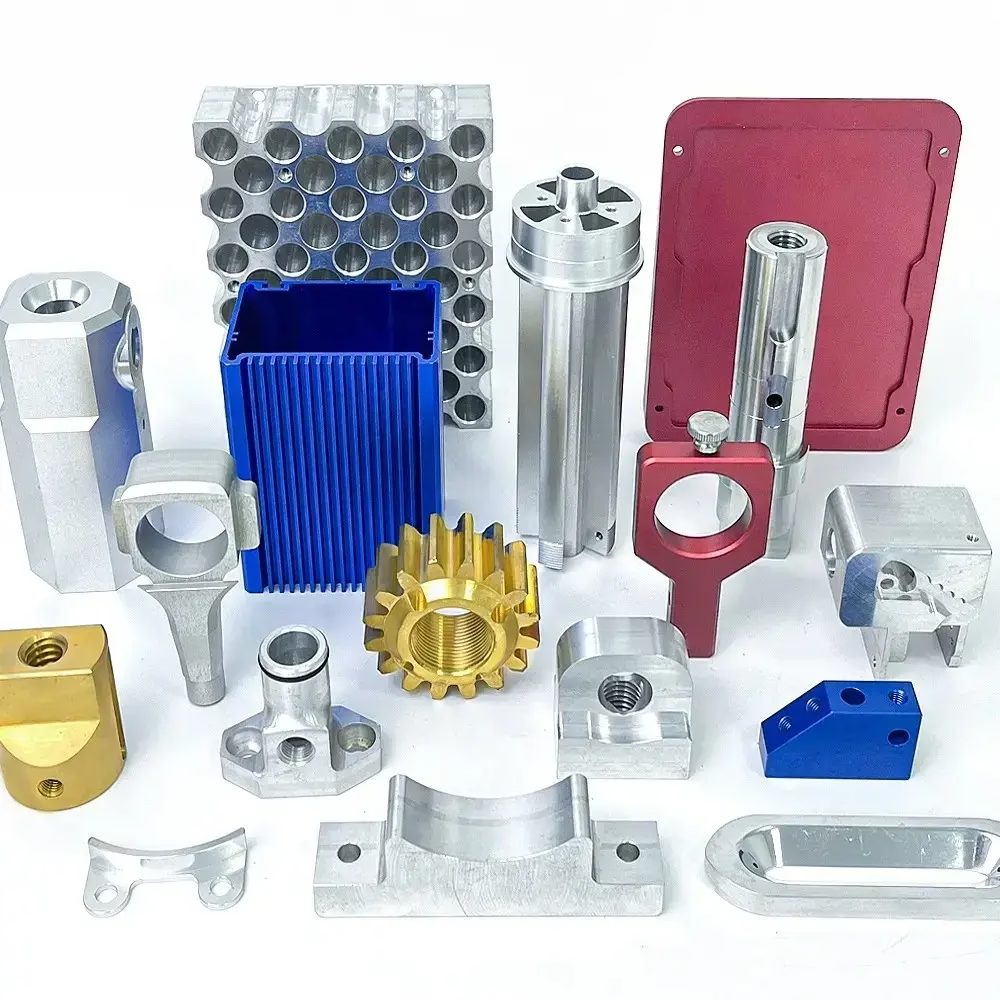
Why aluminum behaves the way it does under the cutter
Aluminum is soft, light, and a good conductor of heat. Those three properties drive almost every decision in this process. Cutting forces are low compared with steel, so you can take deeper passes and spin the tool faster. Heat leaves the cut zone quickly through the chip. The part itself stays cooler, which keeps dimensions stable during long runs.
The flip side is built-up edge. Soft alloys tend to weld onto the cutting edge when speeds are too low or the tool has a neutral rake. Once that happens, surface finish drops and the edge dulls fast. Two-flute and three-flute carbide tools with polished flutes and high rake angles avoid most of it. Coated inserts help on 7075, where the alloy is harder and more abrasive.
Chip evacuation matters more than most people expect. Aluminum chips are light and bulky, and they pack into pockets and deep slots. Through-spindle coolant or strong air blast clears them. Recutting a chip is the fastest way to wreck a finish and a tolerance at the same time.
Picking the right aluminum grade for machining
Most machined parts use 6061-T6. It machines cleanly, welds well, takes anodizing evenly, and costs less than the high-strength grades. If your part carries moderate loads and needs a good surface, start here. It is the default for brackets, housings, fixtures, and most prototypes.
2024 and 7075 are stronger but fussier. Grade 2024 has copper in it, which improves fatigue strength and machines to a fine finish, though it is less corrosion resistant and usually needs a protective coating. Grade 7075 offers the highest strength of the common grades and holds thin walls well, but it is more abrasive on tooling and responds unevenly to anodizing.
For welded assemblies or parts exposed to salt air, 5052 and 5083 are better choices. They form and weld easily and resist corrosion, but they are gummy to machine and harder to bring to a fine finish. Grade 6082 sits between 6061 and 7075 in strength and machines well in Europe, where it is common.
- 16061-T6Default for general machined parts. Good finish, easy anodizing.
- 27075-T6High strength, thin walls, aerospace brackets. Heavier tool wear.
- 32024-T4Fatigue resistance. Needs coating for corrosion.
- 45052 / 5083Welded, marine, and formed parts. Gummy to cut.
What tolerances aluminum actually holds
Aluminum holds ±0.005 mm on critical features when the setup is right, the tool is sharp, and the part is rigid enough. That number is not universal. It applies to a specific bore, slot, or face, not to every dimension on a drawing. Machining an entire part to that band multiplies cost for no functional gain.
The real limit is often thermal, not mechanical. Aluminum expands about twice as fast as steel. A 300 mm part can grow or shrink 0.02 mm or more across a normal shop temperature swing. If you need tight tolerances on a long part, let it stabilize in the inspection room before final cuts and measurement.
Thin walls are the other boundary. Below roughly 1 mm wall thickness, deflection and chatter take over. You can still machine it, but expect slower feeds, lighter passes, and more supports. Sometimes a redesign with a rib or a thicker section costs less than fighting the geometry.
Surface finishes and what they change
As-machined aluminum lands around Ra 1.6–3.2 μm with a sharp tool and a stable setup. That is fine for most internal parts. Visible surfaces usually need better. Reducing feed per tooth and using a wiper insert gets you to Ra 0.8–1.6 μm without a second operation.
Getting to Ra 0.2–0.8 μm takes more care. You need a rigid setup, a fresh tool, and a light finishing pass. Aluminum smears rather than shears at low speeds, so the finish pass runs faster than you might expect. Coolant choice matters too. Some alloys stain if you leave the wrong fluid on them overnight.
Anodizing changes dimensions. Clear anodizing adds roughly half the oxide thickness to each surface, so a 20 μm coating grows a bore by about 20 μm. If a bore has a tight tolerance and gets hardcoat anodized, machine it undersize on purpose. Talk to the finisher before you set the drawing, not after.
When aluminum is the wrong choice
Aluminum loses stiffness quickly as parts get larger. It has about one third the elastic modulus of steel. A long, slender aluminum beam deflects three times as much under the same load. If stiffness is the design driver, steel or a different geometry may cost less than adding aluminum thickness.
Wear surfaces are another limit. Bare aluminum galls against other metals and wears fast in sliding contact. If your part has a bearing bore or a sliding interface, plan for a steel insert, a hardcoat anodized surface, or a different material from the start.
High-temperature service is the third boundary. Aluminum loses strength well below the temperatures where steel is still comfortable. If the part sees sustained heat, check the alloy's temperature limit before you commit. For most room-temperature parts, none of this applies.
Aluminum grades compared for machining
Ratings reflect typical shop experience, not absolute limits.
| Grade | Machinability | Strength | Best for |
|---|---|---|---|
| 6061-T6 | Excellent | Medium | General parts, housings, brackets |
| 6082-T6 | Excellent | Medium-high | Structural parts, European drawings |
| 7075-T6 | Fair | Very high | Aerospace, thin walls, high load |
| 2024-T4 | Good | High | Fatigue-critical, needs coating |
| 5052 / 5083 | Poor | Low-medium | Welded and marine assemblies |
| 6063 | Excellent | Low | Extrusions, cosmetic frames |
| ADC12 | Good (cast) | Medium | Die-cast housings, then machined |
The short answer
Choose aluminum when you want fast cuts, low weight, and a good finish on parts that stay near room temperature. Choose steel or titanium when stiffness, wear resistance, or heat resistance drives the design. If you are not sure, send the drawing and we will tell you which way it should go.
Common questions
Can you machine aluminum to ±0.005 mm on every dimension?
No, and you should not ask for it. That tolerance is achievable on specific features where it matters, such as a bearing bore or a mating face.
Applying it to the whole drawing raises inspection time, scrap risk, and cost without improving function.
Which aluminum alloy is easiest to machine?
6061-T6 and 6063 machine the cleanest. They produce short chips, hold a good finish, and cause little tool wear.
5052 and 5083 are the hardest of the common grades because they are gummy and tend to weld to the cutter.
Does anodizing change my part dimensions?
Yes. The oxide layer grows both outward and, to a smaller degree, inward. A 20 μm clear anodize adds roughly 20 μm per coated surface.
For tight bores or threads, specify the pre-anodize dimension or mask the feature.
Why does my aluminum part warp after machining?
Residual stress in the stock releases as you remove material. Extruded and rolled plate carries more stress than cast stock.
Rough, stress-relieve if needed, then finish. Leaving even material on both sides also helps.
What is the minimum wall thickness you can hold?
Around 0.8–1.0 mm on a stable part with good support. Below that, deflection and chatter dominate and the tolerance widens.
If the design needs thinner walls, a rib or a change in geometry usually costs less than fighting the cut.
Send your aluminum drawing and get a real answer
We review the alloy, geometry, and tolerances, then tell you what is achievable and what is not. Quote and free DFM analysis within 12 hours.
12-hour quote100% inspectionNo minimum order quantity
More from the shop floor
We publish setup notes, tooling trials and inspection data from the factory floor.











