
Appropriate application fields for CNC machine robots
This page is for manufacturing engineers and buyers deciding whether a robot-tended CNC cell suits their part. It covers the part families that fit, the batch sizes where the economics change, and the signs a cell will cost more than it saves.
How to read this guide
Five application fields, one selection table, and the boundary conditions where robot tending stops paying for itself.
Automotive and EV drivetrain parts
Automotive is the field where robot tending pays back fastest. A single engine or transmission family can run for years, and the casting geometry rarely changes once tooling is frozen. That repeatability is what a cell needs.
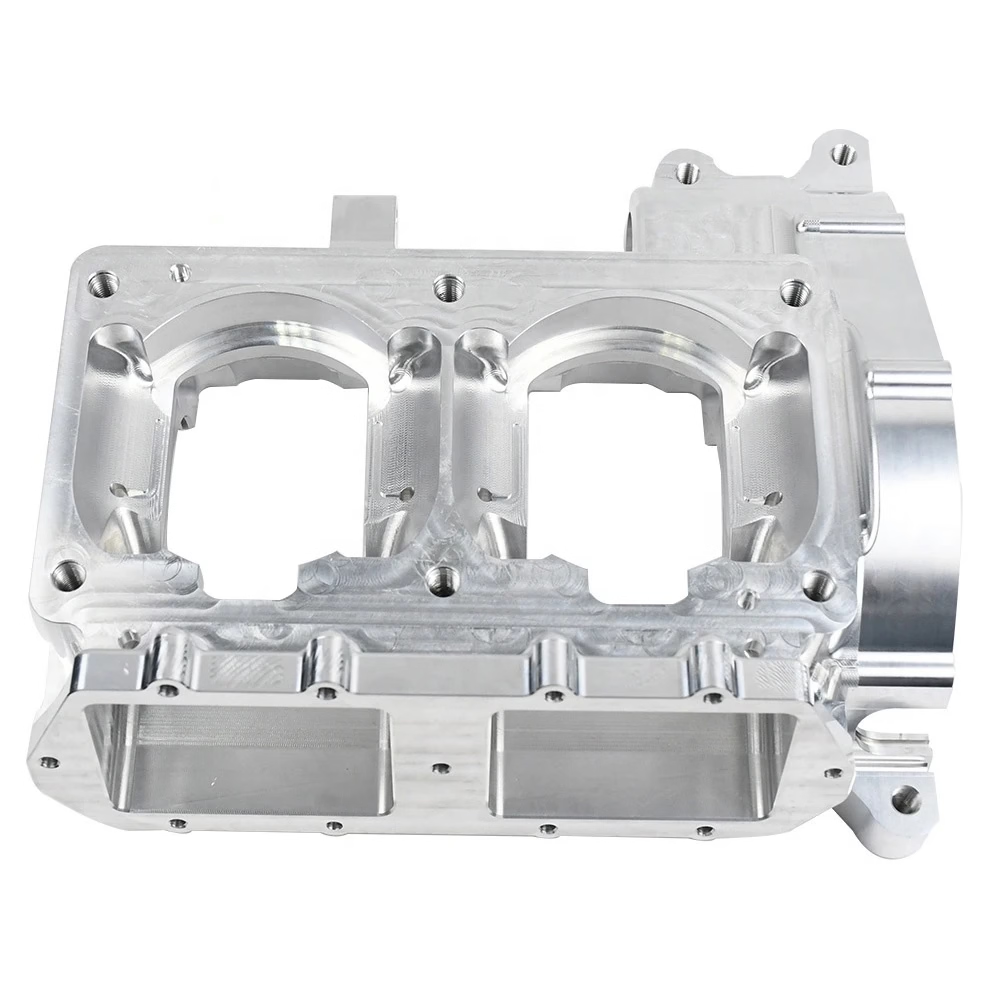
Engine blocks, cylinder heads, transmission housings and EV motor housings all share the same shape profile: heavy, cast, and full of faces that need milling, drilling and boring in one setup. On a 4-axis or mill-turn center with a gantry loader, cycle times drop because the operator is no longer opening and closing the door.
Volume matters more than part size here. Runs below roughly 50 pieces per month usually lose money against a manual setup, because programming, gripper jaws and fixture offsets eat the savings. Push past a few hundred pieces a month and the arithmetic flips.
Tolerances in this field are usually ±0.02 mm or looser on non-critical faces, but bore roundness and deck flatness are tighter. Those are the features that decide whether the cell holds capability over a full shift.
- 1Good fitCast or forged housings, 2–15 kg, stable geometry, monthly volume above 50
- 2Poor fitOne-off brackets, parts under 200 g, or geometry that changes every revision
Aerospace structural and engine components
Aerospace rewards the cell for a different reason: material cost. Titanium and Inconel billets are expensive, so a scrapped part hurts far more than the machine time saved. Robot loading removes the handling marks and the wrong-orientation errors that come from manual clamping.
Typical candidates are wing ribs, brackets, actuator housings and engine mounts. Most of these are thin-walled after roughing, which means the gripper has to hold a part that is already flexible. Vacuum cups or soft jaws with low clamping force are the usual answer.
Traceability is the real constraint. Every part needs a heat lot, a machine record and an inspection report. A cell makes this easier because the load and unload events are logged automatically, but only if the cell is tied into the shop's MES.
The catch is setup time. Aerospace runs are often 5 to 50 pieces, and a new fixture can take a full shift to prove out. Below about 20 pieces, manual machining on a 5-axis center is usually the cheaper route.
Medical implants and surgical instruments
Medical parts are small, precise and often made from difficult materials. Cobalt chrome, titanium and 17-4PH stainless all show up, and surface finish is measured in Ra 0.2–0.8 μm on bearing and mating faces.
The parts that suit automation are bone plates, instrument handles, drill guides and housing components. They are typically 20–300 g, run in batches of 100 to several thousand, and need the same operation repeated with almost no variation.
Cleanliness is the reason many shops hesitate. Cutting fluid carryover, chips trapped in pockets, and gripper contact all create contamination risk. A cell needs an in-process wash or air blast before the part leaves the work envelope.
Inspection is the other gate. Medical work at ISO 13485 demands documented dimensional records. If the cell cannot feed a CMM or vision station automatically, an operator still has to handle every part, which removes most of the labor saving.
Energy, oil and gas hardware
Energy hardware is big, heavy and made in low volumes. Valve bodies, pump housings, downhole tool components and flanges are common, and many of them exceed 500 mm in one dimension.
Large parts change the robot choice. A 200 kg valve body needs a rail-mounted or gantry robot, not a pedestal arm, and the floor space grows with it. Payback comes from safety and consistency rather than speed.
Batch sizes here are often 10 to 100 pieces. That is a gray zone. If the same family repeats four times a year, a cell with quick-change jaws can still work. If every order is a new drawing, keep it manual.
Material is usually 4130, 4140, 17-4PH or duplex stainless. These cut slowly, so the machine is the bottleneck, not the operator. When the spindle is busy 90 percent of the time, a robot adds little.
Electronics, robotics and general industrial parts
This is the broadest field and the one where the decision is least obvious. Heat sinks, motor housings, gearbox plates, robot joint components and enclosure panels all land here, in aluminium and plastics most of the time.
Aluminium cuts fast. A 6061 housing might run a 3-minute cycle, which means the operator spends a large share of the shift just loading and unloading. That is the clearest case for automation.
Plastics behave differently. POM and PEEK parts are light, static-prone and easy to scratch, so gripper design matters more than robot speed. Soft pads and low clamping pressure are mandatory.
The general rule across all five fields: automate the operation, not the part. If one setup repeats hundreds of times a month, it is a candidate. If the part only passes through once, it is not.
Field-by-field fit check
Use this to sanity-check a candidate part before quoting a cell.
| Field | Typical part | Batch size that works | Main blocker |
|---|---|---|---|
| Automotive / EV | Engine and motor housings | 50–10,000 per month | Low volume per variant |
| Aerospace | Wing ribs, actuator housings | 20–200 per run | Fixture prove-out time |
| Medical | Bone plates, instrument handles | 100–5,000 per run | Cleanliness and traceability |
| Energy / oil and gas | Valve bodies, flanges | 10–100 per run | Part weight and floor space |
| Electronics / robotics | Heat sinks, motor housings | 200+ per month | Gripper design for soft parts |
Questions engineers ask before committing
What is the smallest batch size where a robot cell makes sense?
It depends on cycle time and how many setups are involved. As a working number, one operation repeated 50 times a month is roughly the floor for a simple two-jaw gripper on a lathe or 3-axis mill.
Below that, programming and gripper changes usually cost more than the labor they replace. Above 200 repeats a month, the payback is normally under a year.
Can a robot handle parts that need five-sided access?
Yes, but not with a single gripper position. A 5-axis machine with a trunnion can present most faces in one setup, so the robot only loads and unloads once.
If the part needs two separate operations on different machines, the cell needs either two robots or a part-flipping station between them.
How does part weight limit the choice?
Pedestal robots commonly handle 5–20 kg payloads comfortably. Above that, you move to larger arms or gantry systems, and the cost and footprint rise sharply.
For parts over 50 kg, a rail-mounted robot with a dedicated load station is usually the practical option.
What tolerance can a robot-tended cell actually hold?
The robot does not set the tolerance, the machine does. We hold ±0.005 mm on critical features across our 5-axis and mill-turn centers, and robot loading does not change that.
What matters is repeatable seating. If the fixture locates the part the same way every cycle, tolerance is unaffected. If the gripper leaves chips on the locating face, it is not.
Which materials cause the most trouble in an automated cell?
Sticky aluminium alloys and gummy plastics are the usual offenders. They produce stringy chips that wrap around the gripper and build up on locating surfaces.
Titanium and Inconel are harder on tooling but easier on handling, because the chips break cleanly and the parts are stiff.
Do we need to redesign the part for robot loading?
Usually not, but a few features help. A flat locating face, a chamfer on the entry edge, and a grip zone that is not a finished surface all make the cell more reliable.
If the part is already in production, we review the drawing and suggest the smallest change that gets the job done.
Send us the part and the volume
We will tell you whether the job suits a robot-tended cell or a manual setup, and quote either way.
12-hour quoteFree DFM analysis±0.005 mmNo minimum order quantity









