
Are Chinese CNC Machines Any Good?
This page is for design engineers and procurement staff who need a straight answer before sending a drawing overseas. We cover what modern Chinese CNC equipment actually holds, which part features expose a weak supplier, and the checks that separate a real precision shop from a broker with a website.
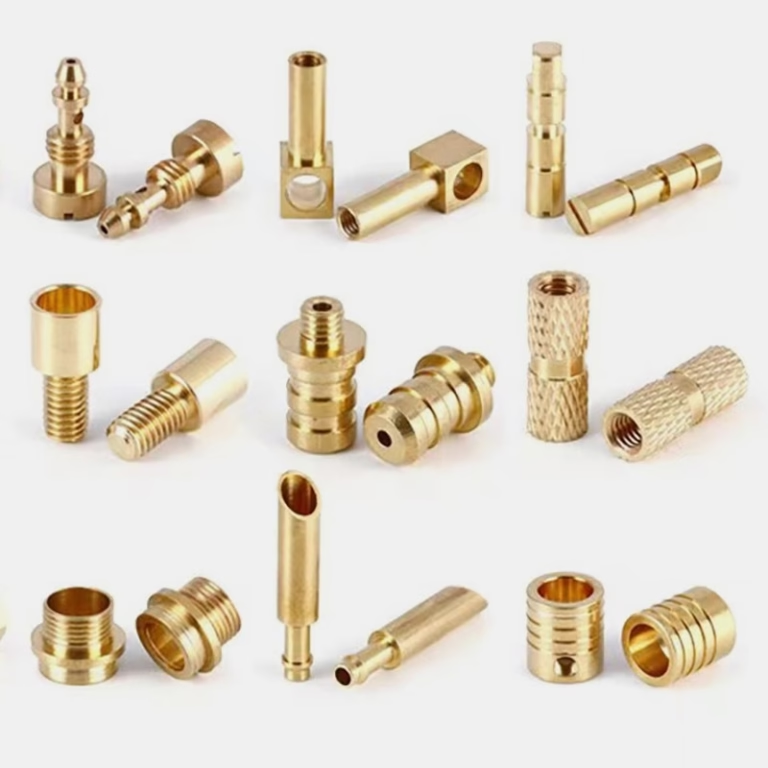
What Changed, and What Still Varies
The machine brand matters less than the people running it.
The Hardware Side: Machines, Spindles, and Axis Count
Twenty years ago a Chinese machine tool was a copy of a Taiwanese or Japanese design, built with softer castings and a control that drifted. That gap has largely closed. Today the leading builders source ballscrews from Japan or Taiwan, use linear guides from the same tier-one vendors as European OEMs, and pair them with Fanuc, Siemens, or Mitsubishi drives.
What matters for your part is not the country on the nameplate but the machine class the job is assigned to. A simultaneous 5-axis machining center with a rotary table holds position differently than a 3-axis mill with a vise. Ask which machine will run your part, and ask for its travel envelope and spindle hours.
At our Dongguan and Singapore plants we run 127 high-precision CNC machines: 16 simultaneous 5-axis centers, 12 four-axis mills, 27 three-axis machines, and 16 mill-turn centers. Maximum processing size is 4,000 mm, and the largest travel is 4,000 × 400 × 150 mm. That range covers everything from a Ø400 mm rotary-table job to a long extrusion profile.
Machine capability is only the entry ticket. The difference between a supplier that hits ±0.005 mm and one that argues about it usually comes down to thermal management, tool life tracking, and whether anyone actually reads the inspection report before the part ships.
- 15-axis simultaneousComplex contoured surfaces, undercuts, one-setup geometry
- 2Mill-turnShafts and housings with both turned and milled features
- 3Large travelParts up to 4,000 mm without splicing
Machine Classes and What They Suit
Match the part feature to the machine before you compare prices.
| Machine type | Typical work | Practical limit |
|---|---|---|
| 5-axis simultaneous | Impellers, brackets, contoured housings | ±0.005 mm on rigid setups |
| 4-axis mill | Multi-face parts, drilled patterns | One rotary axis, indexed |
| 3-axis mill | Plates, simple pockets, flat faces | Fastest cycle, lowest rate |
| Mill-turn | Shafts, bushings, turned-milled hybrids | Ø400 mm rotary table |
| Large gantry | Long profiles, frame rails | 4,000 × 400 × 150 mm travel |
How to Tell a Precision Supplier From a Reseller
The fastest filter is the DFM response. Send a drawing with one tight feature and one ambiguous callout. A real engineering team returns marked-up feedback within a day, flags the datum scheme, and asks about function. A trading company forwards your file and asks for quantity.
Next, ask for the inspection method tied to your tolerance. A ±0.005 mm callout on a bore needs a CMM or a bore gauge with known calibration, not calipers. If the supplier cannot name the instrument and the calibration interval, the tolerance claim is marketing.
Certifications help, but read the scope. ISO 9001:2015 covers quality systems broadly. IATF 16949:2016 and ISO 13485:2016 add automotive and medical requirements, and ISO 27001:2022 covers information security, which matters if your drawings are sensitive. We hold all four.
Finally, look at material handling. A supplier that stocks 6061, 7075, 17-4PH, and Ti-6Al-4V in known mill certs will not stall your job waiting on a plate. One that quotes anything and buys per order will.
Where Chinese CNC Work Still Falls Short
Not every job belongs overseas. If your part needs a signed ITAR flow-down, domestic source restrictions, or a government-approved facility, keep it local. No commercial shop in Dongguan can substitute for that paperwork.
Very low-volume exotic work can also be a poor fit. If you need one part in a material nobody stocks, freight and minimum mill buys can erase the labor saving. Ask for the material lead time before you commit.
Communication is the other variable. Time zone gaps of 12 to 15 hours mean a question asked at 4 pm Eastern gets answered the next morning. That is fine for a two-week build and painful for a same-day iteration.
None of these are reasons to avoid Chinese CNC machines. They are reasons to match the job to the supplier and to write the requirements down.
- 1ITAR or export-controlledKeep domestic unless the shop is separately approved
- 2Exotic single-pieceCheck material lead time and freight before quoting
- 3Same-day iterationTime zone gap slows the loop; plan for it
What a Controlled Job Looks Like
A well-run job starts before the spindle turns. We check the raw material cert against the drawing, confirm the datum scheme, and lock the setup sheet. In-process monitoring catches drift on long cycles rather than at final inspection.
Finishing is often where tolerance gets lost. Anodizing adds thickness, heat treatment moves geometry, and polishing can round an edge you dimensioned. Sequence matters: machine, stress relief, finish, then final measure. We plan that order at quoting, not after the first reject.
Every part we ship gets 100% inspection, and reports are available on request. That is not a slogan. It is the only way to keep a 99.99% qualification rate on runs that mix prototypes with 10,000+ piece orders.
If you are weighing whether Chinese CNC machines are any good for your project, send the drawing. The DFM feedback will tell you more in twelve hours than any capability brochure.
Common Questions
Can Chinese CNC shops really hold ±0.005 mm?
Yes, on the right machine and setup. Tight tolerance depends on rigidity, thermal control, and inspection, not nationality.
Ask which machine runs the feature and how it is measured. If the answer is vague, the tolerance is not real.
How do I verify a supplier before sending production?
Start with a paid prototype or a small batch. Review the inspection report against your drawing.
Ask for the calibration records of the instruments used. A CMM report with a traceable calibration date is a good sign.
What about intellectual property and NDAs?
We sign NDAs on request and treat uploads as confidential. Our information security is covered by ISO 27001:2022.
For sensitive programs, agree on data handling in writing before you release drawings.
Which materials are stocked versus bought per order?
Aluminum grades like 6061, 7075, and 6082, plus common stainless and steels, move fastest because they are widely available in the region.
Exotic alloys and titanium can add lead time. Confirm material availability before locking a schedule.
What lead time should I expect?
Quotation and free DFM analysis come back within 12 hours. Production can start within 24 hours of approval, and parts typically ship in 3–5 days.
Complex parts and exotic materials extend that. The schedule is confirmed at quoting, not assumed.
Is there a minimum order quantity?
No minimum. We run from a single prototype to 10,000+ piece runs.
Prototype and production can share the same setup sheet, which reduces the risk of a spec change between stages.
Send a Drawing, Get a Straight Answer
Upload your file and we return a quote plus DFM feedback within 12 hours. NDA available on request.
12-hour quote100% inspectionNo minimum order









