
What Are 5 Axis CNC Machines Good For?
This page explains what 5 axis cnc machines good for in real shop terms: which geometries need the extra rotary axes, how tolerance and surface finish improve, and when a 3-axis machine is still the cheaper answer. Written for design engineers and sourcing teams who have to pick a process, not a slogan.
In this article
- 1
- 2
- 3
- 4
- 5
- 6
What 5 Axis CNC Machines Good For: The Core Mechanism
A 3-axis mill moves the part under a spinning tool in X, Y and Z only. The tool axis always points straight down. Every angled face, every hole drilled into a side wall, every undercut has to wait for a second or third setup, because the part must be re-clamped at a new angle before the tool can reach it.
A 5-axis machine adds two rotary axes. On a trunnion or table-table layout, the part tilts and rotates while the tool stays vertical, or the spindle itself pivots. Either way the cutting tool can approach the workpiece from almost any direction in a single setup. That is the whole idea behind 5 axis cnc machines good for complex geometry: one clamping, many faces.
The practical gain is not just reaching more surfaces. It is that the tool can stay normal to the surface. When a ball-nose cutter meets a curved wall at an angle, the effective cutting diameter shrinks and the finish turns patchy. Tilting the tool axis keeps the contact point consistent, which is why 5-axis work often shows better surface texture on contoured surfaces.
A second gain is stiffness. A short, rigid tool holder can reach a deep cavity that would need a long, thin tool on a 3-axis machine. Less tool overhang means less chatter, and chatter is what forces operators to slow down and take light passes.
- 1One setup, many facesAngled holes and side features cut without re-clamping.
- 2Normal tool contactTilting keeps the contact point stable on curved walls.
- 3Shorter tool overhangStiffer cutting in deep pockets, less chatter.
Which Part Geometries Actually Need Five Axes
Start with the number of distinct tool approach directions. If a part has features that can all be reached from the top, a 3-axis machine will do it faster and cheaper. If three or more faces carry drilled holes, milled pockets or sealing surfaces that must line up to each other, 5-axis starts to win because the relationship between those features is fixed by one setup instead of three.
Impellers, turbine blades, propellers and bladed disks are the classic case. The blade surfaces are twisted and ruled, and the root fillet blends into a hub. There is no flat reference to clamp against. On a 5-axis machine the tool follows the blade surface continuously and the root radius is cut in the same pass.
Medical and dental parts follow a similar logic. Bone plates, implant housings and surgical instrument bodies have compound curves, small radii and thin walls. Holding them in a second fixture often distorts the very tolerance you are trying to hold. Cutting more of the part in one setup removes that risk.
Aerospace structural brackets are a good example of partial need. A bracket may have a flat mounting face plus two angled lugs. That is two approach directions, not five. A 3-axis machine with a simple angle plate and one extra setup may still be the better route.
- 1Twisted surfacesImpellers, blades and propellers with ruled, non-planar faces.
- 2Feature-to-feature alignmentHoles and faces on three or more sides that must stay true to each other.
- 3Thin or irregular partsMedical and instrument bodies that distort under a second clamp.
What Five Axes Do to Tolerance and Surface Finish
Every extra setup adds a stack of errors: fixture location, clamp pressure, chip clearance, operator judgment. A part machined in one setup under a 5-axis program avoids most of that stack. Datum relationships between features are set by the machine's rotary accuracy, not by how well a vise was tapped into place.
That is why five-axis shops can quote tight numbers on multi-sided work. At GreatLight the general machining tolerance is ±0.005 mm (±0.0002 in), and it applies across features cut in the same setup. Getting that on a 3-axis machine usually means custom fixtures and a lot of inspection time, which can cost more than the machining itself.
Surface finish responds to the same logic. As-machined surfaces sit around Ra 1.6–3.2 μm. With controlled stepover and a tilted tool, contoured surfaces commonly land at Ra 0.8–1.6 μm. Where a sealing face or optical housing needs better, fine finishing can reach Ra 0.2–0.8 μm on the same machine before any polishing step.
Do not read that as a promise on every feature. Deep pockets, hard materials and long tools still limit what any machine can hold. Titanium and Inconel move under heat, and a curved wall 200 mm tall will drift even on a good 5-axis center.
- 1Fewer error stacksOne setup removes fixture and clamp variation between faces.
- 2Finish in the cutRa 0.8–1.6 μm on contoured surfaces with proper stepover.
- 3Not unlimitedHard alloys, long tools and tall walls still cap the achievable numbers.
When 5 Axis Is the Wrong Choice
Five-axis machining is slower per cubic centimeter of metal removed than a 3-axis machine of similar spindle power. Rotary moves are not free, and CAM output is longer. If a part is a simple plate with holes on one face, putting it on a 5-axis center just burns machine hours you will pay for.
Setup time matters too. A 5-axis job needs a post-processed program, a verified fixture position and often a simulation pass. For a one-off simple part, the programming effort can exceed the machining time. A 3-axis machine with a vise and a hand-written program may ship the same day.
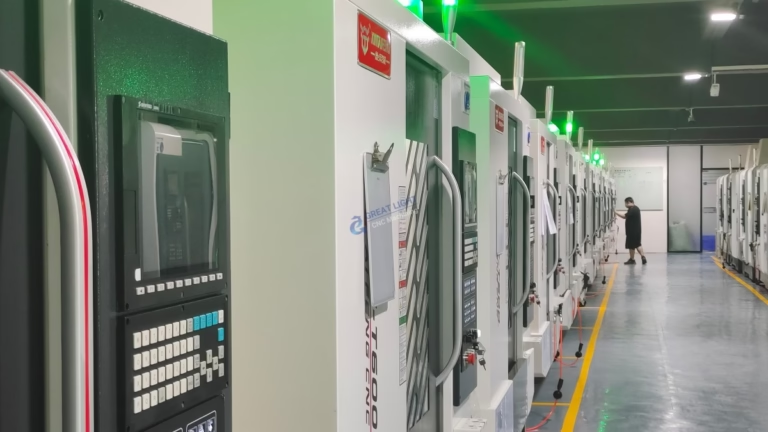
There is also a size ceiling. A 5-axis trunnion has to swing the part inside its work envelope. GreatLight runs 16 simultaneous 5-axis centers, with travels spanning 500 × 500 × 450 mm, 750 × 1,150 × 550 mm and up to 4,000 × 400 × 150 mm on the long-bed machines. A part wider than the trunnion swing cannot be tilted freely, no matter how many axes the control has.
Finally, quantity changes the math. At high volumes a dedicated fixture on a 3-axis or 4-axis machine, or a casting, often beats 5-axis cycle time. Five axes pay off most in prototypes, low-to-mid volumes and parts that are genuinely hard to hold.
- 1Simple, single-face parts3-axis removes metal faster and needs less programming.
- 2Parts past the swingTrunnion clearance limits how much a part can be tilted.
- 3Very high volumesDedicated fixturing or casting usually wins on cycle time.
Setup and Programming Rules That Decide the Outcome
The rotary axes are only as good as their reference. A 5-axis job starts with finding the true center of rotation, not the corner of the blank. Probe the rotary table, set the work offset from that point, and the CAM post will place every feature correctly. Skip it and the part arrives rotated by a fraction of a degree that nobody sees until inspection.
Rigidity is the second rule. Keep the part as close to the table as the geometry allows. Every millimeter of standoff between the trunnion and the part becomes a lever arm that amplifies cutting force into deflection. On thin-walled parts this shows up as a taper you cannot fix with a spring pass.
Tool choice follows. Ball-nose cutters for contoured surfaces, bull-nose for floor and wall blending, and short flute lengths wherever reach permits. A 5-axis program that uses a long tool everywhere gives back most of the stiffness advantage it was bought for.
Verification is not optional. Run the simulation, check for holder-to-part collision at the extreme tilt angles, and confirm that the machine's rotary limits cover the program. Most 5-axis crashes happen at the edge of travel, not in the middle of a cut.
- 1Probe the rotation centerSet offsets from the rotary axis, not the blank corner.
- 2Minimize standoffShort holders and low fixturing keep the setup rigid.
- 3Simulate the extremesCheck collisions and rotary limits before the first cut.
5-Axis vs 3-Axis vs 4-Axis: Which Fits the Part
Match the part to the machine before you request a quote.
| Part characteristic | 3-axis | 4-axis | 5-axis |
|---|---|---|---|
| Features on one face only | Best fit | Workable | Overkill |
| Holes on two opposite sides | Two setups | Best fit | Workable |
| Angled holes and side pockets | Angle plate needed | Limited | Best fit |
| Twisted blades or impellers | Not practical | Not practical | Only route |
| Thin medical housings | Distortion risk | Some risk | Best fit |
| Simple flat plate, high volume | Best fit | Good | Too slow |
| Part wider than trunnion swing | Fine | Fine | Not suitable |
| Prototype, no fixture budget | Cheap | Moderate | Best fit |
The Short Answer
If the part has features on three or more approach directions, or a twisted surface with no flat datum, choose 5-axis and pay for the setup once. If it is flat, single-faced and simple, choose 3-axis and put the money into inspection instead.
Frequently Asked Questions
Is 5-axis machining always more accurate than 3-axis?
No. A well-fixtured 3-axis job on a good machine can hold the same tolerance on a simple part. The advantage of five axes is that it removes the setup stack on multi-sided and contoured work.
Where a part needs three or four setups on a 3-axis machine, each re-clamp adds variation. Cutting the same features in one setup under a 5-axis program keeps their relationship tied to the rotary accuracy instead.
Does 5-axis cost more per part?
The hourly rate is usually higher, because the machine and the programming cost more. Whether the part costs more depends on setup count.
For a part that would need three fixtures on a 3-axis machine, five axes often comes out cheaper overall. For a flat plate with holes on one face, it rarely does.
What materials can be cut on a 5-axis center?
The same range as any CNC mill: aluminum 6061, 7075 and 2024, stainless 303, 304, 316L and 17-4PH, steels such as 4140 and 4340, titanium TC4, Inconel, copper alloys and engineering plastics like POM, PEEK and PC.
Hard alloys cut slower and move more under heat. On thin titanium walls that limits the tolerance you can hold, regardless of axis count.
How large a part can be machined on five axes?
It depends on the trunnion swing, not just the linear travel. GreatLight runs 5-axis travels of 500 × 500 × 450 mm, 750 × 1,150 × 550 mm and 4,000 × 400 × 150 mm on the long-bed machines.
Long parts can be machined on the extended machines, but they cannot be tilted through a full rotation. Check the swing envelope before designing a part that needs to rotate.
Do I need a 5-axis machine for a prototype?
Often yes, because prototypes rarely have fixtures, and five axes let a near-net blank be machined close to final form in one or two setups. That shortens the loop between design revision and a physical part.
There is no minimum order quantity at GreatLight, so a single prototype can run on a 5-axis center without a volume commitment.
How do I know if my part needs five axes?
Count the approach directions and look for non-planar surfaces. Three or more sides with functional features, or any twisted surface with no flat datum, points to five axes.
Send the 3D model and we return a DFM analysis within 12 hours, including a note on whether the part is better suited to 3-axis, 4-axis or 5-axis machining.
Send the Model, Get a Process Recommendation
Upload your STEP file and we will tell you which machine the part belongs on, with a quotation and free DFM analysis within 12 hours.
12-hour quote100% inspectionNo MOQNDA on request
More from the shop floor
We publish setup notes, tooling trials and inspection data from the factory floor.











