
Are There Too Many Problems With Titanium Alloy?
Engineers ask us this every week. Titanium is fussy, but the list of real problems is short and each one has a countermeasure. This article is for design and process engineers who need to decide whether a part should be titanium at all, and how to quote and machine it once that decision is made.
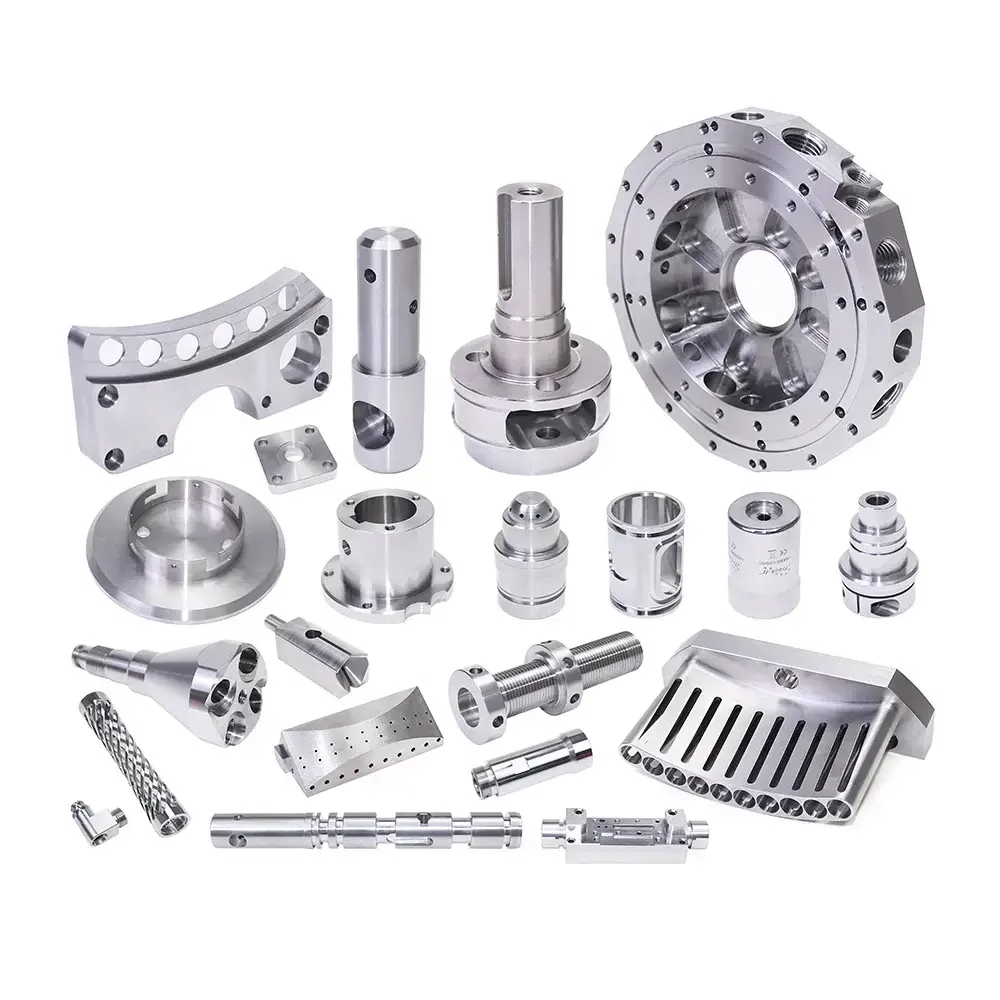
What Actually Goes Wrong With Titanium
Almost every titanium failure on a CNC machine traces back to heat, chatter or workholding. Fix those three and the material behaves.
Why Titanium Punishes Bad Process Choices
Titanium keeps about 80% of its strength at 500 °C, so the chip does not soften the way it does in aluminum or mild steel. All the heat from cutting has nowhere to go except the tool edge and the workpiece. Thermal conductivity sits around 7 W/m·K for Ti-6Al-4V, roughly one fifteenth of 6061 aluminum. That single number explains most of the trouble people run into.
Chips are thin, the contact zone is small, and pressure per unit area climbs fast. Edges chip, tools wear on the flank, and the part surface starts to smear rather than cut cleanly. A dull tool makes it worse because rubbing replaces shearing, which raises temperature again.
The material also springs back. Titanium has a low elastic modulus, about 110 GPa, so thin walls and long shafts deflect under cutting force and then push back against the tool. Dimensions drift between roughing and finishing unless the process leaves stock for a light final pass.
- 1Heat stays in the cutLow conductivity means coolant must reach the edge, not just the part.
- 2Edge pressure is highSmall contact area and thin chips load the tool tip fast.
- 3Springback is realLow modulus pushes thin features away from the cutter.
Speeds, Feeds and Tool Selection That Hold Up
Surface speed for Ti-6Al-4V typically lands between 30 and 60 m/min with carbide, and lower for a long-reach tool. Feed per tooth is small, often 0.05–0.12 mm, because the edge cannot take a heavy bite without heating up. Depth of cut is where you can be generous: a 50% radial engagement with a light axial pass spreads wear and keeps the tool cool.
Use uncoated or AlTiN-coated micrograin carbide with a sharp, positive rake. Titanium reacts with many coating materials at temperature, so a thick coating can flake and take the edge with it. Four flutes is a common starting point for roughing; more flutes mean less chip room and more rubbing.
High-pressure through-spindle coolant changes the picture. Directed at the cutting zone at 70 bar or more, it breaks the chip and pulls heat out before it reaches the tool body. On deep pockets, this is the difference between a stable process and one that burns through inserts.
- 1RoughingLight axial, wide radial, constant engagement. Keep the tool in cut.
- 2FinishingSharp edge, small stepover, high coolant pressure, one clean pass.
- 3Long-reach toolsReduce surface speed and feed before you reduce depth.
Workholding Decides Whether the Part Comes Out Round
Titanium moves. A three-jaw chuck on a thin ring will distort it before the tool ever touches metal. Soft jaws bored to the actual part diameter, or a dedicated fixture, distribute clamping force and keep the bore round. For parts with walls under 2 mm, we often leave a sacrificial web and cut it off in a second operation.
Vibration is the other half of the problem. Titanium damps poorly, so chatter starts early and leaves a pattern on the surface that is hard to polish out. Short, rigid tool holders help. So does supporting the workpiece close to the cut. When the part is long and slender, a steady rest or a tailstock is not optional.
Thermal growth across a batch is easy to miss. A part that measures 50.000 mm at 8 a.m. can measure 49.970 mm after the spindle has been running for three hours. We check the first part, the middle part and the last part, and we let the machine stabilize before holding tight tolerances.
Titanium vs Common Alternatives for CNC Parts
Use this to decide whether titanium is the right call before you send an RFQ.
| Material | Typical use | Machining difficulty | When to avoid it |
|---|---|---|---|
| Ti-6Al-4V (TC4) | Aerospace brackets, implants, high-load parts | High: low conductivity, gummy chips | Large flat panels with no strength need |
| Commercially pure Ti (TA1, TA2) | Chemical and medical housings | Moderate: softer, still springy | Wear surfaces under sliding load |
| 7075 aluminum | Structural prototypes, fixtures | Low: fast, predictable | Parts above 150 °C in service |
| 17-4PH stainless | Shafts, valves, marine hardware | Moderate: work-hardens | Weight-critical aerospace parts |
| Inconel 718 | Hot sections, rocket hardware | Very high: worse than titanium | Any part that does not see high heat |
When Titanium Is the Wrong Answer
Titanium earns its cost when you need strength-to-weight ratio, corrosion resistance or biocompatibility. A bracket that carries 200 N does not need it. Neither does a housing that never leaves a climate-controlled room. In those cases aluminum or stainless will do the job at a fraction of the cost and lead time.
Design details matter more in titanium than in softer metals. Sharp internal corners concentrate stress and are hard to reach with a cutter. A corner radius of at least one third of the pocket depth lets a smaller tool finish the job without a long-reach setup. Threads below M3 in titanium are fragile, especially in thin walls, so we often recommend a thread insert or a larger boss.
Deep holes are another place where titanium fights back. A depth-to-diameter ratio above 5:1 needs through-coolant drilling and peck cycles. Above 10:1, gun drilling or EDM becomes the practical route. If the design can allow a shallower hole or a cross-drilled alternative, the part gets cheaper without losing function.
- 1Good fitWeight-critical parts, corrosive environments, implant contact.
- 2Poor fitCosmetic panels, low-load covers, prototypes with no thermal need.
- 3Watch the cornersRadius one third of pocket depth keeps tooling short and rigid.
Surface Finish, Inspection and What to Specify
As-machined titanium usually lands around Ra 1.6–3.2 μm, and a careful finishing pass with a sharp tool and high-pressure coolant can reach Ra 0.8–1.6 μm. Below that, you are into polishing or a specialized process, and the cost climbs quickly. Tell us the functional surface before you specify a number. A sealing face and a cosmetic face do not need the same callout.
Inspection is straightforward if the drawing is clear. We check raw material certificates, monitor dimensions in process, and inspect 100% of parts before shipment. Reports are available on request. For titanium, we also watch for alpha case on surfaces that see high temperature, though that is usually a heat-treat concern rather than a machining one.
Tolerance is where titanium and aluminum diverge. Holding ±0.005 mm is routine on a rigid setup with a stable thermal environment, but it is not free. If a feature can live at ±0.05 mm, say so. The shop will spend less time on temperature compensation and more time making chips.
Common Questions From Engineers
Is titanium really that hard to machine, or is it overblown?
It is harder than aluminum or mild steel, but not exotic. The problems are predictable: heat, tool wear and springback. A shop that runs titanium regularly has the tooling, coolant pressure and fixtures to handle it.
The trouble usually comes from shops treating it like stainless. Wrong speeds, wrong coolant delivery, wrong workholding. Fix those and the process is stable.
What surface speed should I use for Ti-6Al-4V?
Start at 30–60 m/min with carbide and adjust from the chip color and tool wear. Long-reach tools need to run slower. If the edge is dulling after a few minutes, drop the speed before you change the feed.
Feed per tooth around 0.05–0.12 mm keeps the edge cutting rather than rubbing. Too light a chip work-hardens the surface and shortens tool life.
Can you hold ±0.005 mm in titanium?
Yes, on a rigid setup with thermal stability. We hold that tolerance on many titanium parts. It requires leaving stock for a light finish pass and letting the machine reach steady temperature before the final cut.
Features that do not need that tolerance should be called out separately. It saves time and cost.
When should I switch from titanium to aluminum or stainless?
When the part does not need high strength-to-weight ratio, corrosion resistance or biocompatibility. A low-load bracket, a cosmetic cover or an indoor housing rarely justifies titanium.
If weight matters but temperature does not, 7075 aluminum is often the better call. If corrosion matters more than weight, 316L or 17-4PH will do the job.
Do you machine TA1 and TA2 as well as TC4?
Yes. We machine commercially pure grades and Ti-6Al-4V, along with Inconel and magnesium when a project needs them. Each grade gets its own cutting data and fixture plan.
Send the drawing and the grade, and we will confirm tooling and lead time in the quote.
What do you need to quote a titanium part?
A 3D model or 2D drawing with tolerances, the alloy grade, surface finish callouts and quantity. If you have a target lead time, include it.
We return a quotation and a free DFM analysis within 12 hours, and production can start within 24 hours of approval.
Send Us the Titanium Part You Are Worried About
Upload the drawing and we will tell you what the process looks like, what it costs, and where the risks are. No minimum order quantity, from one prototype to 10,000+ parts.
12-hour quoteFree DFM analysis100% inspectionNDA on request









