
There Are Many Types of Five Axis Machine Tools: A Complete Guide
Five-axis machining is not one machine. It is a family of configurations, each with its own work envelope, stiffness, and setup logic. This guide breaks down the main types of five axis machine tools, explains how each generates motion, and shows you how to match a configuration to a real part.
In this article
- 1
- 2
- 3
- 4
- 5
- 6
- 7
- 8
What makes a machine five-axis
A three-axis mill moves the tool in X, Y, and Z. The workpiece stays still. A five-axis machine adds two rotary axes, usually called A and B, or B and C, depending on the builder. Those two rotations let the cutter approach a surface from an angle instead of only from the top. That single change removes most of the fixturing problems that eat time on a three-axis job.
The rotary axes can live on the table, on the spindle head, or split between the two. Where they sit decides almost everything else: how much mass the servos must push, how the part hangs in the work envelope, and how accurate the machine stays after a long cut. Two machines with the same travel can behave very differently on the same part.
The word simultaneous matters. A 3+2 machine indexes the rotary axes to a position, locks them, and cuts. A true simultaneous machine moves all five axes at once while the tool is in the cut. Both are sold as five-axis. They are not the same capability, and they do not cost the same.
- 13+2 positioningRotaries lock before cutting. Good for angled faces and holes.
- 2Simultaneous 5-axisAll axes move together. Needed for contoured surfaces.
- 3Axis namingA rotates around X, B around Y, C around Z. Builders vary.
Trunnion table machines: the workhorse configuration
A trunnion machine mounts a rotary table on a tilting cradle. The C axis spins the table, the A axis tilts the cradle. The part sits on the table and rotates under a spindle that mostly stays vertical. This is the most common layout for parts up to roughly 500 mm, and it is the easiest to program because the kinematics are simple.
The trade-off is mass. Every time the A axis tilts, it moves the table, the fixture, and the part. A heavy steel fixture slows the rotary response and can introduce deflection under load. For aluminum and small steel parts, that is rarely a problem. For a 300 kg block, the rotary axes become the limiting factor, not the spindle.
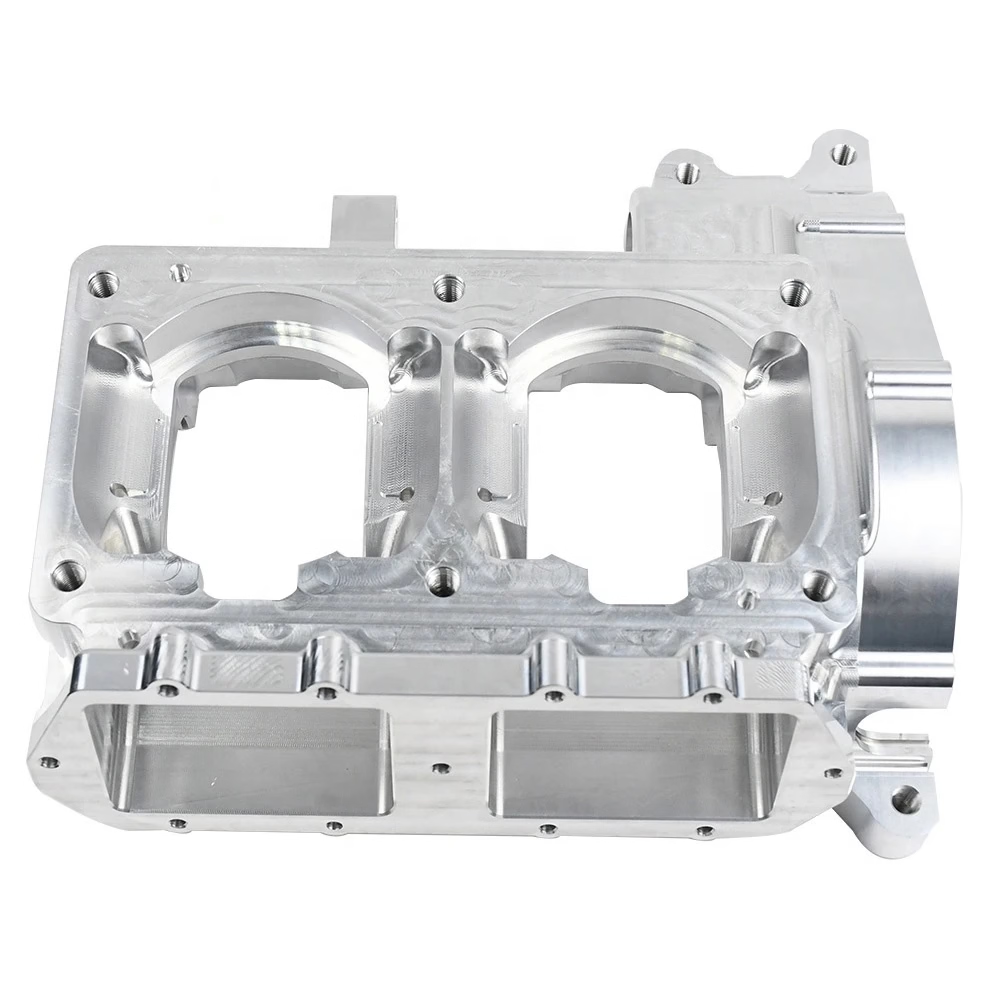
Trunnion machines shine on parts with features on five sides: hydraulic manifolds, gearbox housings, impellers, and medical instrument bodies. One setup replaces four or five on a three-axis mill. On a typical aluminum housing, that alone can cut cycle time by 30 to 50 percent because you stop re-datuming the part.
Watch the work envelope. A Ø400 mm rotary table with a tall part can hit the spindle nose when the A axis tilts to 90°. Check the collision envelope in your CAM before you quote the job. This is the single most common mistake we see on trunnion work.
- 1Best forParts under ~500 mm with features on 4–5 faces
- 2Weak pointHeavy fixtures slow the rotary axes
- 3Typical envelope500 × 500 × 450 mm or 600 × 600 × 600 mm
Gantry and bridge machines for long parts
When a part is long and thin, a trunnion does not help. You need the table to travel instead. A gantry machine carries the spindle on a bridge that moves along the X axis, with the part clamped to a long bed. Rotary axes are often added as a tilting head on the ram rather than as a table.
This layout handles parts that a trunnion cannot even mount. Aircraft stringers, long extrusion profiles, rail components, and large mold bases are typical. On our floor, the largest envelope reaches 4,000 × 400 × 150 mm. That is a different class of machine from a 500 mm trunnion, and it is chosen for part length, not for contour complexity.
Stiffness is the engineering point. A bridge gantry spreads cutting load across two columns, so it resists deflection better than a cantilever head on the same part. The cost is floor space and setup time. Clamping a 3 m part straight takes care. If the bed is not leveled and the clamps are uneven, the part relaxes after the first cut and your second operation goes out of tolerance.
Gantry machines are usually positioned rather than fully simultaneous on the long axis. The rotary head tilts to reach an angled face, then the X axis feeds along the part. That is fine for most long-part work. Full five-axis contouring on a 3 m part is rare because the tolerance stack over that length is dominated by thermal drift, not by the kinematics.
- 1Best forParts over 1,000 mm, long profiles, large mold bases
- 2Weak pointLarge floor footprint and long setup
- 3Typical envelopeUp to 4,000 × 400 × 150 mm
Swivel-head machines: rotation at the spindle
Instead of rotating the part, a swivel-head machine rotates the tool. The spindle head carries the A and C axes, and the workpiece sits on a fixed table. This is common on large die and mold work where the part is heavy and awkward to tilt, but the tool needs to reach deep pockets and steep walls at an angle.
The mechanical challenge moves to the head. Cables, coolant lines, and encoder signals all have to pass through a rotating joint. The head is also a cantilever, so stiffness drops as the head extends. Builders counter this with box-in-box slides and short overhangs, but a swivel head still deflects more than a trunnion under the same load.
For deep-cavity mold work, that deflection matters. A long tool in a swivel head can chatter on a 0.5 mm finishing pass. The fix is usually a shorter tool and more passes rather than a bigger machine. Keep tool overhang under 4× diameter when you can, and let the rotary axes do the reaching.
Swivel-head machines are less common in contract shops than trunnions, but they are the right answer for large, heavy parts that cannot be tilted. If your part weighs more than the rotary table can safely handle, a head-based machine is the practical choice.
- 1Best forHeavy parts, deep mold cavities, large dies
- 2Weak pointHead deflection and routing of cables and coolant
- 3Rule of thumbKeep tool overhang under 4× diameter
Mill-turn and multi-tasking machines
A mill-turn center combines a lathe spindle with milling capability, often adding a B axis and a lower turret. The part turns while the tool mills, or the part is indexed and milled like a prismatic part. This blurs the line between turning and five-axis milling, and that is the point.
The advantage is fewer setups on rotationally symmetric parts with off-axis features. A hydraulic valve body, for example, can be turned, drilled, and milled in one cycle. That removes the concentricity error you get when you move a part from a lathe to a mill and re-chuck it. On tight-tolerance bores, that error is often the whole tolerance budget.
We run 16 mill-turn centers alongside the 5-axis mills. The decision is usually simple. If the part is mostly round and has cross-holes, flats, or angled ports, mill-turn wins. If the part is a prismatic block with complex surfaces, a trunnion or gantry mill wins because the tool can reach more of the part without re-chucking.
The limitation is balance. A mill-turn spindle running at high RPM with an unbalanced workpiece will vibrate. Keep the part mass symmetric where possible, and keep turning RPM within the chuck and spindle limits. Pushing speed on an unbalanced part is how you lose a bearing.
- 1Best forRound parts with off-axis holes, flats, or ports
- 2Weak pointWorkpiece balance at high turning RPM
- 3BenefitRemoves concentricity error from re-chucking
Articulated and robotic five-axis platforms
The newest branch is not a machining center at all. Articulated arms and robotic platforms now carry spindles and use five or six axes of motion. They are used for trimming, drilling, and light milling on large structures where a gantry would be impractical. Aerospace and automotive tooling are the main users.
The kinematics are different from a machine tool. A robot arm has a serial chain, so stiffness and accuracy drop as the arm extends. Repeatability might be ±0.05 mm at the wrist, not ±0.005 mm. That is fine for drilling a pattern of holes in a composite panel. It is not fine for a bearing bore.
Use robotic five-axis where the tolerance is loose and the part is large or awkward to fixture. Use a machine tool where the tolerance is tight. We keep both in the shop for that reason. The mistake is quoting a tight-tolerance job on an arm because the arm can reach the part.
For most contract work, the practical set is trunnion, gantry, and mill-turn. Swivel-head and articulated platforms solve specific problems, and you should choose them for those problems, not because they sound more advanced.
- 1Best forLarge, loose-tolerance drilling and trimming
- 2Weak pointLower stiffness and repeatability than a machine tool
- 3Practical setTrunnion, gantry, mill-turn cover most work
How to pick the right configuration
Start with part size and weight. Under 500 mm and under 50 kg, a trunnion is almost always the right call. It is accurate, fast to set up, and easy to program. Between 500 mm and 1,500 mm, look at weight and feature distribution. A heavy part on a small rotary table will deflect or slip. A swivel head avoids that by keeping the part still.
Then look at where the features are. If you need to reach five faces with tight positional tolerance, a single-setup five-axis machine beats any number of three-axis setups. Every re-chuck adds error. On a part with a true position callout of 0.05 mm across several faces, that stack is usually the difference between passing and failing.
Finally, look at quantity. For one prototype, the setup cost of a five-axis job is real, but it is still usually less than building three fixtures. For 5,000 parts, the cycle time on the right machine matters more than the setup. If the part is round, mill-turn will often beat a trunnion on cycle time because turning removes material faster than milling.
The wrong reason to choose five-axis is surface finish alone. A good three-axis machine with a ball nose tool can produce Ra 0.8–1.6 μm on a simple surface. Five-axis earns its cost when it removes setups, reaches angles, or holds position across faces. If none of those apply, use the simpler machine.
- 1Under 500 mmTrunnion is the default choice
- 2Heavy or longGantry or swivel head, keep the part still
- 3Mostly roundMill-turn removes material faster
Compare the types of five axis machine tools
Match the configuration to the part, not the other way around.
| Type | Motion source | Typical part | Watch out for |
|---|---|---|---|
| Trunnion table | Rotary table + tilting cradle | Housings, manifolds, impellers | Heavy fixtures slow the rotaries |
| Gantry / bridge | Moving bridge, tilting head | Long profiles, large mold bases | Big footprint, long setup |
| Swivel head | A and C axes at the spindle | Heavy dies, deep cavities | Head deflection, cable routing |
| Mill-turn | Lathe spindle + B axis + turret | Valve bodies, round parts | Workpiece balance at high RPM |
| Articulated arm | Serial robot chain | Large panels, loose drilling | Lower stiffness and repeatability |
The short version
If your part is small and prismatic, choose a trunnion. If it is long or heavy, choose a gantry or swivel head. If it is round with off-axis features, choose mill-turn. Five-axis pays off when it removes setups, not when it just looks advanced.
Frequently asked questions
Is 3+2 the same as simultaneous five-axis?
No. A 3+2 machine indexes the rotary axes to a position and locks them before cutting. A simultaneous machine moves all five axes while the tool is in the cut.
3+2 is enough for angled faces, holes, and pockets. Simultaneous motion is needed for contoured surfaces like impeller blades or complex mold cavities.
What tolerance can five-axis machining hold?
On our machines, we hold ±0.005 mm (±0.0002 in) on critical features. That is a shop capability, not a guarantee for every geometry.
Long parts, thin walls, and deep cavities are harder. The tolerance you can hold depends on part stiffness, tool overhang, and thermal stability during the cut.
When should I avoid five-axis and use three-axis instead?
If the part has features on one or two faces, a three-axis machine is faster and cheaper. Setup is simpler and the programming is straightforward.
Five-axis adds value when it removes re-chucking, reaches angles a three-axis cannot, or holds position across several faces. If none of those apply, stay with three-axis.
Can you machine both prototypes and production runs?
Yes. There is no minimum order quantity. We run from one prototype to 10,000+ part runs on the same equipment.
For prototypes, we usually quote and return a free DFM analysis within 12 hours, and production can start within 24 hours.
What materials do you run on five-axis machines?
Aluminum (6061, 7075, 2024), stainless (303, 304, 316L, 17-4PH), steel (1018, 4140, 4340), titanium (Ti-6Al-4V), Inconel, copper, brass, and engineering plastics including POM, PEEK, and PA.
Material choice affects tool selection and cutting parameters. Titanium and Inconel need slower speeds and more coolant, which changes cycle time.
How do you handle confidentiality on customer parts?
Uploads are secure and confidential. We sign an NDA on request before we see the drawings or the model.
We hold ISO 27001:2022 for information security, alongside ISO 9001:2015, IATF 16949:2016, and ISO 13485:2016 for quality.
Send us your part and we will tell you which machine fits
Upload a STEP file and get a quotation plus a free DFM analysis within 12 hours. No minimum order quantity, from one prototype to 10,000+ parts.
12-hour quote100% inspection±0.005 mm toleranceNDA on request
More from the shop floor
We publish setup notes, tooling trials and inspection data from the factory floor.











