
01
A quoted four-week lead time becomes eight
Your line plan assumed four weeks. The supplier confirms six, then pushes again. Every week of slip costs expedited freight, overtime, and a schedule you rebuild by hand.
When your primary supplier slips, a qualified backup matters more than a cheaper quote. GreatLight runs 127 CNC machines across three plants and quotes new parts within 12 hours.
These are the situations buyers describe when one supplier controls the schedule.
Your line plan assumed four weeks. The supplier confirms six, then pushes again. Every week of slip costs expedited freight, overtime, and a schedule you rebuild by hand.
Parts that live in a single mold or on a single spindle have no recovery path. A broken insert or a spindle fault stops your build until someone fixes it.
Status updates arrive without dates or quantities. You plan around a promise, not a schedule, and your own customers hear the same vague answer you did.
Out-of-tolerance parts arrive, get rejected at incoming inspection, and come back as a credit note. The second pass costs more than the first quote saved.
Dual sourcing works when both suppliers are already capable of the part, not when one is still learning it.
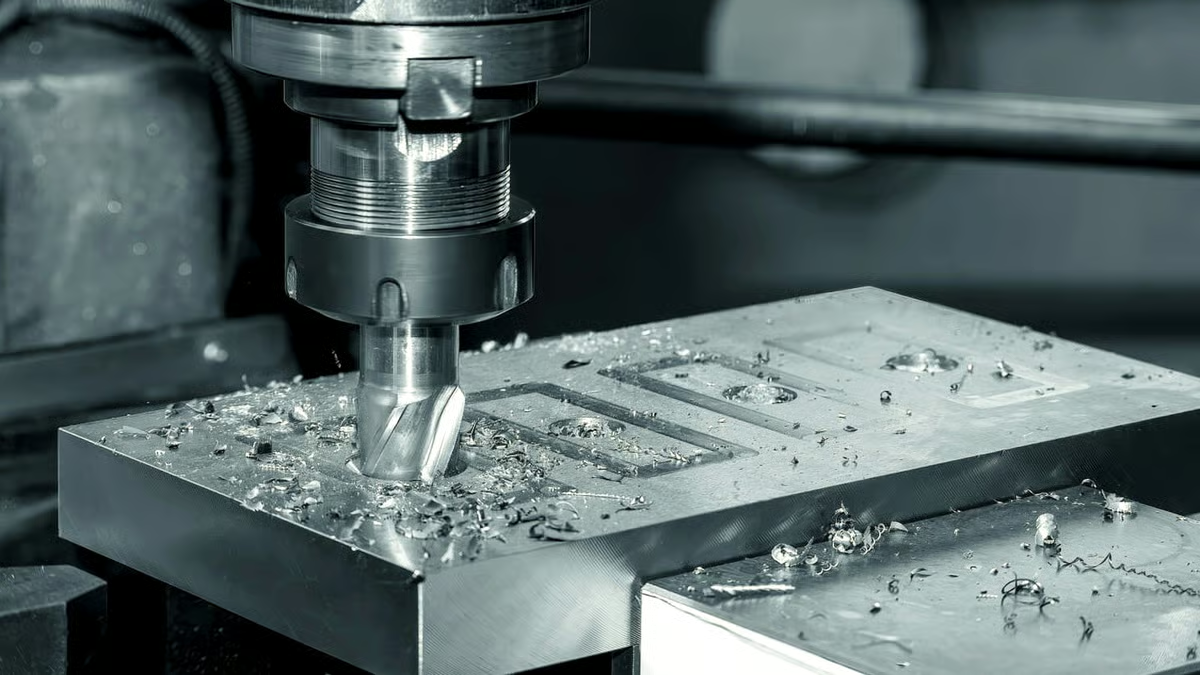
Dual sourcing means two approved suppliers running the same revision. It works best on parts with steady demand, a stable drawing, and a tolerance band both shops can hold. You keep one inspection standard and compare first-article reports side by side.
It stops working when volumes are tiny, when the part needs a dedicated tool, or when the two suppliers run different processes. Then you have two learning curves instead of one backup plan.
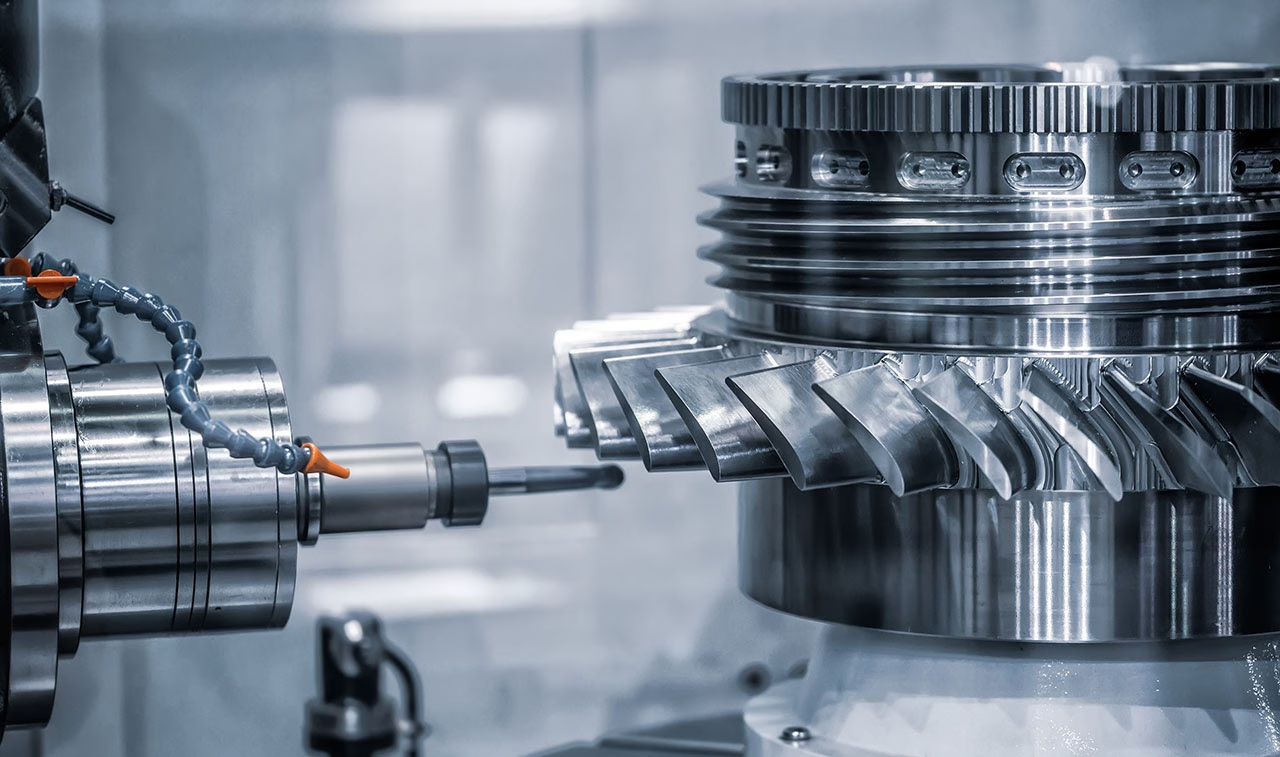
Backup capacity only counts if it is idle when you call. Our three plants hold 127 machines, including 16 simultaneous 5-axis centers and 16 mill-turn centers, so a job can move to another spindle without a new setup review.
A 750 × 1,150 × 550 mm envelope covers most housing and bracket work. For long parts we machine up to 4,000 mm. Production can start within 24 hours of an approved first article.
Match the route to volume, tooling, and tolerance before you commit.
| Situation | Route | Why |
|---|---|---|
| Steady volume, stable drawing | Dual sourcing | Two approved shops absorb demand swings |
| Owned tooling, low volume | Move the tool | Tooling stays, only the machine changes |
| One-off or prototype | Rapid prototyping | No tooling cost, geometry checked first |
| Tight tolerance, complex faces | 5-axis machining | Fewer setups means less stack-up error |
| Cast geometry, high volume | Die casting plus machining | Near-net shape cuts cycle time |
| Sheet parts, no turning | Sheet metal fabrication | Faster than milling from solid |
One supplier for the processes a disrupted schedule usually needs.
Complex faces and undercuts held to ±0.005 mm without repositioning the part between operations.
Mill-turn centers handle shafts and housings in one cycle, which shortens the queue for repeat parts.
Functional prototypes in metal or plastic to prove fit before you commit to a production route.
Brackets, panels, and enclosures when the geometry is flat and the volume is low to mid.
Aluminium and zinc castings for housings where the wall thickness repeats across thousands of parts.
Anodizing, plating, powder coating, and laser marking, kept under the same inspection record.
The numbers you need before sending a drawing.
| Item | Range |
|---|---|
| Tolerance | ±0.005 mm (±0.0002 in) |
| Surface finish | Ra 0.2–0.8 μm fine, Ra 1.6–3.2 μm as machined |
| Aluminium | 6061, 7075, 2024, 5083, ADC12 |
| Stainless | 303, 304, 316L, 17-4PH (SUS630) |
| Steel | 1018, 1045, 4130, 4140, 4340, A36 |
| Titanium and special | TC4 (Ti-6Al-4V), Inconel, magnesium AZ31B |
| Plastics | POM, PEEK, PA, PC, ABS, carbon fibre |
| Order size | One prototype to 10,000+ part runs |
Data points, not adjectives.
Send a STEP file and get a price plus manufacturability notes the same working day.
After first-article approval, the job releases to the floor instead of waiting in a queue.
Standard machined parts leave within the week, with inspection records attached.
Five-axis and mill-turn setups keep tight features on one datum.
One prototype and a 10,000-part run use the same quoting path.
ISO 9001, IATF 16949, ISO 13485, and ISO 27001 cover quality and data.
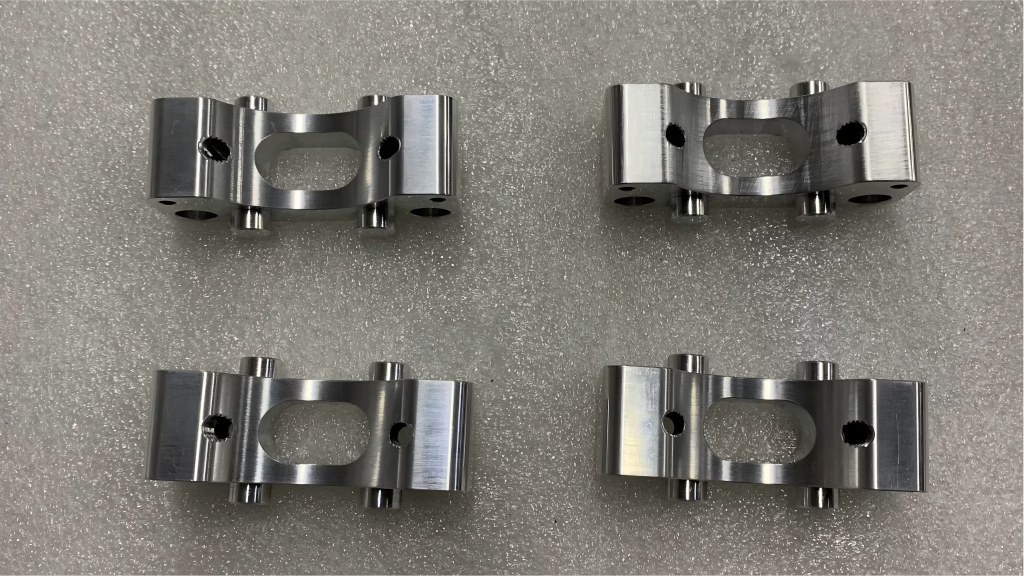
Housings and brackets need traceable first-article reports and IATF 16949 records.

Long rails and structural parts up to 4,000 mm, checked before they leave the floor.
Clean geometry and documented inspection steps under an ISO 13485 quality system.
Frames, heat sinks, and fixtures quoted from a STEP file with DFM notes attached.
It pays off on parts with steady repeat demand and a drawing that will not change for a few months. Both suppliers quote the same revision, and you compare first-article reports against one inspection standard.
It is a poor fit for one-off prototypes or parts locked to a dedicated tool. In those cases the setup cost doubles and you still have one process path.
We return a quotation and a free DFM analysis within 12 hours of receiving a STEP file and the tolerance callouts. If a feature cannot be machined as drawn, the note tells you which one and why.
Complex assemblies with several parts take longer because each drawing is reviewed separately.
Yes, if the grade is on our list. We machine 6061, 7075, 304, 316L, 17-4PH, 4140, TC4, and POM among others, then anodize, plate, powder coat, or bead blast to your callout.
We check the raw material certificate before the first cut, not after the parts are finished.
Put the tightest tolerance only on the features that need it. ±0.005 mm is our standard capability, but applying it to every dimension adds cost without adding function.
Datums and a clear fit to the mating part matter more than a long list of tight numbers.
Uploads stay secure and confidential, and we sign an NDA on request before any file moves. Our quality system is certified to ISO 27001 for information security.
Send the drawing through the quote form and we will confirm the NDA path before production starts.
Send the released drawing and the quantity you need. We check whether the part is already in our process list, then quote against the existing revision instead of rebuilding the setup from zero.
Production can start within 24 hours of first-article approval, and parts ship in 3–5 days after that.
Yes. There is no minimum order quantity, so a single prototype and a 10,000-part run go through the same quoting path. Small orders are not pushed to the back of the schedule.
For repeat small orders, we keep the setup record so the second run starts faster than the first.
Five-axis, four-axis, and three-axis milling, mill-turn, sheet metal fabrication, die casting, vacuum casting, 3D printing, and surface finishing. Keeping finishing in-house means one inspection record covers the whole route.
If a step falls outside our scope, we tell you at the quote stage instead of after the parts are made.
Send a STEP file and drawing. You get a price, DFM notes, and a clear lead time within 12 hours.
12-hour quote100% inspection before shipmentNo minimum order quantity
Trusted by engineers and manufacturers worldwide










Upload your 3D model or 2D drawing and get a quotation with a free DFM analysis. Maximum processing size 4,000 mm.
CNC Metals 13 grades
CNC Plastics 10 grades
Machines & processes 12 options
Surface & post-processing 10 options
Material: not selected Machine: not selected Post-process: not selected
Fill in this short form and we'll open WhatsApp with your message ready to send. We only use these details to reply to you.
Nothing is sent until you press send inside WhatsApp.