
Austin CNC machining and the future of manufacturing
This guide is for engineers and sourcing teams comparing machining routes for production parts. It covers what modern CNC shops can hold, which geometries belong on a mill or lathe, and where casting or printing wins instead. Read it to judge fit before you send an RFQ.
What this page covers
A working reference for engineers specifying CNC machined parts, from prototype quantities to 10,000+ piece runs.
What CNC machining actually controls
CNC machining removes material with a rotating cutter or a single-point tool, driven by a program. The machine controls position, feed rate, and spindle speed along each axis, so the same file produces the same part on the first run and the thousandth. That repeatability is the reason machined parts sit at the center of aerospace, medical, and automotive supply chains.
The tolerance you can hold depends on the machine, the setup, and the material. A 3-axis mill on aluminum with a clean setup reaches ±0.005 mm at the feature level. Titanium or Inconel on the same machine may need more passes and a stiffer fixture to stay inside ±0.01 mm. Thin walls, deep pockets, and long tools all move the number.
Surface finish follows the same logic. As-machined aluminum lands around Ra 1.6–3.2 μm. A finishing pass with a smaller stepover gets you to Ra 0.8–1.6 μm, and a dedicated fine finish reaches Ra 0.2–0.8 μm. Tell us the finish callout early; chasing it after the part is cut costs time.
A CNC program is portable. Move the job from a 3-axis to a 5-axis center and you keep the same geometry, often with fewer setups and better access to the part. That flexibility is what makes CNC the default process for design revisions and low-volume production.
- 1Same file, same partProgrammed motion removes operator variance between runs.
- 2Tolerance is setup-dependentMachine, fixture, tool length, and material all shift the achievable number.
- 3Finish is a second operationRough and finish passes are planned, not assumed.
3-axis, 4-axis, and 5-axis: matching the machine to the part
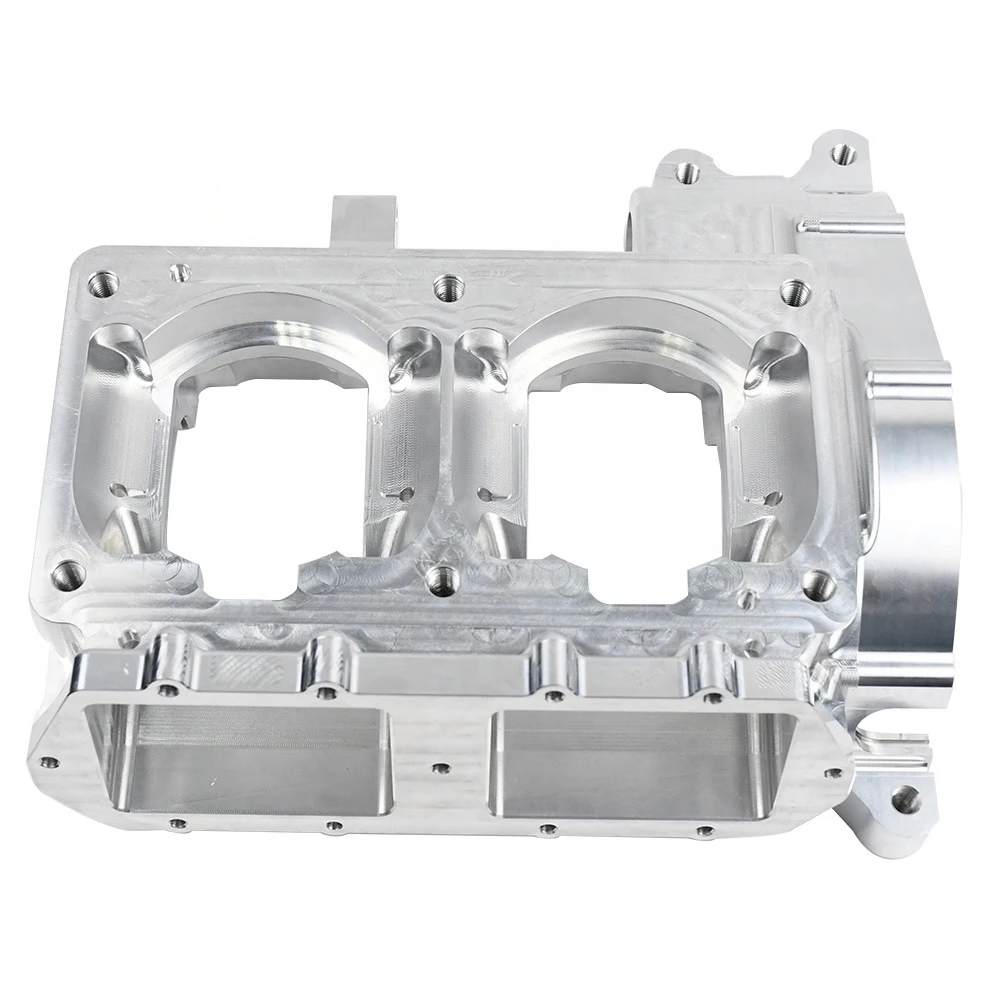
Three-axis work is still the backbone of most shops. The cutter moves in X, Y, and Z while the part stays fixed, so the part can only be reached from one direction at a time. Flat plates, brackets, housings with open faces, and parts with features on a single side run fast and cheap on a 3-axis mill.
A fourth axis adds rotation around one axis, usually A or B. That lets you machine four sides of a prismatic part in one setup, or cut a cylinder with a live tool. Valve bodies, shafts with cross-holes, and parts with features on four faces fit here. You save the re-fixturing error that comes with flipping a part by hand.
Five-axis simultaneous machining tilts both the tool and the table while cutting. The payoff is access: undercuts, deep pockets with curved floors, and impeller or turbine blade geometry that no 3-axis setup can reach. On a five-axis center, one setup can finish five faces of a complex part and hold position within ±0.005 mm across them.
Not every part belongs on a five-axis machine. Short runs of simple geometry are cheaper on 3-axis, and the programming time for five-axis only pays off when the part needs the access or the setup reduction. A good shop routes each job to the machine that fits it.
Choosing the right machine for the geometry
Match the part to the machine before you quote. The wrong choice adds setups, not accuracy.
| Part type | Best machine | Typical reason |
|---|---|---|
| Flat plate, open face | 3-axis mill | Single-direction access is enough |
| Housing, four sides | 4-axis mill | One setup covers four faces |
| Shaft with cross-holes | 4-axis or mill-turn | Rotation exposes radial features |
| Impeller, blade, undercut | 5-axis simultaneous | Tool must tilt to reach the feature |
| Long part up to 4,000 mm | Large-travel 3-axis | Bed length fits the part |
| Turned part with milled flats | Mill-turn center | Turning and milling in one setup |
Material choices and how they behave on the machine
Aluminum is the default for prototypes and most production parts. 6061 and 6061-T6 cut fast, hold tight tolerances, and anodize well. 7075 gives higher strength for aerospace brackets but machines slower and is harder to weld. 2024 is strong but has poor corrosion resistance without cladding or coating.
Stainless grades split by use. 303 machines easily and suits fittings and bushings. 304 and 316L resist corrosion and show up in medical and food-contact parts. 17-4PH (SUS630) takes heat treatment to high strength. All stainless work-hardens, so feeds and speeds must be set to cut under the hardened layer, not rub it.
Steel covers the structural range. 1018 and 1045 are common for shafts and general parts. 4130, 4140, and 4340 appear in high-load automotive and aerospace components. Tool steel is reserved for dies and wear surfaces. Heat treatment after machining can move dimensions, so allow for it in the drawing.
Titanium and nickel alloys are the slow ones. Ti-6Al-4V (TC4) needs low cutting speeds, high coolant pressure, and sharp tooling. Inconel is harder still. These materials are chosen for temperature and strength, not for easy machining. Expect longer cycle times and plan the tolerance budget around tool wear.
- 1Aluminum 6061-T6Fast, stable, anodizes cleanly. Good default for most parts.
- 2Stainless 316LCorrosion resistance for medical and marine use. Watch work hardening.
- 3Ti-6Al-4VHigh strength-to-weight. Slow to cut, needs rigid setup.
Where CNC loses to casting and printing
CNC removes material, so it wastes stock and takes time proportional to the volume removed. A part with a lot of internal space is expensive to cut from solid. Die casting or vacuum casting can produce that shape near-net, then CNC finishes the critical faces. At high volume, the casting carries the form and the machining holds the tolerance.
Additive printing wins when the geometry is organic, lattice-filled, or has internal channels that no cutter can reach. A printed part often needs CNC finishing on mating faces, so the two processes pair rather than compete. The decision is about which process produces the near-net shape most cheaply, then where the tolerance really matters.
Sheet metal fabrication beats CNC for enclosures, brackets, and panels made from flat stock. Bending and laser cutting are faster and cheaper than milling a part from a block when the design is a folded box. If the part is a solid block with pockets, CNC is the answer.
The practical rule: use CNC where the tolerance, finish, or material callout drives the design. Use casting, printing, or sheet metal where the shape drives it and CNC only touches the critical features.
Questions engineers ask before quoting
What tolerance can you hold on a 5-axis part?
We hold ±0.005 mm (±0.0002 in) on critical features when the setup and material allow it.
Very thin walls, deep pockets, and long tool reaches may need a wider band. Send the drawing and we will flag the features that cannot hold that number.
How do I know if my part needs five-axis?
If the part has undercuts, curved floors in deep pockets, or features that face more than four directions, five-axis is likely cheaper than a multi-setup 3-axis route.
Simple prismatic parts with features on three or four faces usually run better on a 4-axis mill.
What is the minimum order quantity?
There is no minimum. We run from one prototype to 10,000+ part runs.
Small runs use the same machines and inspection as production runs, so the first part tells you what the tenth will look like.
How fast can I get a quote and a DFM review?
Quotation and free DFM analysis come back within 12 hours.
Production can start within 24 hours after approval, and parts typically ship in 3–5 days.
Which materials do you machine most often?
Aluminum 6061-T6, stainless 303 and 316L, and steel 1018 and 4140 cover most work.
We also machine titanium, Inconel, copper alloys, and engineering plastics including PEEK and POM.
Can you finish parts after machining?
Yes. Anodizing, plating, powder coating, black oxide, bead blasting, and polishing are available.
Laser marking is also offered, with a minimum character height of 1.5 mm.
Send your part and get a machining plan
Upload a STEP file and we will return a quote with DFM notes within 12 hours. Your files stay confidential, and an NDA is available on request.
12-hour quote100% inspectionNDA on request









