
AWEA CNC Vertical Machining Center: Capabilities and Fit
An AWEA CNC vertical machining center is a bridge-style VMC built for milling, drilling, tapping and boring on boxy parts that load from the top. This page covers the spindle, table and travel geometry, the part shapes that suit it, and the cases where we move the job to a 5-axis or mill-turn machine instead. Written for engineers and buyers comparing vertical VMC capacity.
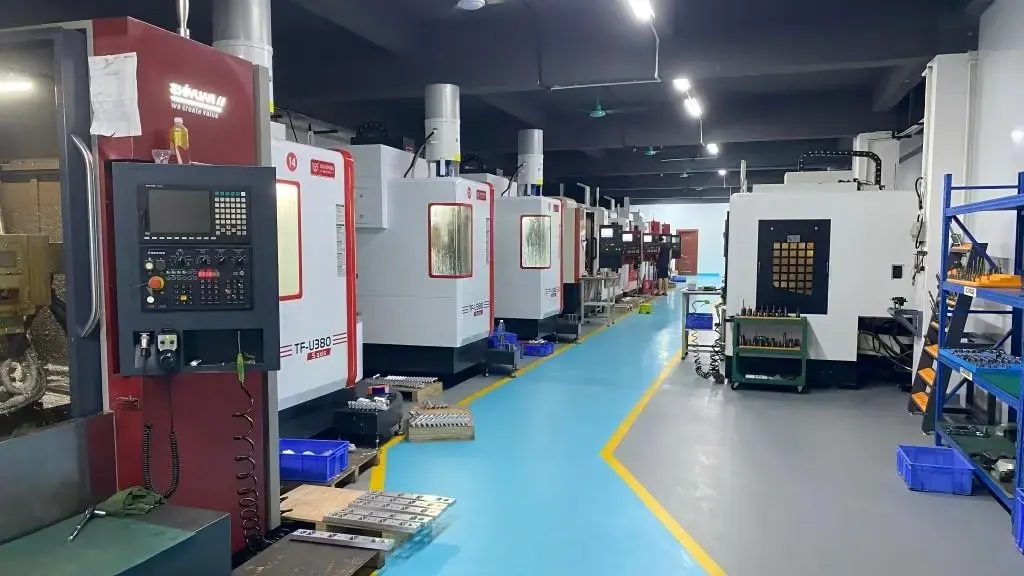
How We Evaluate a Vertical VMC Job
Vertical machining centers earn their keep on prismatic parts. Everything else is a geometry problem.
What an AWEA CNC Vertical Machining Center Actually Is
AWEA builds bridge-type vertical machining centers. The column and bridge carry a spindle that moves in Z, while the table moves in X and Y. That layout puts the cutting tool above the workpiece, so chips fall away and the operator can see the cut. Workholding is simple: vise, chuck, fixture plate or tombstone.
The spindle is the heart of the machine. AWEA VMCs ship with belt-driven or direct-drive spindles, typically 8,000 to 15,000 rpm for general work, with higher speeds on graphite and aluminium packages. Torque matters more than rpm on steel and titanium. Check the torque curve at the speed you actually cut, not the peak number on the spec sheet.
A vertical machining center is not a universal machine. It mills faces, pockets, slots and holes on parts that present their features upward. Turn the part over and you need a second setup, a second fixture and a second datum. That is where tolerance stacks grow.
- 1Spindle orientationTool points down; Z travel sets depth and tool length.
- 2Table loadingParts clamp from above, so access is easy and setup is fast.
- 3Chip evacuationGravity helps. Deep pockets still need through-spindle coolant.
- 4Setup countFive-sided parts usually need two or more operations.
Travel, Table Size and the Parts That Fit
Travel defines what you can cut in one setup. A compact AWEA vertical machine might offer 500 × 500 × 450 mm or 500 × 310 × 200 mm. Mid-size frames run 750 × 1,150 × 550 mm and 600 × 600 × 600 mm. Large bridge mills reach 4,000 × 400 × 150 mm for long, flat parts such as rails and beams.
Table size is different from travel. A 1,200 mm table does not mean a 1,200 mm part. Leave room for clamps, fixturing and tool clearance at the ends of every pass. A safe rule is to keep the part under 70% of table length when you need edge access on all four sides.
Height is the constraint people forget. A tall part with a deep bore may not fit under the spindle nose with the tool holder loaded. Measure from the table surface to the gauge line, then subtract tool length and any fixture height. If the number is negative, the job goes to a horizontal machine or a boring mill.
When a Vertical VMC Is the Right Choice
Prismatic parts win on a vertical VMC. Housings, brackets, plates, manifolds, valve bodies and fixture plates all present their critical features from one direction. Setup is fast, tool changes are quick, and the operator can inspect the cut without moving the part.
Aluminium and plastics run well at high spindle speeds. A 10,000 rpm spindle with a 12 mm carbide end mill removes material quickly in 6061 or 7075, and Ra 0.8–1.6 μm comes off the tool in one pass. Add a fine finish pass and Ra 0.2–0.8 μm is reachable on faces and bores.
Steel and stainless need lower speeds and more torque. A 50 mm face mill in 4140 at 200 m/min is comfortable on a rigid bridge machine. Chatter shows up first on thin ribs and long tools, so keep the tool overhang under four times the diameter where the geometry allows.
Titanium and Inconel change the math. Heat stays in the cut, tool life drops fast, and coolant pressure matters more than spindle speed. A vertical VMC can cut these alloys, but cycle times run two to four times longer than aluminium for the same volume removed.
- 1Good fitBoxy parts, features from one side, moderate tolerance.
- 2Marginal fitDeep cavities, thin walls, tight true-position callouts.
- 3Poor fitRadial holes on a cylinder, undercuts, five-sided work.
- 4Move to 5-axisOne-setup access to five faces, or contoured surfaces.
Matching Part Geometry to Machine Type
Use this as a first filter before quoting. Tolerance and setup count decide the rest.
| Part feature | Vertical VMC | Better alternative |
|---|---|---|
| Flat face, pocket, slot | One setup, fast cycle | No change needed |
| Holes on four sides | Two or three setups | 4-axis with rotary table |
| Radial holes on a shaft | Awkward, needs indexer | Mill-turn center |
| Contoured 3D surface | Ball-nose, many passes | 5-axis simultaneous |
| Long rail, 3 m+ | Bridge mill, 4,000 mm travel | No change needed |
| Ø400 mm round flange | Ø400 mm rotary table | Vertical lathe for heavy stock |
Holding ±0.005 mm on a Vertical Machine
A vertical VMC holds ±0.005 mm when the process is controlled. That number is not automatic. Thermal growth, tool wear and fixture deflection all move the cut, and none of them are fixed by a better control.
Warm up the spindle before the first finish pass. A cold spindle grows 10 to 20 μm over the first hour of running. If the first part is measured hot and the last part cold, the spread lands in your tolerance band. We run a warm-up cycle at the start of every shift.
Cutter compensation and in-process probing do the rest. Measure a datum, set the work offset, cut a test feature and adjust the offset before the finish pass. For runs above 50 pieces, a probe on every tenth part catches drift early.
Materials with high thermal expansion need care. Aluminium grows roughly twice as fast as steel per degree. A 200 mm aluminium part measured at 25 °C and inspected at 20 °C shifts about 12 μm. Let parts stabilize before final inspection.
How We Run AWEA Vertical Capacity at GreatLight
GreatLight runs 127 high-precision CNC machines across three plants in Dongguan plus a Singapore factory. The mix includes 16 simultaneous 5-axis centers, 12 four-axis mills, 27 three-axis machines and 16 mill-turn centers. Vertical VMC work sits in the three-axis and four-axis pool, with 5-axis taking over when one-setup access to five faces saves a fixture.
Every job starts with a DFM review. We check wall thickness, tool reach, corner radii and datum strategy before quoting. Quotation and free DFM analysis come back within 12 hours. Production can start within 24 hours of approval, and parts ship in 3–5 days.
Inspection is 100% before shipment: raw material check, in-process monitoring and final inspection, with reports on request. Historical late-delivery probability is below 2%. We hold ISO 9001:2015, IATF 16949:2016, ISO 13485:2016 and ISO 27001:2022.
Materials cover aluminium 6061, 7075 and ADC12; stainless 303, 304, 316L and 17-4PH; steel 1018, 1045, 4140 and 4340; titanium TC4; Inconel; copper and brass; and plastics from POM to PEEK. Finishes include anodizing, plating, powder coating, bead blasting and laser marking.
No minimum order quantity. One prototype or a 10,000-part run both work. Uploads stay secure and confidential, and an NDA is available on request.
Common Questions
What is the difference between a vertical machining center and a horizontal one?
The spindle axis points down on a vertical machine and sideways on a horizontal. Vertical machines load from the top, which suits flat and boxy parts with features on one face. Horizontal machines cut four faces in one setup and clear chips better in deep cavities.
Pick vertical when setup speed and visibility matter. Pick horizontal when the part needs four-sided access or heavy stock removal in a confined pocket.
Can an AWEA vertical VMC cut titanium and Inconel?
Yes, with the right tooling and coolant pressure. These alloys keep heat in the cut, so surface speed drops and tool life shortens. Expect cycle times two to four times longer than aluminium for the same material volume.
Rigidity matters more than spindle speed here. We run these jobs on the stiffest frames and check tool wear on a fixed interval rather than by sound.
How many setups does a typical part need?
A part with features on one face takes one setup. Add a side or a back face and you add a setup, a fixture and a datum transfer. Each transfer adds error.
When a part needs four or five faces, we compare a two-setup vertical plan against one 5-axis setup. The 5-axis route often wins on tolerance even when the hourly rate is higher.
What tolerance can you hold on a vertical machining center?
±0.005 mm (±0.0002 in) on controlled features. That requires a warm spindle, sharp tooling, a rigid fixture and in-process measurement.
Position tolerance tighter than that is possible on specific features but needs discussion. Send the drawing and we will tell you what is realistic before you commit.
Do you need a rotary table for angled holes?
A 4-axis rotary table lets the part index while the tool stays vertical. That handles holes on four sides and features on a cylinder. A Ø400 mm rotary table covers most flange and housing work.
Truly angled features on a contoured surface are a 5-axis job. Trying to tilt a vise on a 3-axis machine introduces setup error that shows up in true position.
What information do you need to quote a vertical VMC job?
Send a 3D model and a 2D drawing with tolerances, material, finish and quantity. Note any critical features and whether they are functional or cosmetic.
We return a quote and a free DFM analysis within 12 hours. If a feature will not machine cleanly, we say so and propose a change before cutting metal.
Send Your Part, Get a Machining Plan
Upload a model and drawing. We review the geometry, pick the right machine and return a quote with DFM notes within 12 hours.
12-hour quote100% inspectionNo MOQ









