
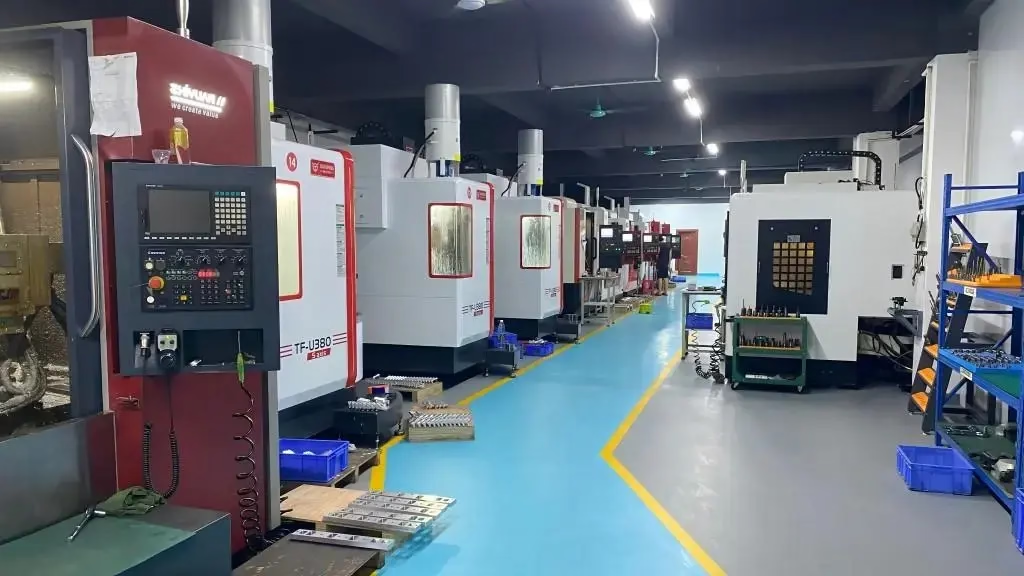
CNC Vertical Machining Center
A CNC vertical machining center holds the spindle upright and the work on a table below it. That single layout decision sets what the machine does well and what it struggles with. This page explains the mechanics, the tolerance limits, and the part shapes where a VMC is the wrong choice.
In this article
- 1
- 2
- 3
- 4
- 5
- 6
What defines a CNC vertical machining center
The spindle points down. The workpiece sits on a table that moves in X and Y, while the spindle head or the column carries Z. Gravity pulls chips down and away from the cut, which is why the vertical layout is the default for flat, plate-like parts. A standard 3-axis CNC vertical machining center moves in three linear axes and nothing more.
That configuration covers a large share of production work: pockets, slots, drilled hole patterns, faces, and contoured profiles. The spindle nose is open and easy to reach, so setup is fast and fixtures are simple. Operators can see the tool enter the cut, which matters more than most people admit when you are dialing in a first article.
The trade-off appears when the part needs features on five sides, or when the cut is deep inside a cavity. The tool holder has to reach past the part edge, and a long holder deflects under load. A vertical machine can still do the job, but you pay in tool overhang, extra setups, and sometimes in surface finish.
- 1Spindle axisVertical, pointing down at the table
- 2Typical work envelope500 × 500 × 450 mm up to 4,000 × 400 × 150 mm
- 3Best part familyPlates, housings, brackets, manifolds, mold inserts
Why the vertical layout wins on most prismatic parts
Consider a 300 × 200 × 40 mm aluminum housing with pockets on the top face and a bolt circle on the bottom. On a vertical machine you machine the top in one setup, flip the part, and machine the bottom. Two fixtures, two datums, and the relationship between the two faces depends on how well you locate the part on the flip.
Now consider the same part with a side port. That is a third setup, and the side datum is now tied to a vise jaw rather than to a machined surface. Every additional setup adds stack-up error. At ±0.005 mm, a three-setup part is a different risk class than a one-setup part. This is the real reason shops track setup count, not just cycle time.
Vertical machines also handle tools cheaply. A BT30 or BT40 holder is common, widely stocked, and quick to change. Deep pockets and long-reach features need slim holders, and the further the tool hangs out, the more it bends. A rule of thumb on a 12 mm carbide end mill: keep overhang under 4× diameter unless the cut is light.
- 1Setup count drives accuracyEach flip adds datum transfer error
- 2Tool stiffness mattersOverhang above 4× diameter invites chatter
- 3Chip evacuation is easyGravity does most of the work
What a vertical machine can hold on tolerance and finish
Geometry aside, the accuracy ceiling comes from the machine frame, the spindle, and the thermal state of the shop. On a well-maintained machine, a normal production run holds ±0.005 mm on critical features and Ra 0.8–1.6 μm on milled surfaces. A fine finishing pass with a sharp tool can reach Ra 0.2–0.8 μm, though that usually costs cycle time.
As-machined surfaces sit around Ra 1.6–3.2 μm and are fine for most brackets and housings. If a sealing face or a bearing bore needs better, plan a separate finishing operation rather than slowing the whole cycle down. It is cheaper to run the roughing pass fast and come back with a light finish cut.
Material changes the numbers. Aluminum 6061 and 7075 cut cleanly and hold tight tolerances. Stainless 316 and 17-4PH work-harden, so the tool has to keep moving. Titanium Ti-6Al-4V needs lower cutting speeds and more coolant. Inconel is the hardest case and often pushes the finish into a second operation.
- 1Production tolerance±0.005 mm (±0.0002 in) on critical features
- 2Every part inspectedRaw material check, in-process monitoring, final inspection
- 3Reports on requestInspection data supplied with the shipment
When a CNC vertical machining center is the wrong machine
Long parts with deep side features are the classic mismatch. A 1,200 mm extrusion with a slot running the full length needs either a very long reach or a horizontal machine that approaches from the side. A vertical machine can do it with the part stood on end, but the fixture becomes a frame, and the part may sag under its own weight.
Parts with features on four or five faces are the second mismatch. You can run them on a 3-axis vertical machine with multiple fixtures, but every flip costs time and accuracy. A 4-axis mill with a rotary table, or a 5-axis machine, machines those faces in one setup. At GreatLight we run 16 simultaneous 5-axis machining centers and 12 four-axis mills for exactly this reason.
Very heavy parts are the third. A 200 kg casting on a 500 × 500 mm table is fine, but a 600 kg block stresses the table and the ways. At that point a horizontal machine with a tombstone fixture handles the weight better and lets chips fall clear of the cut.
- 1Deep side slotsHorizontal spindle reaches better
- 2Five-sided features4-axis or 5-axis avoids flips
- 3Heavy castingsHorizontal layout handles mass better
How workholding and tooling change the outcome
The machine only moves the tool. Workholding decides whether the part stays where you put it. A vise is fine for a block, but thin plates need support underneath or the part lifts and rings during the cut. Vacuum chucks work well on flat aluminum plates down to about 3 mm thick. Soft jaws machined to the part profile hold round and irregular shapes without marking.
Tool selection follows the same logic. Rough with the largest tool the geometry allows, then finish with a smaller one. A 12 mm end mill removes material far faster than a 6 mm tool, and the finish pass only needs to clean up the last 0.2–0.3 mm. Using one small tool for everything is a common way to double cycle time for no gain.
Coolant choice matters on stainless and titanium. Flood coolant keeps the edge cool and flushes chips. On aluminum, high-pressure through-spindle coolant helps clear deep pockets. On plastics such as POM and PEEK, air blast is often enough and avoids the mess.
- 1Thin platesSupport underneath or use a vacuum chuck
- 2Rough then finishLarge tool for bulk, small tool for detail
- 3Coolant by materialFlood for steel, air blast for plastics
Choosing a machine type by part geometry
Match the part to the spindle orientation before you commit to a process.
| Part feature | Vertical machining center | Horizontal machining center | 4-axis or 5-axis |
|---|---|---|---|
| Flat plate with top-face pockets | Best fit, one setup | Workable but wasteful | Overkill for flat work |
| Deep cavity with long reach | Tool deflection risk | Better chip evacuation | No advantage |
| Features on three faces | Two or three flips | Two setups typical | One setup, best accuracy |
| Features on five faces | Four or more flips | Two setups | One setup, clear winner |
| Part above 500 kg | Table load concern | Better mass handling | Depends on trunnion rating |
| Simple bracket, high volume | Fast cycle, low tooling cost | Higher fixture cost | Only if volume justifies |
The short version
If the part is flat or has two or three accessible faces, a CNC vertical machining center is the fastest and cheapest route. If it needs five faces in one setup, or the features sit deep on the side, move to a 4-axis, 5-axis, or horizontal machine instead of adding flips.
Common questions
Can a 3-axis vertical machine cut a part with holes on the side?
Yes, with a right-angle head or by flipping the part. A right-angle head lets the spindle approach from the side without a second setup, but it adds a tool change and reduces rigidity.
For a few holes it is fine. For a full side face with pockets, a 4-axis mill with a rotary table is usually faster and holds the datum better.
What surface finish can I expect from a vertical machining center?
As-machined surfaces run Ra 1.6–3.2 μm. A normal finishing pass reaches Ra 0.8–1.6 μm. Fine finishing can hit Ra 0.2–0.8 μm on aluminum and mild steel.
The limit depends on tool condition, overhang, and material. Hardened steel and Inconel finish worse than 6061 aluminum at the same parameters.
How does part size affect the choice?
GreatLight runs work envelopes from 500 × 310 × 200 mm up to 4,000 × 400 × 150 mm. Within that range, part size is less important than feature direction.
A long thin part may need extra support to stop it vibrating, even if it fits the table easily.
Do I need 5-axis machining for a part with angled holes?
Not always. A simple angled hole can be drilled with a tilted fixture on a 3-axis machine. The fixture is the cost.
If the part has several angled features at different angles, a 5-axis machine cuts them in one setup and removes the fixture cost. That is where the setup savings pay back.
What materials run well on a vertical machining center?
Aluminum 6061, 7075, and 6082; stainless 303, 304, 316, and 17-4PH; steel 1018, 1045, and 4140; brass and copper alloys; and plastics such as POM, PEEK, and ABS.
Titanium Ti-6Al-4V and Inconel are machinable but need slower parameters and sharper tools. They are better suited to a rigid machine with good coolant delivery.
How many setups should I expect for a typical housing?
A simple housing with top and bottom features takes two setups. Add a side port and it becomes three on a 3-axis machine.
On a 4-axis mill the same part can often be done in two setups, or one if the features wrap around a single axis. Fewer setups means tighter tolerance stack-up.
Send us the drawing and we will tell you which machine fits
Upload your CAD file and we will return a quotation with a free DFM analysis within 12 hours. Production can start within 24 hours, and parts ship in 3–5 days.
12-hour quote100% inspectionNo minimum order quantityNDA on request
More from the shop floor
We publish setup notes, tooling trials and inspection data from the factory floor.











