
Benefits of 4-Axis CNC Machining
This page explains what the fourth axis actually changes on the shop floor: how the rotary table works, which parts gain the most, and where the process stops being the right choice. Written for design engineers and sourcing engineers who need to pick an axis count before sending an RFQ. By the end you should be able to tell whether your part belongs on a 3-axis, 4-axis, or 5-axis machine.
What the fourth axis changes
Four-axis machining adds one rotary motion to the standard three linear axes. Everything else on this page follows from that single change.
How a 4-axis machine is built and what the A axis does
A 3-axis mill moves the cutter along X, Y, and Z only. Add a fourth axis and the workpiece itself starts to turn. Most 4-axis mills in our shop carry the rotary on the table, either as a bolt-on indexer or a built-in trunnion. GreatLight runs 12 four-axis mills alongside 27 three-axis machines and 16 simultaneous 5-axis centers, so we match the axis count to the geometry rather than the other way around.
The fourth axis is usually labeled A. It rotates around the X axis, so the part spins about an axis parallel to the machine table. On a horizontal mill the same motion is often called B and turns around Y. Some builders mount the rotary on the spindle instead, which lets the tool tilt while the table stays still. Either way the goal is the same: reach features that would otherwise need a second setup.
Programming follows the hardware. The CAM post must output the rotary angle together with the linear moves, and the operator has to know whether the table can turn while cutting or only index between operations. Live rotary cutting allows contouring around a cylinder in one pass. Indexed rotary cutting stops, locks, and machines each face as a flat pocket or profile.
- 1A axisRotary motion around X. Most common on vertical mills.
- 2B axisRotary motion around Y. Common on horizontal machines.
- 3IndexedTable locks at set angles. Rigid and simple to program.
- 4Live or continuousTable turns during the cut. Needed for wrapped profiles.
The practical benefits 4-axis CNC brings to a job
The clearest benefit is fewer setups. A shaft with four flats, a cross hole, and a slot on the end can be cut in one program if the rotary indexer holds the part. Each setup you remove is a chance for a locating error to appear, and a chance for the job to sit in a queue. On short runs that matters more than cycle time.
Positional accuracy improves for the same reason. When all the features are cut from one datum, the relationship between them depends on the machine geometry rather than on how well the operator re-clamped the part. We hold ±0.005 mm on critical features, and that figure is easier to defend when the part never leaves the fixture.
Surface finish on cylindrical work gets better as well. Turning the part under the cutter keeps the tool engaged along a continuous path, so you avoid the stop marks that appear when a 3-axis machine has to reposition. On aluminum and stainless parts we can reach Ra 0.8–1.6 μm without a second finishing operation.
Tool life and cutter choice also shift. A shorter, stiffer tool can often reach an angled face once the part rotates toward it. Less overhang means less chatter, and chatter is what kills small-diameter end mills in deep pockets.
- 1Fewer setupsMulti-face features cut from one datum.
- 2Tighter positionFeature-to-feature error no longer depends on re-clamping.
- 3Cleaner cylindersContinuous contact avoids stop marks on turned surfaces.
- 4Stiffer cuttingRotating the part lets a shorter tool reach the face.
Which parts belong on a 4-axis machine
Cylindrical parts with features around the circumference are the natural fit. Think camshafts, drive shafts, valve bodies, and bushings with cross holes. If the part can be described as a cylinder with things attached to its side, the fourth axis earns its keep.
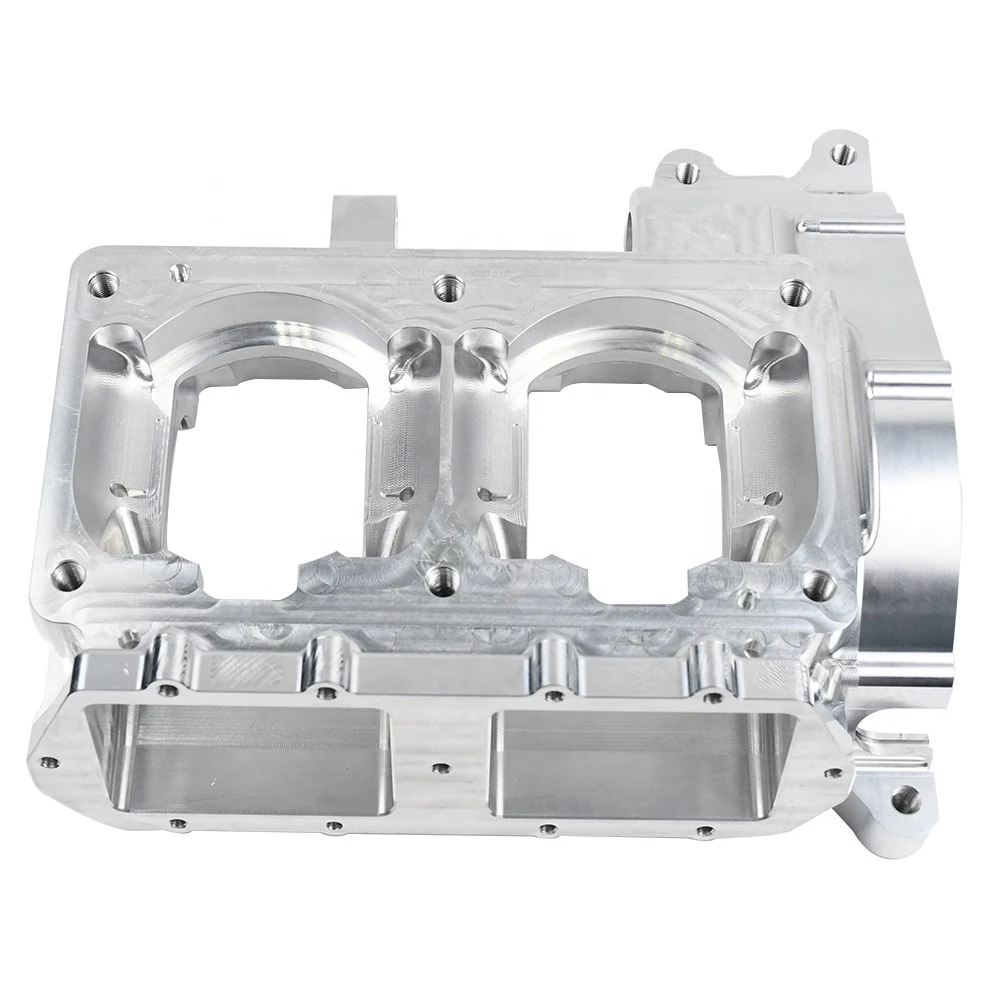
Parts with features on more than one face also qualify. A rectangular housing with pockets on the top, a bore through the side, and a mounting flange on the end is a good candidate. The rotary table indexes the part so each face comes to the spindle in turn.
There is a size limit. Our rotary tables handle up to Ø400 mm, and the largest parts we run reach 4,000 mm in the long travel. Beyond that the part has to move to a machine with a different work envelope, or the design has to be split.
Materials make little difference. Aluminum 6061 and 7075, stainless 303 and 17-4PH, titanium Ti-6Al-4V, and engineering plastics such as POM and PEEK all run on the same machines. What changes is the cutting data, not the axis count.
3-axis vs 4-axis vs 5-axis: a quick selection guide
Use this when the drawing does not obviously point to one machine type.
| Factor | 3-axis | 4-axis | 5-axis |
|---|---|---|---|
| Faces reachable in one setup | One face | Up to four around a rotary | Most of the part |
| Typical part shape | Prismatic plates | Cylindrical, multi-face | Organic, deep cavities |
| Rotary motion | None | One axis (A or B) | Two axes (A plus C) |
| Setup count on a shaft | Three or more | One | One |
| Programming effort | Low | Moderate | High |
| Best fit for tight ±0.005 mm | Flat features only | Multi-face features | Complex 3D surfaces |
| Relative cycle time | Baseline | Faster on round parts | Faster on 3D contours |
| Typical cost per part | Lowest | Middle | Highest |
When 4-axis is the wrong answer
If the part is a flat plate with features on one side, a 4-axis machine adds nothing. You pay for the rotary and the extra programming, then never index it. A 3-axis mill will do the job at a lower hourly rate.
If the part needs undercuts or compound angles on several faces at once, 4-axis will not reach them. You need a second rotary axis so the tool can approach from any direction. That is the point where 5-axis becomes cheaper than three separate 4-axis setups.
Watch the overhang on long shafts. A rotary table holds the part at one end, so a slender shaft can deflect under cutting load even when the machine is stiff. A tailstock or a steady rest helps, but there is a length-to-diameter ratio past which turning on a lathe is the better process.
Fixturing is the other hidden cost. Odd shapes need a custom tombstone or a machined soft jaw before the first chip is cut. For a one-off prototype that fixture can cost more than the part. We quote the fixture with the part so the number is visible up front.
Questions engineers ask about 4-axis machining
What is the real difference between 4-axis and 5-axis machining?
A 4-axis machine adds one rotary motion, usually the A axis, so the part can turn around a single direction. A 5-axis machine adds a second rotary axis, typically C, so the tool can reach almost any orientation in one setup.
Four axes cover cylindrical parts and multi-face work. Five axes cover deep cavities, undercuts, and complex contoured surfaces that a single rotary cannot expose.
Can 4-axis machining hold tighter tolerances than 3-axis?
Yes, for features that sit on different faces of the part. When every feature is cut from one datum, the position error between them is set by the machine rather than by how the part was re-clamped.
We hold ±0.005 mm on critical features and inspect 100% of parts before shipment. Reports are available on request.
Which materials can be cut on a 4-axis mill?
Aluminum 6061, 7075, and 2024; stainless 303, 304, 316L, and 17-4PH; alloy steels such as 4140 and 4340; titanium Ti-6Al-4V; copper and brass grades; and plastics including POM, PEEK, and PA.
The axis count does not restrict the material. Only the cutting parameters change.
How do I know if my part needs a fourth axis?
Look at the drawing and count the directions the tool must approach from. If more than one face carries machined features, or if features are spread around a cylinder, a fourth axis usually removes at least one setup.
If everything is on one flat face, stay with 3-axis.
What size parts can GreatLight run on 4-axis machines?
Our rotary tables take up to Ø400 mm, and the largest machines in the shop reach 4,000 mm of travel. Work envelopes include 4,000 × 400 × 150 mm, 750 × 1,150 × 550 mm, and 600 × 600 × 600 mm.
Send the drawing and we will confirm which machine fits before quoting.
How fast can a 4-axis job start and ship?
Quotation with a free DFM analysis comes back within 12 hours. Production can start within 24 hours of approval, and parts typically ship in 3–5 days.
There is no minimum order quantity. One prototype and a 10,000-part run go through the same process.
Send the drawing, get an axis recommendation
Upload your part and we will tell you whether 4-axis is the right machine, what it costs, and how fast it ships. DFM feedback within 12 hours. Uploads stay confidential, and an NDA is available on request.
12-hour quote100% inspectionNo MOQNDA on request









