
Benefits of CNC Machining for Precision Parts
This page is for engineers and buyers deciding whether to route a part through CNC milling or turning. It covers what the process actually delivers in tolerance, repeatability and material choice, and the cases where another process is cheaper or faster. Read it to judge fit before you send a drawing.
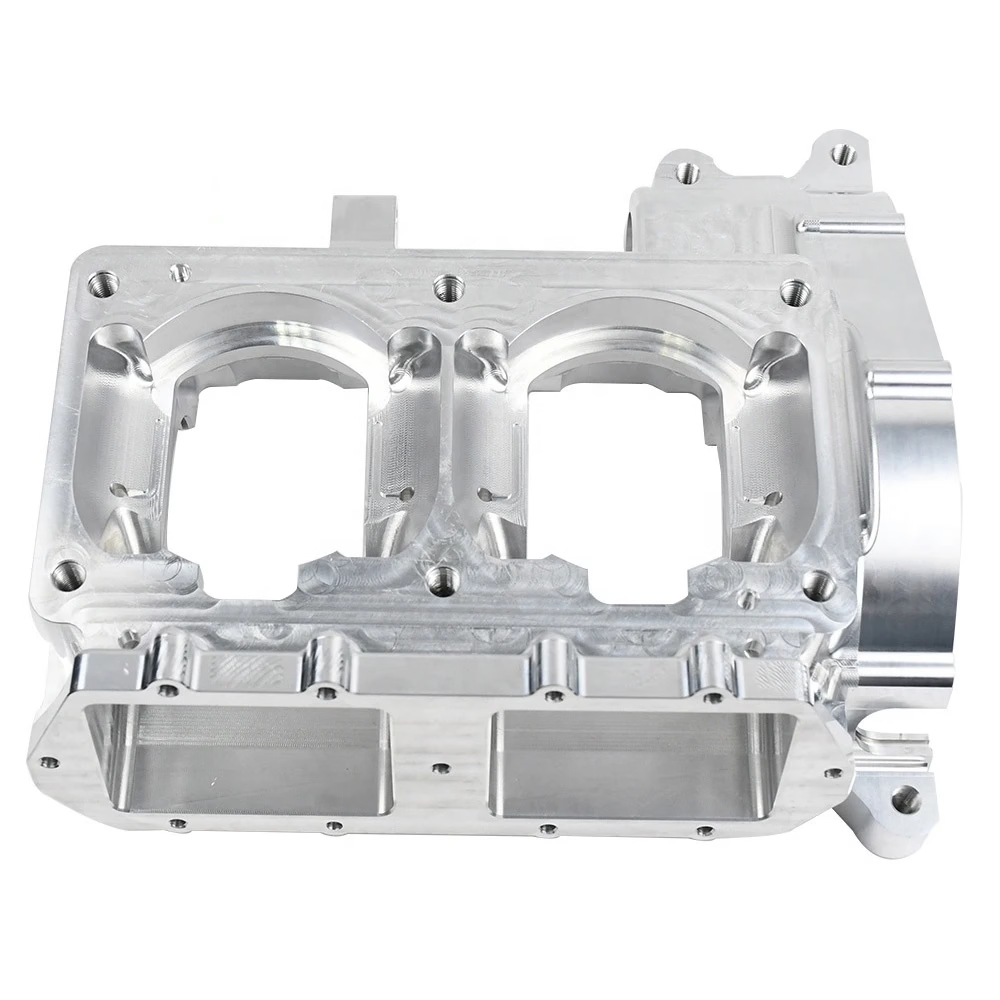
What CNC machining is good at
Subtractive cutting from a solid billet, driven by a program. The benefits come from that program being repeatable.
Tight tolerance, part after part
CNC machining removes material from a solid block with a computer-controlled cutter. The tool path is fixed in code, so the second part is cut the same way as the first. On our 127 high-precision machines we hold ±0.005 mm (±0.0002 in) on features that matter, and surface finish down to Ra 0.2–0.8 μm when a sealing face or bearing bore needs it.
That repeatability is the real benefit. A manually machined batch drifts as the operator adjusts; a programmed batch does not. For a pump housing, a manifold block, or an implant trial, the tenth part measures like the first unless something in the setup changes.
It also means the drawing can carry tighter callouts than most processes allow. Bores, slots, threads and flatness live on the same part without secondary hand work. We inspect 100% before shipment and keep the reports on request.
- 1Best fitBores, faces, threads and pockets that must line up across a batch.
- 2Where it stopsVery deep small holes or thin unsupported walls can deflect; talk to us first.
Metals, plastics, and hard-to-cut alloys
CNC cutting works across a wide material list because the cutter, speed and feed are chosen per job. We run aluminium 6061, 7075 and ADC12, stainless 303, 316L and 17-4PH, steels 1018 through 4340, copper and brass, titanium TC4 (Ti-6Al-4V), Inconel, magnesium, and plastics from POM and PEEK to carbon fibre.
That range is what makes the process useful early in a program. A prototype in 6061 can be validated, then moved to 7075 or 17-4PH for the production version without changing the geometry. You learn about the design before spending on tooling.
Hard alloys cost more in cycle time, not in feasibility. Inconel and titanium cut slowly and wear tools, so we plan roughing passes and tool changes around that. If a part only needs cosmetic detail, a softer alloy with a coating may serve better and cost less.
What the machines can hold
Numbers below are the shop envelope, not a promise for every geometry.
| Item | Specification | Typical use |
|---|---|---|
| Tolerance | ±0.005 mm / ±0.0002 in | Mating bores, spigots |
| Fine finish | Ra 0.2–0.8 μm | Sealing faces, bearing seats |
| General finish | Ra 0.8–1.6 μm | Most functional surfaces |
| Largest travel | 4,000 × 400 × 150 mm | Long extrusions, rails |
| 5-axis centers | 16 simultaneous | Multi-angle, one-setup parts |
| Rotary table | Ø400 mm | Round and indexed features |
| Max processing size | 4,000 mm | Frame and beam parts |
Fewer setups, more angles in one pass
A 3-axis machine reaches the part from one direction. If the design has features on five sides, the part is repositioned, and each reposition adds a chance for error. Our 16 simultaneous 5-axis centers cut undercuts and compound angles without that re-clamping.
The benefit is not only geometric. Fewer setups mean less fixture cost, shorter queue time, and one inspection reference instead of three. Aerospace brackets, medical instruments and EV housings are the usual beneficiaries because their features are rarely flat and square.
For simpler parts, 3-axis or 4-axis is cheaper per hour. We route work to the machine that fits it, not to the newest one. A flat plate with holes does not need 5-axis time.
One part or ten thousand, same program
CNC has no tooling cost to amortize. A single prototype and a 10,000-part run use the same program; only the setup and cycle time change. That is why we quote from one piece with no minimum order quantity.
Unit cost drops as volume rises because setup is spread wider, but the curve is gentler than in casting or molding. The break-even usually sits where a casting or die needs an expensive hard tool and the CNC version only needs fixtures.
The trade-off is cycle time on hard materials and complex geometry. If a part has a deep cavity and a thousand units a year, casting may win. If it changes every revision, CNC wins because there is no tool to re-cut.
- 1Low volumeCNC is usually the cheapest route at 1–500 parts.
- 2High volumeCompare against casting or molding once tooling is quoted.
- 3Design churnA program edit is faster and cheaper than a tool change.
When CNC is the right call
| Situation | CNC fit | Why |
|---|---|---|
| Tight tolerance, low volume | Strong | No tooling cost, tight control |
| Complex angles, one setup | Strong | 5-axis reaches five sides |
| Deep cavities, high volume | Weak | Casting or molding may be cheaper |
| Sheet parts, thin walls | Weak | Sheet metal or stamping fits better |
| Rapid design changes | Strong | Edit the program, not the tool |
| Large flat panels | Mixed | Check travel and stiffness first |
What backs the numbers
A tolerance claim only means something if it is checked. We inspect incoming material, monitor in process, and inspect 100% before shipment. Reports go out on request. Our quality system is certified to ISO 9001:2015, IATF 16949:2016, ISO 13485:2016 and ISO 27001:2022.
The medical and automotive certificates matter for different reasons. ISO 13485 covers device work; IATF 16949 covers automotive and EV programs. ISO 27001 covers how we handle your files. Uploads are secure and confidential, and we sign an NDA on request.
Quotation and free DFM analysis come back within 12 hours. Production can start within 24 hours, and parts ship in 3–5 days. If a feature will be hard to hold, we say so in the DFM note rather than waiting for the first article.
Common questions
Is CNC machining more accurate than other processes?
For metal parts at low to medium volume, yes. A programmed tool path holds ±0.005 mm and repeats across a batch.
Casting and molding can also hold tight numbers, but they need hard tooling and the first article is harder to change. Grinding can beat CNC on flatness and roundness for specific features.
What materials can be machined?
Aluminium, stainless, carbon and alloy steel, copper, brass, titanium, Inconel, magnesium and engineering plastics. We list 6061, 7075, 316L, 17-4PH, TC4 and PEEK among the common ones.
Hard alloys are feasible but cut slower. If the part is cosmetic, a coated softer alloy is often the better economic choice.
Is CNC machining cost-effective at low volume?
Yes. There is no tool to amortize, so one piece costs about the same program time as the hundredth.
We quote from one part with no minimum order quantity. Cost per part falls with volume, but less sharply than with casting or molding.
When should I choose casting or sheet metal instead?
Pick casting or molding when geometry is deep, volume is high, and the design is stable. Pick sheet metal or stamping for thin, flat parts.
CNC remains the better fit when tolerances are tight, features sit on several faces, or the design is still moving.
How fast can parts ship?
Quotation and free DFM analysis within 12 hours. Production can start within 24 hours and parts ship in 3–5 days.
Cycle time depends on material and geometry. We flag long-lead features in the DFM note.
Do you sign an NDA?
Yes, on request. Uploads are secure and confidential, and our information security system is certified to ISO 27001:2022.
If your drawing package is controlled, tell us at quote stage and we will route it through the NDA process.
Send a drawing, get a process answer
Upload your files for a quote and free DFM analysis within 12 hours. We will tell you if CNC is the right route or if another process fits better.
12-hour quoteNo MOQ100% inspectionNDA on request









