
Aluminum CNC Mill: Choosing the Right Machine and Setup
This guide is for design engineers and buyers who need to cut aluminum parts and want to know what makes a mill suitable for the job. It covers spindle power, tool geometry, workholding and coolant, plus the point where a job should leave the shop floor for a 5-axis production environment. Read it and you can judge whether a given mill and setup will hold your tolerance on aluminum.
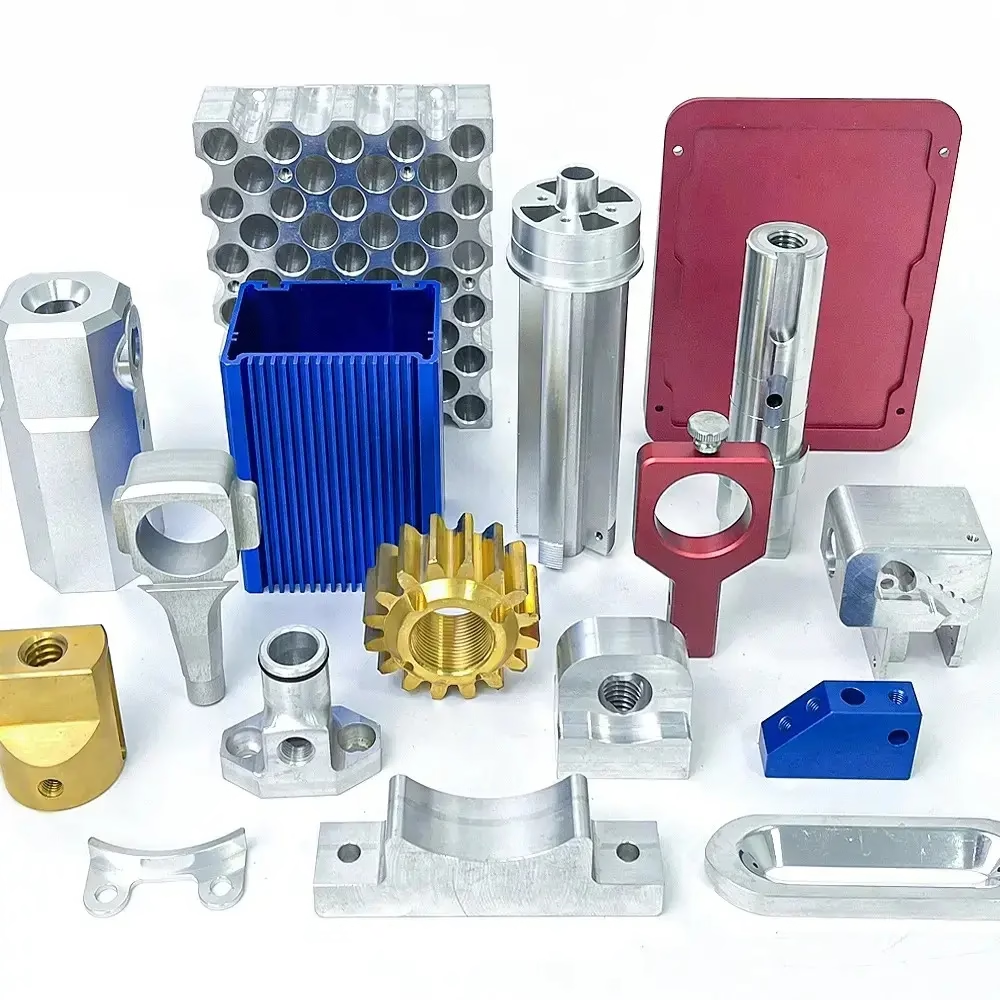
What Makes a Mill Good at Aluminum
Aluminum cuts fast and generates heat fast. The machine and the setup have to keep up.
Spindle Power, Speed and Rigidity
Aluminum is soft, so the cutting force is low compared with steel. That sounds easy, but the metal removes heat by carrying it away in the chip. A spindle that turns too slowly makes thick chips and pushes heat back into the part. For small end mills in 6061, a spindle that reaches 12,000–24,000 rpm keeps the surface speed in a useful range. On a 6 mm cutter, that is often where the finish comes from.
Power matters more than raw top speed. A 1 kW spindle will cut aluminum, but a 5–15 kW spindle lets you take a real depth of cut without chatter. Our 5-axis centers and 3-axis mills are sized for that range. The frame has to absorb the reaction force. A light gantry flexes under load, and the cutter starts rubbing instead of shearing. Rubbing raises tool temperature and leaves a torn surface.
Rigidity is not only about the casting. Tool holders, spindle taper and the way the part is clamped all add compliance. A shrink-fit or hydraulic holder on a 12 mm end mill will run quieter than a worn collet. That matters on deep pockets where the tool sticks out 4× its diameter.
- 1Spindle speed12,000–24,000 rpm suits small cutters in 6061 and 7075.
- 2Spindle power1 kW cuts aluminum; 5–15 kW takes real depth of cut.
- 3RigidityFrame, holder and workholding all add compliance.
End Mill Geometry and Flute Count
Two or three flutes is the normal starting point for aluminum. Fewer flutes leave more room for the chip, and a deep gullet clears it before the cutter comes around again. A three-flute tool is a good compromise: it feeds faster than a two-flute and still has space for chips. Four flutes can work in finishing passes where the chip load is light, but they tend to pack the flutes in a deep slot.
The helix angle and rake angle control how the tool shears the metal. A high helix, around 40–45°, pulls the chip up and out. Aluminum-specific tools use a polished flute and a sharp edge, which lowers cutting pressure. A tool ground for steel has a honed edge and will rub on aluminum. That is one of the most common causes of a poor finish.
Coatings are optional for aluminum. An uncoated polished carbide tool often cuts cleaner than a coated one, because some coatings are chemically active with aluminum and build up on the edge. If you run a coated tool, watch the first few parts. A built-up edge changes the effective diameter and the finish.
- 12–3 flutesStandard choice for slots and roughing in aluminum.
- 240–45° helixLifts chips out of deep pockets.
- 3Uncoated carbideOften cuts cleaner than a coated tool.
Aluminum Alloys and Typical Use
The alloy decides machinability and what happens after the cut.
| Alloy | Machinability | Typical parts | Notes |
|---|---|---|---|
| 6061-T6 | Good | Brackets, housings, fixtures | Welds well, anodizes evenly |
| 2024 | Fair | Aerospace structures, ribs | Higher strength, less corrosion resistant |
| 7075 | Fair | High-load parts, tooling | Strong, can be stress sensitive |
| 5052 / 5083 | Good | Panels, enclosures, tanks | Marine and sheet-metal work |
| 6063 / 6082 | Good | Extrusions, frames | Good finish, moderate strength |
| ADC12 | Good | Die-cast housings | Cast, then milled on faces and bores |
Coolant, Chip Evacuation and Climb Milling
Aluminum conducts heat well, so the tool and the part both get hot. A mist coolant or a light lubricant keeps the edge from welding to the chip. WD-40 works for light cuts; a mist system holds up better in production. Flood coolant is the most stable option if the machine and the part allow it. Air blast alone can work, but only when the chip load is high enough to carry the heat away.
Chip evacuation is the real problem in deep pockets. Recutting a chip doubles the load on the edge and leaves a mark on the wall. Use a ramp or helical entry instead of a straight plunge. A dwell at the bottom of a pocket lets the chip pack, so keep the tool moving. Adaptive tool paths keep the radial engagement constant, which reduces the peak load on a small cutter.
Climb milling is the default for aluminum on a machine with low backlash. The cutter starts with a thick chip and thins it, which pushes the heat into the chip. Conventional milling does the opposite and tends to rub. On a worn machine, climb milling can pull the part into the cutter, so check backlash before you commit.
- 1Mist or floodKeeps the edge from welding to the chip.
- 2Ramp entryAvoids chip packing at the bottom of a pocket.
- 3Climb millingThick-to-thin chip, but check backlash first.
Holding Thin Aluminum Parts
Thin aluminum walls move when you clamp them. A vise with 2 mm of wall left will bow the part and spring back after unclamping. Soft jaws bored to the part profile spread the load. For a thin plate, a vacuum table or a fixture plate with toe clamps holds more evenly. The goal is to support the part under the cut, not just at the edges.
Facing and pocketing both release stress in the material. A plate that is flat as stock can bow after the first pass. Rough, then let the part rest, then finish. On a 7075 part with tight flatness, we sometimes leave 0.5 mm on the floor and take it in a light finishing pass after the part has cooled.
Tabs and sacrificial material are useful when the part is small or flexible. A 1 mm tab keeps the part attached during the last pass. It is faster to cut a tab than to chase a part across the table. For production runs, a dedicated fixture is usually worth the setup time.
- 1Soft jawsSpread clamping load on thin walls.
- 2Rough then finishLets stress release before the final pass.
- 3TabsHold small or flexible parts through the last cut.
Desktop Mills vs. Production 5-Axis
A desktop mill can hold ±0.05 mm on a small aluminum part with a rigid setup. That is fine for a bracket or a prototype. The limit shows up on deep pockets, long tools and parts that need more than one setup. Each re-clamp adds error, and the operator has to re-zero the part.
A 5-axis machining center cuts the part from five sides in one setup. That removes the re-clamp error on a complex part. It also lets the tool reach an undercut that a 3-axis machine cannot. Our shop runs 16 simultaneous 5-axis centers, 12 four-axis mills and 27 three-axis machines, with a maximum processing size of 4,000 mm.
Tolerance is the other dividing line. A production aluminum CNC mill in a temperature-controlled shop holds ±0.005 mm and Ra 0.8–1.6 μm on a well-supported part. A benchtop machine will not repeat that across a batch. If your drawing calls for tight bores or a flat sealing face, the setup and the machine both have to be right.
- 1DesktopGood for ±0.05 mm prototypes and simple parts.
- 25-axisOne setup, five sides, no re-clamp error.
- 3Production±0.005 mm and Ra 0.8–1.6 μm on supported parts.
Common Questions
Can a small mill cut aluminum well?
Yes, if the spindle is fast enough and the frame is stiff. A 1 kW spindle with a 6 mm three-flute cutter will cut 6061 cleanly at a light depth of cut.
The limit is usually the tool stick-out and the workholding, not the spindle itself.
How many flutes should I use on aluminum?
Two or three flutes for roughing and slots. More flutes leave less room for the chip and can pack in a deep cut.
A four-flute tool is fine for finishing passes where the chip load is light.
Do I need coolant for aluminum?
Not always. A mist or a light lubricant helps on most cuts and keeps the edge from welding to the chip.
Flood coolant is the most stable option for deep pockets or long runs.
Why does my aluminum part bow after machining?
Clamping and released stress both move the part. A vise can bow a thin wall, and a plate can move after the first facing pass.
Rough, let the part rest, then take a light finishing pass. Soft jaws help on thin walls.
What tolerance can a production aluminum CNC mill hold?
We hold ±0.005 mm on a well-supported part, with a surface finish of Ra 0.8–1.6 μm as machined.
Tighter finishes down to Ra 0.2–0.8 μm are available depending on the feature.
When should a part go to a 5-axis shop?
When it needs more than one setup, an undercut, or a tight tolerance across several faces. Re-clamping is where the error comes from.
A 5-axis center cuts five sides in one setup and removes that error.
Send Your Aluminum Part for Review
Upload your drawing and we will return a quote and a free DFM analysis within 12 hours. No minimum order quantity, from one prototype to 10,000+ parts.
12-hour quote±0.005 mm100% inspectionNDA on request









