
7 Essential Features of the Best Benchtop CNC Mill for Aluminum
This guide is for engineers and shop owners who want to cut aluminum in-house instead of sending every prototype out. You will get seven checks that separate a machine that holds tolerance on 6061 from one that only looks good on a spec sheet, plus the point where a benchtop stops being the right answer.
In this article
- 1
- 2
- 3
- 4
- 5
- 6
- 7
- 8
- 9
Key takeaways
Benchtop mill vs. job shop vs. full CNC shop
Use this to decide which route fits the part in front of you.
| Route | Best fit | Watch out for |
|---|---|---|
| Benchtop mill | Flat plates, blocks, brackets, one-off fixtures | No torque at low rpm, open-loop motion |
| Job shop (prototype) | Complex 3D contours, thin walls, tight tolerances | Lead time and per-part cost on small runs |
| Full CNC shop | ±0.005 mm work, 5-axis, 10,000+ part runs | Higher setup minimum on simple parts |
| Benchtop + job shop | Design iterations in-house, production outsourced | Two sets of feeds and speeds to manage |
The verdict
Buy a benchtop mill for prototypes and fixtures in aluminum where ±0.05 mm is enough. Move to a production shop when the part needs tight tolerance, 3D contours, or volume.
Frame rigidity and linear guide systems
Aluminum cuts fast and pushes back. A 12 mm end mill at 0.1 mm per tooth and 12,000 rpm pulls a real load through the frame. On a light benchtop, that load shows up as chatter at the tool tip, and chatter kills surface finish before it kills the cutter. Cast iron or polymer concrete frames damp vibration better than welded steel tube, which rings.
Slide design matters as much as mass. Dovetail ways need frequent adjustment and lose preload as they wear. Unsupported round rods flex under side load. Profile linear rails with preloaded carriages hold stiffness over the full travel and keep the table from lifting on climb cuts.
Ball screws should be ground, C3 class or better, with double nuts. A single nut with light preload will show backlash within a few hundred hours on aluminum. Check backlash with a dial indicator against the table, not by feel.
The base and column joint is the weak point on most benchtop frames. If the column bolts to a thin plate, the head deflects under load. Look for a one-piece column or a bolted joint with a machined register.
- 1Frame materialCast iron or polymer concrete damps better than welded steel tube.
- 2Guide typePreloaded profile rails hold stiffness; dovetails and round rods do not.
- 3Ball screwsGround C3 or better, double nut, measured backlash under 0.01 mm.
Spindle power and the torque curve for aluminum
Peak horsepower tells you almost nothing. What matters is torque at the speed you actually run. Aluminum is usually cut between 8,000 and 16,000 rpm with small to mid-size tools, so the spindle needs usable torque in that band, not just at 24,000 rpm.
A 1.5 kW to 2.2 kW spindle handles a 6 mm to 10 mm carbide end mill in 6061 at 0.05 mm to 0.1 mm per tooth. Step up to a 16 mm face mill or a deep pocket and the same spindle bogs down. If the controller shows a load meter, watch it during a test cut.
Air-cooled spindles are cheaper and simpler. Liquid-cooled spindles hold thermal stability over long runs, which matters if you are cutting the same part for six hours. Bearings should be ceramic hybrid or at least angular contact pairs, not deep groove.
Runout at the tool holder taper should stay under 0.01 mm. Higher runout shortens tool life and pushes you toward smaller chiploads, which makes the whole machine feel weaker than it is.
- 1Torque bandAsk for the curve from 8,000 to 16,000 rpm, not the peak figure.
- 2Power range1.5–2.2 kW covers 6–10 mm end mills in 6061.
- 3CoolingLiquid cooling holds stability on runs longer than a few hours.
Axis drives, servo systems and motion control
Stepper motors are open loop. If the cutter loads the axis beyond the motor's torque, the motor misses steps and the part is scrap without any alarm. Servos close the loop and report following error, which is why every machine that claims repeatable aluminum work uses them.
Rapids around 5,000 mm/min (200 IPM) and acceleration above 0.3 G keep cycle times reasonable on small parts with many moves. That acceleration is a function of motor torque, screw lead and moving mass together, not of the motor alone.
Look for a controller with look-ahead and adaptive feed. Look-ahead keeps the tool from overshooting corners on 3D contours. Adaptive feed slows the feed rate when the chip load rises, which saves tools on roughing passes with varying engagement.
On a benchtop, thermal drift shows up as a slow change in Z over the first hour. Run a warm-up cycle before the first part if the machine does not include one.
- 1Drive typeClosed-loop servos over open-loop steppers for any repeated work.
- 2RapidsAround 5,000 mm/min (200 IPM) with acceleration above 0.3 G.
- 3ControllerLook-ahead and adaptive feed on the feature list, not just as an option.
Chip evacuation and flood coolant
Aluminum makes long, stringy chips that wrap around the tool and pack into pockets. Recutting those chips doubles the heat at the cutting edge and dulls the tool fast. The machine needs a way to move chips away from the cut, not just a tray to catch them.
Flood coolant does two jobs: it flushes chips and it pulls heat out of the part. Mist systems are common on benchtop machines because they are cheap, but they do not clear chips from a deep pocket. If you plan to cut pockets deeper than two times the tool diameter, plan on flood.
Enclosure and drainage matter. Coolant that pools on the table or drips onto the floor will stop being used. Look for a sloped table, a chip screen and a sump you can reach without disassembling the machine.
Air blast is a useful backup for dry cuts and for clearing the vise between parts. It is not a replacement for flood on any cut that generates real heat.
- 1Chip pathSloped table and a screen keep chips out of the sump.
- 2Coolant typeFlood for pockets deeper than 2× tool diameter; mist for shallow passes.
- 3MaintenanceA sump you can reach in under five minutes gets cleaned.
Workholding, fixturing and vise compatibility
A machine with a bare table and no T-slot pattern forces you to make every fixture from scratch. Standard T-slots or a threaded table let you bolt down a vise, a tooling plate or a set of soft jaws without a custom adapter.
Vise capacity sets the largest part you can hold. A 100 mm vise handles most brackets and small housings. Above that, you are looking at a tooling plate and toe clamps, which need more Z clearance and more setup time per part.
For thin plates, vacuum or adhesive workholding beats clamping because it does not bow the part. On a benchtop mill, that is often the difference between a flat part and one that springs back after unclamping.
Plan for the second operation. A machine without a rotary table or a fourth axis means you re-fixture the part to reach the back side. Each re-fixture adds setup time and a new chance for error.
- 1Table interfaceT-slots or threaded holes for a vise and tooling plate.
- 2Vise size100 mm covers most small brackets and housings.
- 3Thin partsVacuum or adhesive holding avoids clamp-induced bow.
After-sales support, tooling ecosystem and scalability
Spindle bearings, driver boards and controller screens fail. A machine with no spare parts channel becomes a table with a vise bolted to it. Before you buy, ask how long the controller model has been in production and where spares ship from.
Tooling compatibility matters more than it sounds. ER collet holders are common and cheap. Heat-shrink or hydraulic holders give better runout and rigidity for heavy cuts, but only if the spindle taper accepts them. Check the taper standard before you buy holders.
Scalability is about the next part, not this one. If your production volume is heading toward hundreds of identical aluminum housings, a benchtop machine will not keep up. The jump to a 3-axis or 5-axis production center changes the tolerance you can hold and the cycle time you can hit.
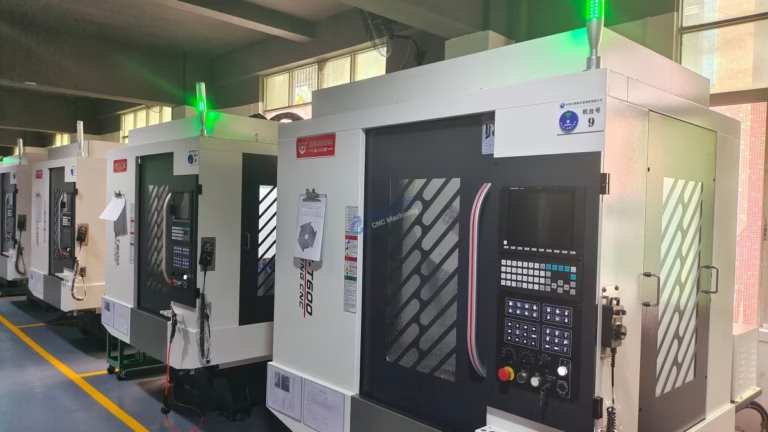
At GreatLight we run 127 high-precision CNC machines, including 16 simultaneous 5-axis centers, in a 7,600 m² plant in Dongguan plus a factory in Singapore. Tolerances reach ±0.005 mm with finishes from Ra 0.8–1.6 μm on aluminum parts. That is the tier above benchtop work, and it is where most aluminum programs end up after prototyping.
- 1SparesAsk where bearings, driver boards and screens ship from.
- 2ToolingConfirm the taper standard before buying holders.
- 3VolumeMove to a production center before hundreds of identical parts.
How to evaluate a benchtop CNC mill for aluminum
Run these steps in order before you commit to a machine.
- 1Cut a test part in 6061Bring your own geometry. A pocket 20 mm deep with a 6 mm end mill at 0.05 mm per tooth shows both torque and chip clearing.
- 2Measure backlash on each axisMount a dial indicator against the table, jog 0.05 mm in and out, and read the difference. Anything above 0.01 mm needs attention.
- 3Check runout at the taperIndicate a test bar or a precision pin in the holder. Runout should stay under 0.01 mm at 50 mm from the gauge line.
- 4Run a 30-minute warm-up and re-check ZThermal drift on a benchtop shows up as a Z shift over the first hour. Measure before and after.
- 5Cut a pocket twice the tool diameter deepThis is where mist cooling fails and flood earns its place. Watch for chip packing and audible load changes.
- 6Confirm the workholding interfaceTest whether your existing vise or tooling plate bolts down without an adapter. Measure the Z clearance you have left.
- 7Ask for the spares list and lead timeGet the part numbers for spindle bearings, driver boards and the controller screen before you sign.
Common questions
Can a benchtop CNC mill hold ±0.005 mm on aluminum?
Rarely, and not over a full day of cutting. The frame and screws on a benchtop machine drift with temperature and load.
±0.005 mm work belongs on a production machine with temperature control and closed-loop feedback. A benchtop mill is for prototypes and fixtures where ±0.05 mm is acceptable.
Is flood coolant worth the mess on a small machine?
Yes, if you cut pockets deeper than two times the tool diameter. Mist cannot clear chips from a deep pocket, and recutting dulls tools quickly.
If your parts are flat plates with shallow passes, a mist system plus an air blast is enough and much easier to maintain.
What spindle power do I need for a 10 mm end mill in 6061?
Plan on 2.2 kW or more with usable torque in the 8,000 to 16,000 rpm band. Below that, you will have to reduce chipload and accept slower cycle times.
Check the torque curve rather than the peak power rating. A spindle with high peak power and weak mid-range torque will stall in a deep cut.
When should I stop using a benchtop mill and outsource?
When the part needs 3D contours, thin walls, or tolerances tighter than ±0.02 mm. Also when volume passes a few dozen identical parts.
At that point a production shop with 5-axis capacity is cheaper per part and more predictable. GreatLight quotes within 12 hours and can start production within 24 hours.
Do I need servos or are steppers enough?
Steppers are fine for one-off fixtures and light cuts where you can watch the machine. They are open loop, so a missed step is not reported.
Servos cost more but report following error and hold position under load. For any repeated production, closed loop pays for itself in scrap avoided.
What should I ask a supplier before ordering aluminum parts?
Ask which alloys they stock, how they inspect, and what certification applies to your industry. For medical work, ISO 13485:2016; for automotive, IATF 16949:2016.
Also ask about minimum order quantity. GreatLight has no minimum, from one prototype to 10,000+ part runs, and offers an NDA on request.
Send us the aluminum part you are trying to make
Upload your files and get a quotation with free DFM analysis within 12 hours. No minimum order quantity, and uploads stay confidential.
12-hour quoteNo minimum order±0.005 mm toleranceISO 9001 / IATF 16949
More from the shop floor
We publish setup notes, tooling trials and inspection data from the factory floor.











