
Biggest CNC Machine Manufacturer: 7 Secrets to Choosing the Right One
This guide is for design engineers and sourcing teams who are comparing large CNC suppliers. It covers seven things worth checking before you send a drawing: machine mix, certifications, 5-axis routing, process chain, headcount, data handling, and how the shop runs your first article. Read it and you can tell the difference between a factory that owns capacity and one that only rents it.
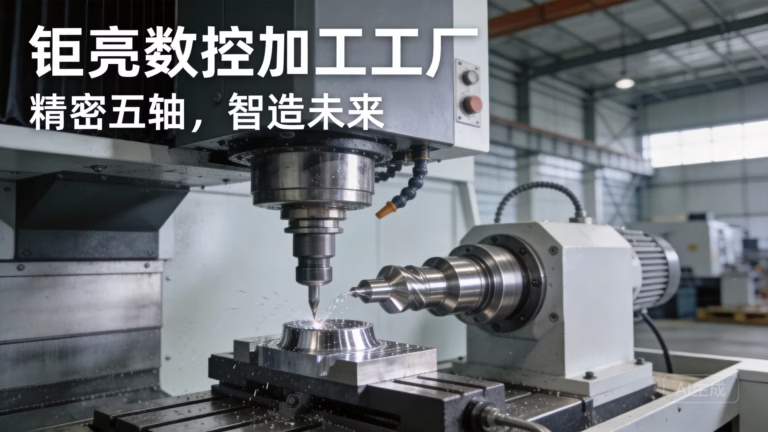
Machine count is a number. Machine mix is the answer.
A big CNC machine manufacturer will always quote a total machine count. It sounds impressive and means very little. What matters is how the fleet is split by axis count, spindle type, and work envelope, because that split decides which of your features can be cut in one setup. GreatLight runs 127 high-precision CNC machines: 16 simultaneous 5-axis centers, 12 four-axis mills, 27 three-axis machines, and 16 mill-turn centers.
Ask for the work envelope, not the brochure photo. Maximum processing size reaches 4,000 mm, with a large travel of 4,000 × 400 × 150 mm. Medium travels cover 750 × 1,150 × 550 mm and 600 × 600 × 600 mm. Compact cells run 500 × 500 × 450 mm and 500 × 310 × 200 mm. A Ø400 mm rotary table handles round parts that would otherwise need a second op.
The trap is a shop with one five-axis machine and fifty three-axis machines. Every complex feature queues behind that single spindle. If your part is mostly prismatic with two or three angled ports, three-axis plus a rotary table is cheaper and faster. If it has deep undercuts, blended surfaces, or five faces of work, you need a shop where five-axis capacity is real capacity.
Size also decides cost. A 4,000 mm part that fits one large mill avoids two setups on a smaller machine. Two setups mean two datums, two fixture builds, and twice the stack-up error. Match the envelope to the part before you compare hourly rates.
- 1Count by axisBreak the fleet into 3-axis, 4-axis, 5-axis, and mill-turn before you compare totals.
- 2Check the envelopeA large machine that cannot hold your part is not capacity, it is a photo.
- 3Watch the queueOne five-axis spindle behind fifty jobs adds days, not hours.
Certifications are process proof, not wall decoration
A certificate tells you the shop writes procedures down and audits them. It does not tell you the parts are good. Still, the absence of a certificate tells you a lot. For medical work, ISO 13485:2016 means the quality system covers traceability and validation. For automotive and EV, IATF 16949:2016 means the shop already lives with PPAP, control plans, and change notification.
ISO 9001:2015 is the baseline. ISO 27001:2022 is the one engineers forget. If your drawings and CAD files leave your building, the supplier's information security system matters as much as its spindle runout. An uncontrolled shop is a leak path for your next product.
Read the scope statement, not the logo. A certificate covering machining of aluminium parts does not automatically cover heat treat, plating, or die casting if those steps are subcontracted. Ask which processes sit inside the audited boundary and which are bought out.
GreatLight holds ISO 9001:2015, IATF 16949:2016, ISO 13485:2016, and ISO 27001:2022. That combination lets one supplier serve an automotive housing, a surgical instrument, and a robotics joint without you rebuilding the quality relationship each time.
- 1Scope checkConfirm the certificate covers the exact process you are buying.
- 2Data checkISO 27001:2022 covers file handling, not just the shop floor.
What each certificate actually covers
Use this to decide which certificate you need on the quote package.
| Standard | What it proves | Typical part type |
|---|---|---|
| ISO 9001:2015 | Documented quality process and audits | General industrial parts |
| IATF 16949:2016 | Automotive PPAP and change control | EV housings, brackets, e-axle parts |
| ISO 13485:2016 | Medical traceability and validation | Surgical tools, implant fixturing |
| ISO 27001:2022 | Controlled handling of your CAD data | Any confidential new product |
Five-axis only pays when the geometry asks for it
Five-axis machining removes setups, shortens tool reach, and holds position across angled faces. It also costs more per hour than three-axis work. The right question is not whether the supplier has five-axis centers. It is whether your part needs them for most of its cycle.
Parts that earn five-axis: impellers and rotors, medical instruments with blended radii, robot joint housings with ports on five sides, and thin-wall aerospace brackets where two setups would warp the part. Parts that do not: flat plates, simple shafts, and housings that a three-axis mill plus a rotary table can reach in two clean setups.
A practical split is to machine roughly 80 percent of a part on a three-axis or four-axis machine, then move it to a five-axis center for undercuts and blended transitions. This keeps the hourly rate down and still delivers the geometry. Ask a supplier how they route work between machine types and you will learn more than any equipment list shows.
Tolerance is a separate conversation. Five-axis positioning does not guarantee a tight tolerance on its own. Tool wear, thermal drift, and fixture stiffness set the floor. GreatLight works to ±0.005 mm (±0.0002 in) and finishes as fine as Ra 0.2–0.8 μm when the drawing calls for it.
- 1Angled portsMore than two non-parallel faces usually justify five-axis.
- 2Blended surfacesSculpted transitions are hard to blend across two setups.
- 3Thin wallsFewer setups means less re-clamping and less distortion.
A full process chain beats a low hourly rate
The handoff trap is simple. A shop mills your part, then sends it out for anodizing, grinding, or EDM. Your part sits in a truck. The outside vendor's schedule becomes your schedule, and if a feature comes back out of tolerance, nobody owns it.
Look for a supplier that keeps milling, turning, grinding, EDM, and surface finishing under one roof. GreatLight runs three wholly-owned plants across 7,600 m² and handles finishing in house: anodizing in clear, colour, hardcoat, and conductive; electroless nickel, zinc, silver, and gold plating; powder coating and black oxide; bead blasting, tumbling, brushing, and polishing; laser marking with a minimum character height of 1.5 mm.
Material range tells the same story. Aluminium 6061, 7075, and ADC12 sit alongside stainless 17-4PH, tool steel, titanium TC4, Inconel, and plastics from POM to PEEK. When one shop can cut the metal and finish it, the inspection report covers the whole chain instead of just the first operation.
The cost question changes too. A slightly higher hourly rate at a shop with in-house finishing often lands cheaper than a low rate plus freight, outside setup fees, and a week of waiting between operations.
- 1No handoffFinishing in house keeps responsibility with one supplier.
- 2One reportInspection covers the finished part, not just the machined blank.
Headcount and first-run discipline
A shop with 150 technicians is not automatically better than one with 40. What matters is how those people are split. Programmers, setup machinists, and inspectors do different jobs. If the same person programs, sets up, and inspects every job, no one catches the mistake.
The first-run mirror is the clearest test. Send a part that stresses the features you care about: a thin wall, a tight bore, a blended corner. Watch how the supplier handles it. Do they send a DFM note before cutting? Do they flag a feature that will need a custom tool? Do they measure the first article and share the numbers, or just ship it?
GreatLight returns a quotation and a free DFM analysis within 12 hours, and production can start within 24 hours. Parts ship in 3–5 days with a historical late-delivery probability below 2 percent. Those numbers only mean something if the first article is measured and reported, so ask for the inspection data on the sample run.
Inspection here is 100 percent before shipment, with raw material checks, in-process monitoring, and a final inspection. Reports go out on request. There is no minimum order quantity, so a single prototype can go through the same gate as a 10,000-part run.
- 1Separate rolesThe person who programs should not be the only one inspecting.
- 2First articleAsk for measured values, not a pass or fail stamp.
Data control and the questions to ask on the call
Your CAD files carry the whole product. A supplier without an information security system is a risk you cannot see until it is too late. ISO 27001:2022 is the standard to look for, and it should cover file storage, access, and disposal, not just the shop floor.
GreatLight keeps uploads secure and confidential, and an NDA is available on request. If your program is under embargo, settle the NDA before you send the step file, not after.
Here is a short list to run through on the first call. How do you route work between three-axis, four-axis, and five-axis machines? What is your maximum processing size? Which finishing steps are in house? How do you report first-article measurements? What is your late-delivery history? A supplier that answers these without a follow-up email is usually a supplier that knows its own floor.
None of this replaces a sample part. The sample is the only proof that the answers are real. Budget two to three weeks for a sample run on a new geometry, and treat the DFM feedback as part of the deliverable.
- 1Sign firstNDA before the step file, every time.
- 2Ask routingMachine routing answers reveal real capacity.
- 3Test with a sampleA sample part proves the process, not the sales deck.
Questions engineers ask before awarding a job
Does a bigger CNC machine manufacturer always mean better parts?
No. Size tells you about capacity, not about process control. A large fleet with one five-axis spindle and no in-house finishing can be slower than a mid-size shop with a balanced machine mix.
Check the axis split, the work envelope, and which operations stay in house. Those three answers predict delivery more reliably than a total machine count.
How do I know whether my part needs five-axis machining?
Count the faces that need work and look for undercuts or blended transitions. More than two non-parallel faces, or a sculpted surface that would be re-clamped between setups, usually justifies five-axis.
Simple plates and shafts are usually cheaper on three-axis machines with a rotary table.
What tolerance can a large CNC shop actually hold?
That depends on the machine, the fixture, and the material. GreatLight works to ±0.005 mm (±0.0002 in) on machined features, with surface finishes from Ra 1.6–3.2 μm as machined down to Ra 0.2–0.8 μm when specified.
Ask for the tolerance on your specific feature, not a general number. Thin walls and deep bores behave differently from a flat face.
Why does ISO 27001 matter for a machining supplier?
Because your drawings and CAD models are the product. ISO 27001:2022 shows the supplier has controls around file storage, access, and disposal.
For embargoed programs, pair it with a signed NDA before any file leaves your building.
Can I order just one prototype?
Yes. There is no minimum order quantity here, so a single part can run through the same inspection gate as a production batch.
Prototypes usually move faster because the DFM feedback comes back before cutting starts.
What should I include in an RFQ to get a useful quote?
Send the 3D model, the 2D drawing with tolerances and finish callouts, the material grade, and the quantity. Note any features you are worried about, such as thin walls or tight bores.
With that, a quotation and DFM analysis can come back within 12 hours.
Send a drawing. Get a DFM note and a quote.
Upload your files and an engineer will review manufacturability and pricing. Uploads stay confidential, and an NDA is available on request.
12-hour quote100% inspectionNo minimum order quantity±0.005 mm









