
7 Secrets to Choosing the Perfect Metal CNC Machine for Your Factory
A machine tool is a ten-year commitment. This guide walks through the seven checks that decide whether a metal CNC machine fits your part mix, your tolerance band and your floor space. Written for process engineers and procurement teams who have to justify the number, not just pick a brand.
Start with the part, not the brochure
Every secret below answers one question: what does this specification do to your parts, your cycle time and your scrap rate?
Five axes cost more than the fifth axis
A simultaneous 5-axis machining center is not a 3-axis mill with two rotary axes bolted on. The controller has to coordinate five motors through one toolpath, the post-processor has to be verified per machine, and the CAM programmer needs to think in tool vectors rather than in X, Y and Z. Budget for all three.
The real cost shows up in three places: machine price, programming hours per new part, and the smaller pool of operators who can set up and prove out a 5-axis job without scrapping the first article. If your parts are prismatic with a handful of angled holes, a 4-axis mill with a trunnion table will usually run cheaper and faster.
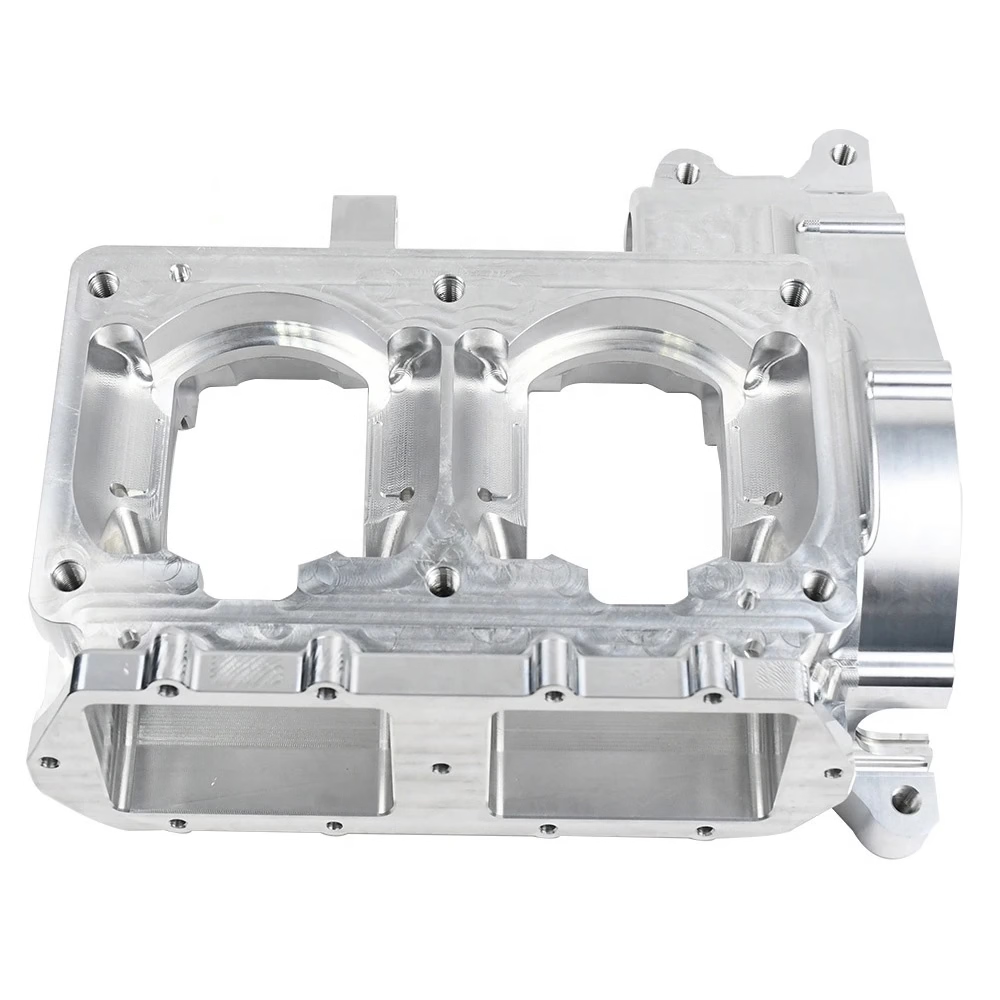
Where 5-axis pays back is short-run complexity. One setup instead of four, no refixturing stack-up, and better access to deep pockets and undercuts. Aerospace brackets, engine housings, medical instrument bodies and robot joint parts are typical cases. Check how many of your live part numbers actually need five simultaneous axes before you sign.
- 1Needs 5 axesContoured surfaces, undercuts, deep angled pockets, tight positional tolerance across faces
- 2Does not need 5 axesPrismatic plates, shafts, simple housings, parts with one or two angled features
- 3Middle ground3+2 positioning on a 4-axis or trunnion machine, lower programming load
The casting decides the finish you can hold
Rigidity cannot be added after the machine is built. It comes from the base and column: cast iron, polymer granite, or a welded steel frame. Cast iron damps vibration well and is the default for general milling. Polymer granite damps better and reacts less to temperature, which matters for grinding-level finishes and long unattended cuts.
Structure matters as much as material. A C-frame vertical is stiff in Z but deflects under heavy side load. A bridge or gantry spreads load across two columns and holds better over a large table, at the cost of floor space and a longer warm-up routine.
Ask for the static stiffness and the thermal compensation strategy. Then check the practical things: foundation bolts, leveling pads, coolant containment, chip conveyor direction. A machine that settles 0.02 mm over a shift will not hold ±0.005 mm no matter what the spec sheet says.
- 1Cast iron baseGood damping, stable for most milling and turning work
- 2Polymer graniteLower thermal drift, better for fine finishes and long cycles
- 3Bridge or gantryBest for large workpieces and heavy cutting; needs more floor area
Read the spindle curve, not the peak number
A spindle rated 15 kW peak may deliver 6 kW at the speed you actually cut at. Ask for the power and torque curve across the full speed range, then mark the point where your roughing cut sits. That is the number that sets your metal removal rate.
Spindle type follows the same logic. Belt-driven spindles are cheaper to service and fine for low-speed torque. Direct-drive and integral motor spindles reach high rpm with less vibration, which helps aluminium and small-diameter tools. They also cost more to rebuild.
Check the taper, the tool change time, and whether through-spindle coolant is available. Through-coolant is close to mandatory for deep holes in stainless and titanium, and it changes the tooling you buy from day one.
- 1Low-speed torqueSteel and stainless roughing, larger face mills, tough alloys
- 2High rpmAluminium, small end mills, fine surface finish
- 3Through-spindle coolantDeep holes, difficult chip evacuation, longer tool life
Machine class versus part profile
Use this as a first filter before you request machine quotes.
| Machine class | Typical travel | Best-fit parts | Watch out for |
|---|---|---|---|
| 3-axis vertical | 500 × 500 × 450 mm | Prismatic plates, fixtures, simple housings | Multiple setups on angled features |
| 4-axis with trunnion | 500 × 310 × 200 mm | Shafts, cylinders, parts with one rotary face | Limited access to deep pockets |
| Simultaneous 5-axis | Ø400 mm rotary table | Contoured aerospace, medical, robotics parts | Programming cost and operator skill |
| Large gantry or bridge | 4,000 × 400 × 150 mm | Long frames, rails, structural components | Floor space, foundation, thermal drift |
| Mill-turn center | Varies by chuck size | Turned parts with milled features, one setup | Tooling package cost, setup complexity |
Box ways or linear guides: pick by duty cycle
Box ways are hand-scraped surfaces with a large contact area. They absorb vibration and hold up under heavy interrupted cuts, which is why they still appear on heavy mills and lathes. The trade-off is friction: rapid speeds are lower and stick-slip can show up in fine finishing passes.
Linear guides use recirculating rollers or balls on a rail. They run fast with almost no stick-slip, so they suit high-speed finishing and tool paths with many small moves. They are more sensitive to contamination and shock, so way covers and regular lubrication matter.
A practical rule: heavy roughing in steel with long tool engagement favors box ways. Aluminium or light alloy work with high feed rates and fine finishes favors linear guides. Many builders now mix the two, with box ways on the loaded axis and guides elsewhere.
- 1Box waysHeavy cuts, strong damping, slower rapids, needs good lubrication
- 2Linear guidesFast positioning, smooth finishing, sensitive to chips and shock
- 3Mixed designCommon compromise on mid-size verticals
The controller sets your hiring and your data flow
The control is where the machine meets your shop. Familiarity cuts training time and programming errors. If your team already writes for one platform, a second brand means new posts, new macros and a learning curve on every job.
Look at what the control can do offline. File transfer over network, tool life management, in-process probing and shop-floor dashboards all reduce manual steps. Probing in particular removes a lot of setup error on first articles.
Then ask about support. How fast can the builder or distributor get a service engineer to your plant, and do they stock the drives and boards you would need? Downtime is the most expensive specification on any machine.
- 1Training loadMatch the control to the platforms your programmers already know
- 2Data and probingNetwork transfer, tool life tracking, on-machine probing reduce setup error
- 3Service reachLocal parts stock and response time matter more than feature lists
Tooling, automation, and the supplier behind the machine
A machine is only as productive as its tooling package. A proper holder set, balanced for the spindle speed you run, plus preset tooling offline, can cut setup time by a large margin. Automation follows: a pallet changer or bar feeder turns a one-shift machine into a two-shift asset without hiring.
The last secret is the least technical. The company you buy from decides how fast problems get solved. Ask how they handle spare parts, who trains your operators, and what happens when a spindle needs rebuilding in year three.
We run 127 high-precision CNC machines across three wholly-owned plants in Dongguan and Singapore, including 16 simultaneous 5-axis machining centers, 12 four-axis mills, 27 three-axis machines and 16 mill-turn centers. Maximum processing size reaches 4,000 mm. That mix exists because one machine class never covers a real part mix.
For buyers comparing quotes, the useful question is not which machine is best, but which combination of machines gets your parts out at the tolerance and cost you need. Send us the drawing and the annual volume; we will tell you which class we would run it on and why.
- 1ToolingBalanced holders, offline presetting, spare tapers and pull studs
- 2AutomationPallet changers and bar feeders extend unattended hours
- 3SupplierParts stock, training and rebuild path decide year-three cost
- 4Our setup3-axis, 4-axis, 5-axis and mill-turn under one roof
Questions engineers ask before signing
How do we decide between buying a 5-axis machine and outsourcing 5-axis work?
Count the part numbers that truly need simultaneous motion and the annual hours they consume. If that load is under roughly one shift per week, outsourcing usually costs less than owning, because you avoid programming staff, post-processor work and the spare-parts inventory a 5-axis machine needs.
If the load grows past that, or the parts are confidential and cannot leave your plant, owning starts to win. A middle path is a 4-axis machine with a trunnion for 3+2 work, which covers many angled-feature parts at lower cost.
What tolerance can we realistically expect from a new metal CNC machine?
Positioning accuracy on the spec sheet is measured under lab conditions, at a controlled temperature, with no cutting load. In production you lose some of it to thermal growth, fixture deflection and tool wear.
For a well-built machine on a proper foundation, in a temperature-controlled shop, ±0.005 mm is reachable on critical features with in-process checks. On larger parts, or in a shop that swings 10 °C between day and night, plan for wider bands and compensate.
Do we need through-spindle coolant?
For deep holes in stainless, titanium or Inconel, yes. Chip evacuation is the limiting factor on those jobs, and high-pressure through-coolant cuts tool breakage and rework.
For aluminium plates and light alloy work with shallow pockets, flood coolant is usually enough. If you buy a machine without it, confirm that the spindle can be retrofitted later, because it is difficult to add after the fact.
How much floor space and foundation work should we plan for?
Add the machine envelope, the chip conveyor, the coolant tank, the tool cart and a walkway on the operator side. A mid-size vertical often needs two to three times its own footprint once those are included.
Large gantry machines and heavy lathes usually need a separate foundation, isolated from the surrounding slab. Check this before you sign a lease, not after the machine arrives.
What should we ask for in a machine acceptance test?
Ask for a test cut on a part similar to your own work, not just a geometric accuracy report. Measure the features that matter to you: flatness, hole position, surface finish, and repeatability over a run of parts.
Run the spindle through its speed range and check vibration. Cycle the tool changer several hundred times. Verify the thermal drift by cutting a test part cold and again after two hours of running.
Can a single supplier run our parts across several machine classes?
That is how we are set up. With 3-axis, 4-axis, 5-axis and mill-turn capacity in the same plants, a part can move to the machine class that fits its tolerance and volume instead of being forced onto whatever is free.
Quotation and DFM feedback come back within 12 hours, production can start within 24 hours, and parts ship in 3–5 days. No minimum order quantity, from one prototype to 10,000+ part runs.
Send the drawing, get a machine-matched plan
Tell us the part, the material and the annual volume. We will come back with the process route, the machine class and a quotation within 12 hours.
12-hour quoteDFM feedback±0.005 mmNo MOQ









