
Brass CNC Machining: A Guide to High-Quality Precision Parts
This guide is written for design engineers and buyers who need brass cnc machining with high dimensional control. We cover which brass grades machine well, what tolerances hold on a lathe or mill, where the alloy falls short, and how to judge a supplier before you send a drawing.
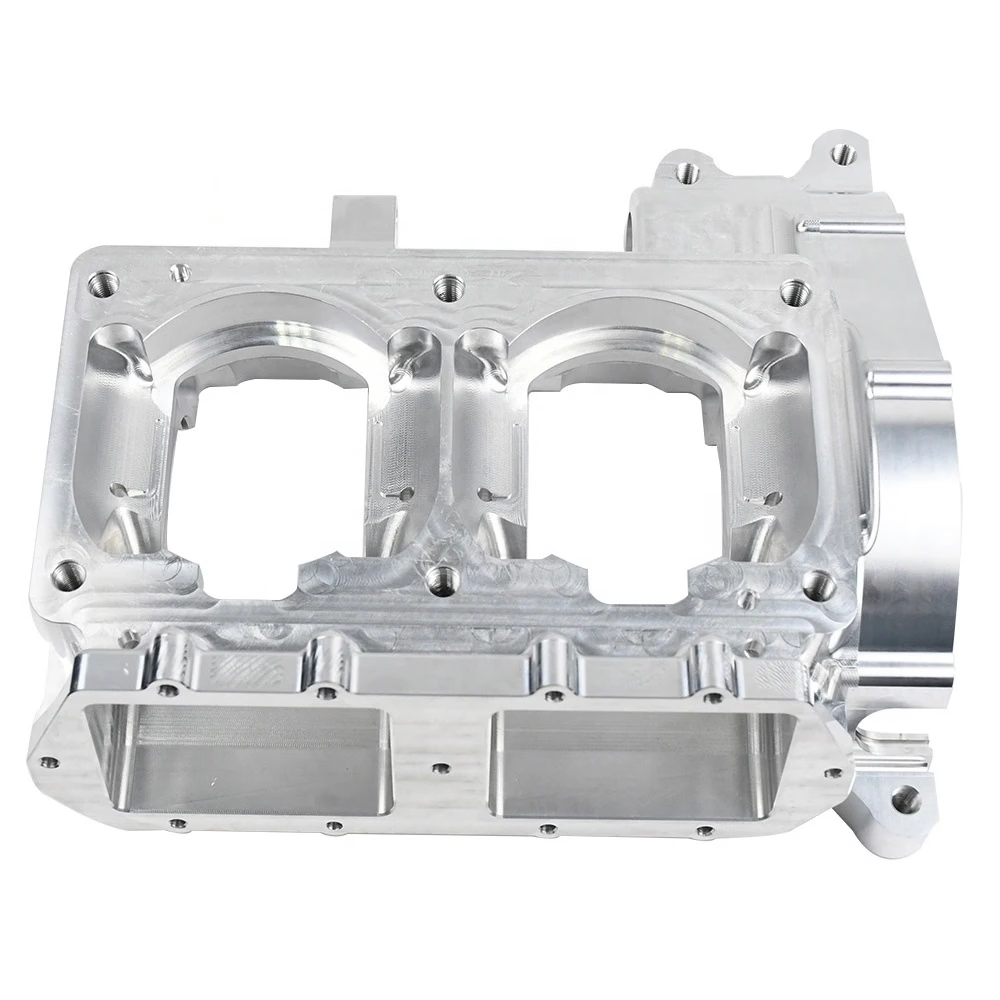
Why brass is often the right call
Brass machines faster than steel, holds a better finish than aluminium in some cuts, and does not need heavy coolant or high spindle loads. That combination makes brass cnc machining a practical route to high-quality precision parts when the part is small, detailed, and used in a wet or electrical environment.
Which brass grade to put on the drawing
The alloy you name changes how the part cuts, how it finishes, and how it behaves in service. Free-cutting C36000 is the default for high-volume turned parts because the lead content breaks chips cleanly and lets a lathe run at high surface speed. C27400 and C28000 carry less lead and more zinc, so they form better and take soldering well but tend to tear on fine threads.
For electrical contacts and busbars, C110 is the usual pick. Conductivity sits near 100% IACS in the annealed state, and the soft temper allows tight bends without cracking. It machines stringy, though, so chip control on a Swiss lathe takes more attention than C36000.
Beryllium copper C17200 is the outlier. It machines to a high strength after age hardening and holds spring temper at elevated temperature, which is why it shows up in connectors and instrument parts. The trade-off is cost and handling rules around beryllium dust.
If the part sees seawater or a humid plant floor, dezincification resistance matters more than machinability. In that case a lower-zinc alloy such as C27400 usually outlasts C36000, even if the cycle time goes up.
- 1C36000Best chip control and surface finish on automatic lathes.
- 2C110High conductivity for contacts, terminals, and busbars.
- 3C27400 / C28000Lower lead, better forming and corrosion resistance.
- 4C17200Spring temper and strength after age hardening.
Tolerances, tooling, and the cuts that hold them
Brass is forgiving on a lathe but not unlimited. On a part under 100 mm, turning diameters to ±0.005 mm is routine with sharp carbide and a rigid setup. Over 300 mm, thermal growth in the bar and tool wear start to eat that window, so we aim for ±0.01 mm unless the feature is critical.
Bore and thread accuracy depend more on tool rigidity than on the alloy. A 0.5 mm pitch thread on a thin wall will deflect, so we support the wall with a plug or leave a shoulder for the tool to push against. Deep bores over 8× diameter need a boring bar with a tuned overhang, or the taper shows up in the first 20 mm.
On mills, brass cuts clean at 200–400 m/min surface speed with uncoated carbide. Climb milling on the finishing pass leaves a better wall than conventional milling, and air blast clears chips without the mess of flood coolant. Coolant still helps on deep pockets where chips pack.
Thin walls are the common failure point. A 0.8 mm wall on a 25 mm diameter part will move when the chuck releases if you take the finishing pass in one go. Two light passes with a spring pass in between holds the roundness.
Brass grades at a glance
Machinability is rated against C36000 at 100.
| Grade | Machinability | Typical use | Watch out for |
|---|---|---|---|
| C36000 | 100 | Turned fittings, valves, connectors | Lead content limits some food and water use |
| C27400 | 60–70 | Formed and soldered assemblies | Tears on fine threads and sharp corners |
| C28000 | 55–65 | Tubes, architectural hardware | Lower strength than C36000 in thin sections |
| C110 | 20–30 | Electrical contacts and busbars | Stringy chips and soft temper |
| C17200 | 40–50 | Spring contacts, instrument parts | Cost and beryllium handling controls |
Finishes that suit brass parts
Brass polishes to a bright, warm tone that holds up indoors without a coating. Where the part needs wear resistance or a stable color, plating is the usual next step. Electroless nickel gives a uniform layer on complex geometry and does not build up on edges the way electroplated nickel can.
Gold and silver plating on brass is common for RF and connector parts because the base metal already conducts well and the plating only needs to stop oxidation at the contact face. Thickness matters more than the metal here. A 0.5 μm gold layer over 2 μm nickel is a normal stack for a mating contact.
For mechanical parts, bead blasting or tumbling removes tool marks and gives a matte surface that hides fingerprints. Laser marking works well on brass and reads clearly at a 1.5 mm minimum character height. Engraving is deeper and survives handling longer than a marked surface.
Clear lacquer is cheap and keeps the polished look, but it scratches and ages. On parts that get handled, a plated or blasted finish is the better long-term choice.
- 1Electroless nickelEven coverage on threads, bores, and internal features.
- 2Gold or silverFor contact faces where oxidation must be blocked.
- 3Bead blastingMatte look that hides handling marks.
- 4Laser marking or engravingPart numbers and logos, 1.5 mm minimum height.
How to judge a brass machining supplier
Ask what the shop does for chip control on brass. A supplier who runs brass on the same tooling and speeds as steel will burn through inserts and hand you parts with torn threads. The good ones keep separate insert grades and know the feed per tooth that breaks a chip without chatter.
Inspection is the next filter. On a 5,000-part run, 100% inspection before shipment is realistic on a CNC shop with in-process gauging, and we report dimensions on request. If a supplier only checks the first and last part, the middle of the run is a gamble.
Lead time claims are easy to make. Ask what happens when a tool breaks at 2 a.m. on a Friday. A shop with its own tool room and spare spindles recovers in hours; one that outsources everything does not. We run 127 CNC machines across three plants, so a broken tool does not stop the order.
Finally, check the paperwork trail. Brass scrap has value, and material certificates should match the heat number on the bar. If a shop cannot show that link, you may be getting a mixed melt with unknown lead content.
Common questions on brass cnc machining
What tolerance can brass cnc machining hold?
On turned parts under 100 mm, ±0.005 mm is achievable with sharp carbide and a rigid setup. Larger parts or long bores typically land at ±0.01 mm unless the feature is critical and the process is dialed in.
We inspect 100% before shipment and can supply dimensional reports on request.
Is brass suitable for food or drinking water contact?
It depends on the alloy. C36000 contains lead for machinability, so it is not the right choice for potable water or food contact in many markets.
For those applications, specify a lower-lead grade such as C27400 or C28000 and confirm the local limit on lead release before you commit to the design.
How does brass compare to aluminium for CNC parts?
Brass is denser and more expensive per kilogram, but it machines faster, holds threads better, and resists corrosion in humid or wet service without anodizing.
Aluminium wins on weight and cost for large, lightly loaded parts. Brass wins on small, detailed parts that need conductivity, wear resistance, or a stable finish.
Can you machine brass and aluminium on the same machine?
Yes, with a full cleaning between jobs. Brass chips embed in aluminium and cause scratches or galvanic issues if they are not cleared.
We typically run brass on dedicated lathes and mills to avoid cross-contamination, and we clean the work envelope and coolant lines before switching back.
What lead time should I expect for a brass part?
Quotation and DFM feedback come back within 12 hours, and production can start within 24 hours of a released order.
Standard parts ship in 3–5 days. Complex parts with plating or engraving add a few days for the finishing step.
Do you keep my brass part design confidential?
Uploads are secure and confidential, and we can sign an NDA before you send drawings.
We hold ISO 27001:2022 for information security, so file handling and access are controlled across the project.
Send a brass drawing, get a real answer
Upload your CAD file and we return a quote with DFM notes within 12 hours. No minimum order quantity, from one prototype to a 10,000+ part run.
12-hour quoteDFM feedback included100% inspection before shipment









