GreatLight CNC Machining Factory logo
CNC Machining
Rapid Prototyping
Materials
Industries
News
About GL

Get Instant Quote

Supply Chain Strategy

Can Minimalism Work in a Supply Chain

Fewer suppliers, fewer handoffs, fewer drawings lost between them. Here is how a machined-part supply chain gets simplified without losing tolerance control.

One prototype to 10,000+ parts±0.005 mm tolerance12-hour quote and DFMISO 9001 / IATF 16949No minimum order quantity
products-that-can-only-be-made-with-5-axis-cnc-machining
127High-precision CNC machines
16Simultaneous 5-axis centers
±0.005 mmAchievable tolerance
3–5 daysTypical part shipment
Where complexity hides

Four Places a Bloated Supply Chain Costs You

Minimalism fails when it is treated as a slogan. It works when it removes a specific, measurable step.

01

Is your supplier list longer than your part list?

Every extra vendor adds a purchase order, a receiving check, and a payment cycle. On a bracket that costs a few dollars, the paperwork can cost more than the machining. Consolidation is not a philosophy here. It is arithmetic.

02

Do parts sit in transit while a machine waits?

Splitting turning, milling, and finishing across three shops means three queues and three chances for a late truck. Schedule slips compound. A single shop with 127 machines can move a job between operations the same day instead of the same week.

03

Does the same feature get re-inspected three times?

Each new supplier re-checks incoming stock and outgoing parts because they did not make the previous cut. That cost lands in your unit price. One source of truth for inspection reports removes the duplication.

04

Do revision changes arrive late to half the chain?

A rev change has to reach every shop at once. Miss one and you build scrap. Consolidating to fewer partners shortens the communication path and makes a single controlled drawing set possible.

The practical version

Simplify the Process, Not the Capability

Cutting suppliers only helps if the remaining partner can carry the whole job.

cnc machining
Step one

Consolidate machining and finishing under one roof

The largest hidden cost in a fragmented chain is the handoff. A part that leaves a mill as a raw block and returns from a plating shop three weeks later has been touched by four companies, none of which owns the final tolerance. When anodizing, plating, and bead blasting happen in the same facility as the cutting, the critical dimensions stay under one inspection plan.

That does not mean every process should live in one building forever. It means the processes that affect a tolerance should. A finish that only changes color can travel. A finish that changes wall thickness or bore size should not.

  • 1
    One inspection planRaw material, in-process, and final checks recorded together.
  • 2
    Fewer freight legsLess time in a truck, less risk of transit damage.
  • 3
    Single drawing revisionThe shop that cuts the part also reads the latest rev.

Get Instant Quote

cnc machining
Step two

Match the machine to the feature, not to the habit

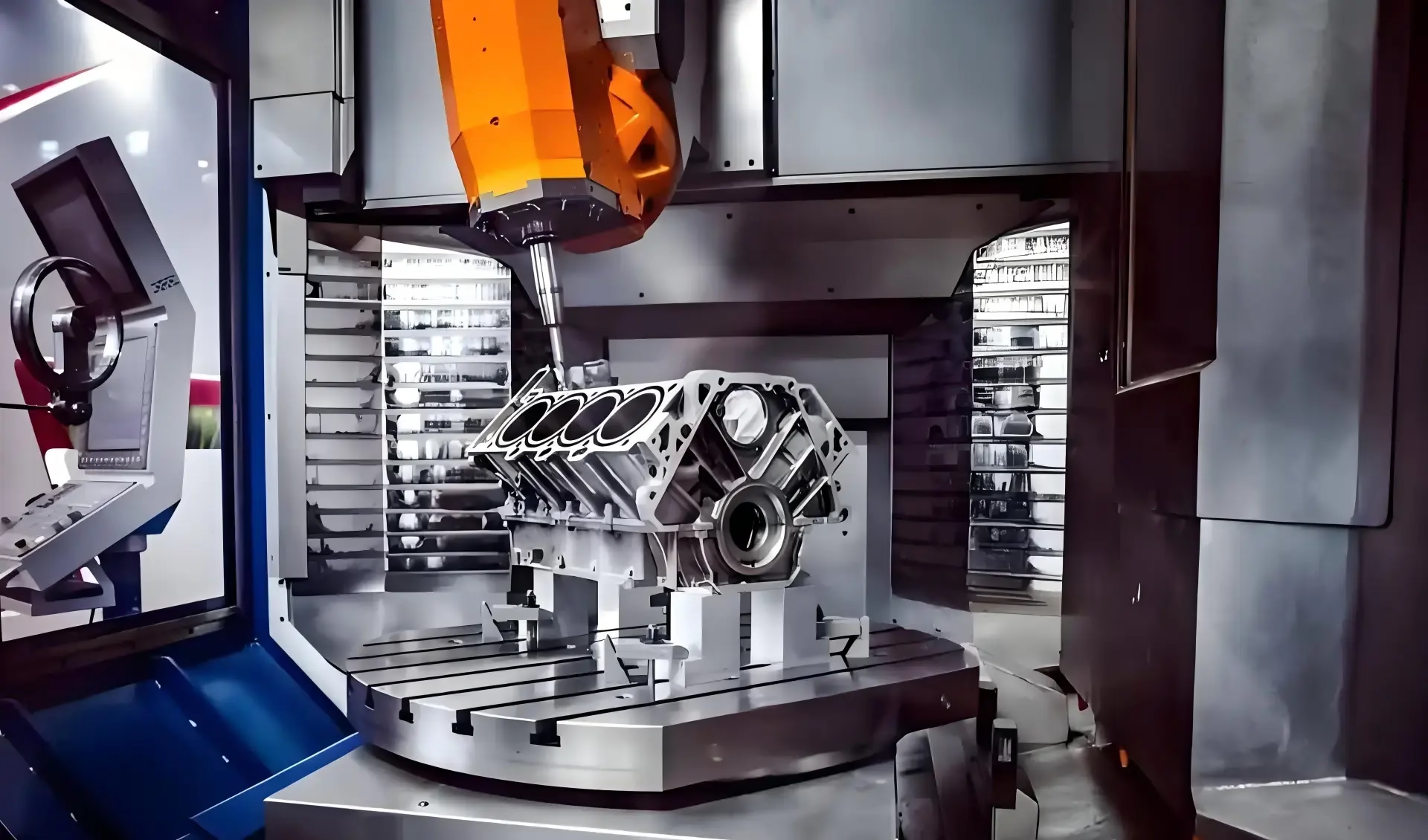
A part with angled ports or undercut pockets does not need four setups if it can be reached in one. Moving that work onto a simultaneous 5-axis center removes fixtures, removes re-clamping error, and removes a queue. The savings show up as fewer operations, not as a lower hourly rate.

The same logic applies downward. A simple plate should not occupy a 5-axis machine. We keep 27 three-axis machines for flat work and 16 mill-turn centers for parts that need turning and milling in one cycle. Routing by feature keeps the schedule open for the jobs that actually need the complex equipment.

  • 1
    Up to 4,000 mmMaximum processing size for long frames and rails.
  • 2
    Ø400 mm rotary tableFor cylindrical parts that need indexed milling.
  • 3
    16 mill-turn centersTurning and milling completed in one setup.
Decision guide

When Consolidation Helps and When It Does Not

Not every program should be reduced to one supplier.

SituationConsolidate?Reason
Part needs machining plus a finishYesThe finish can change a critical dimension.
Part is a standard fastenerNoOff-the-shelf stock is cheaper than cutting it.
Annual volume above 10,000UsuallyOne setup absorbs tooling and fixture cost.
Prototype with unknown geometryYesFast DFM feedback beats a low unit price.
Two suppliers already hold a qualified processMaybeCompare total landed cost, not unit price.
Part spans turning and millingYesOne setup removes a re-clamping error.
What we run

Services That Fit a Simplified Chain

Six capabilities, each able to stand alone or feed the next step.

01

5 Axis CNC Machining

Simultaneous 5-axis centers for angled features, deep pockets, and parts that would otherwise need four setups. One clamping, one datum.

02

CNC Milling & Turning

Three-axis mills and mill-turn centers for prismatic and cylindrical work. Turning and milling finished in a single cycle where geometry allows.

03

Rapid Prototyping

From a single unit to a small batch, with a free DFM analysis inside 12 hours so a design problem surfaces before the tooling does.

04

Sheet Metal Fabrication

Enclosures, brackets, and chassis that pair with machined internals, cut and formed to the same drawing revision.

05

Part Surface Finishing

Anodizing, plating, powder coating, bead blasting, and laser marking. Minimum character height 1.5 mm for traceability marks.

06

Custom 3D Printing

For fixtures, jigs, and low-stress covers where a printed part is faster than a machined one and the load is low.

Scope

What a Simplified Order Includes

ItemSpecificationNotes
Achievable tolerance±0.005 mm (±0.0002 in)Confirmed against drawing before quoting.
Fine finishRa 0.2–0.8 μmFor sealing faces and bearing bores.
Standard finishRa 0.8–1.6 μmTypical machined surface.
As-machinedRa 1.6–3.2 μmNon-critical surfaces.
Minimum orderOne partPrototype to 10,000+ part runs.
Inspection100% before shipmentReports on request.
Qualification rate99.99%Across shipped production.
Why this works

The Numbers Behind the Simplification

Fewer handoffs only pay off if the remaining shop can hold the tolerance.

15Y

Machining since 2011

Fifteen years of routing parts by feature instead of by habit. The process plan is chosen for the geometry, not for whatever machine is free.

±0.005

Millimeter tolerance

Equivalent to ±0.0002 in. Held on production parts, not just on a sample the first time.

127

CNC machines on site

Sixteen simultaneous 5-axis centers, 12 four-axis mills, 27 three-axis machines, and 16 mill-turn centers in one network.

24H

Production start

A quote and free DFM analysis within 12 hours. Production can begin within 24 hours of approval.

<2%

Late-delivery probability

Historical rate across shipped orders. Not a guarantee, but it is the track record we plan against.

4

Quality systems

ISO 9001:2015, IATF 16949:2016, ISO 13485:2016, and ISO 27001:2022 cover process, automotive, medical, and data handling.

7,600 m²Manufacturing space
3Wholly-owned plants
150Technicians
1Singapore factory
Sector requirements

What Each Industry Demands from a Lean Chain

cnc machining

Aerospace

Material traceability and a documented inspection path from raw stock to final part.

  • ±0.005 mm
  • 100% inspection
cnc machining

Automotive & EV

Process control that satisfies IATF 16949 and holds up across a production run, not just a first article.

  • IATF 16949
  • 99.99% qualification
cnc machining

Medical Devices

Clean finishes on sealing faces and bores, with inspection records kept per lot.

  • Ra 0.2–0.8 μm
  • ISO 13485
cnc machining

Robotics & Automation

Single-setup machining for joint housings and brackets where hole position drives assembly fit.

  • 5-axis
  • 3–5 day shipment
FAQs

Questions Engineers Ask About Supplier Consolidation

Does cutting suppliers actually reduce cost, or just move it?

It reduces cost when it removes a handoff that affects a tolerance. Purchase orders, receiving checks, and duplicate inspections are real line items.

It does not help if the remaining supplier has to subcontract the same process anyway. Ask who actually touches the part.

How many suppliers should a machined-part program keep?

One primary source for parts that need machining plus a tolerance-affecting finish is usually enough. Keep a second qualified source only if the volume or downtime risk justifies the duplicate qualification cost.

For off-the-shelf hardware, buying from stock is cheaper than adding a cutting supplier.

What is the risk of putting all machining in one shop?

Capacity and single-point failure. That risk is real and should be priced in.

A shop running 127 machines across three plants absorbs a machine outage better than a five-machine job shop. Ask how work is rerouted when a spindle goes down.

How does a simplified chain handle a design revision mid-run?

One controlled drawing set goes to one place. There is no risk of a second shop cutting from the old revision.

We confirm the revision in writing before restarting production, and we re-quote if the change alters the process plan.

Can a single supplier hold ±0.005 mm through finishing?

Only if the finishing step is under the same inspection plan. Anodizing and plating can add or remove microns on a bore or a sealing face.

When the finish changes a critical dimension, it should be machined with the coating thickness already accounted for.

What happens to lead time when operations are consolidated?

Fewer queues and fewer freight legs. Parts typically ship in 3–5 days, and production can start within 24 hours of approval.

The gain comes from removing the wait between shops, not from running the machine faster.

Is there a minimum order quantity if we simplify to one supplier?

No. We run from one prototype to 10,000+ part runs.

Low-volume and high-volume work use different machines, so a prototype does not have to wait for a production slot.

How is confidential geometry protected across fewer vendors?

Fewer partners means fewer copies of the drawing outside your control. Uploads are secure and confidential, and an NDA is available on request.

Our data handling is covered under ISO 27001:2022.

Send One Drawing and See What the Simplification Looks Like

Upload a CAD file and get a quote with free DFM analysis within 12 hours. No minimum order quantity, 100% inspection before shipment.

12-hour quote100% inspectionNo minimum orderNDA on request

Trusted by engineers and manufacturers worldwide

Tesla Ford Motor Company BYD Auto Denso Magna International Boeing Airbus Medtronic KUKA FANUC