
Can You Coin Parts in a CNC Machine?
Yes, with limits. A CNC machine cuts the die or mills the blank directly, but it cannot reproduce the tonnage of a coining press. This guide covers how we set up die work, what geometry survives, and when milling is the wrong choice.
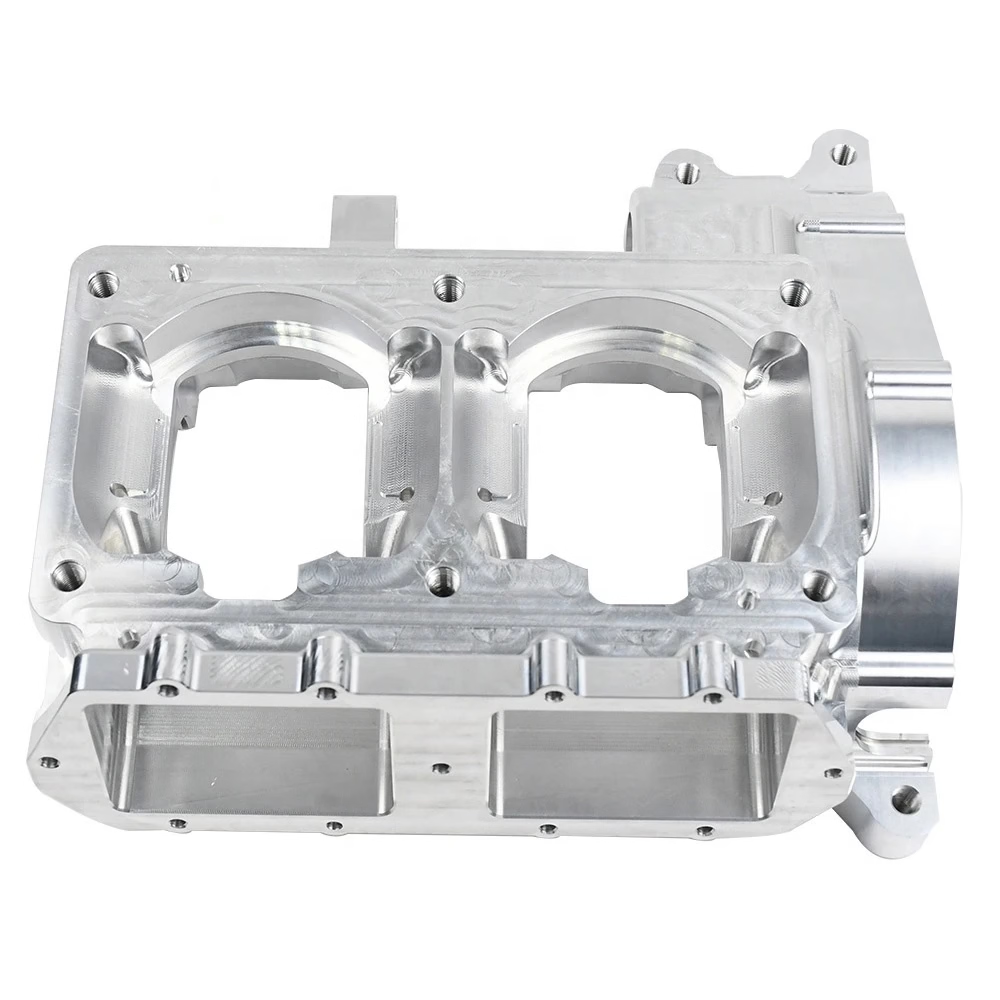
Two different jobs, two different machines
A CNC mill cuts metal by rotation. A coining press squeezes it hydraulically. Confusing the two is where most projects go wrong.
What a CNC machine actually does to a coin blank
A CNC machine removes material with a rotating cutter. A coining press deforms material under tonnage, flowing metal into a die cavity. The two are not interchangeable, and the phrase "can coin parts CNC" usually hides a question about which one you need.
Direct milling is the simpler route. You take a brass or copper blank, clamp it in a fixture, and cut the relief directly with a small ball nose or V-bit. The result is a machined medallion, not a struck coin. You get crisp edges and predictable dimensions, but the surface carries tool marks unless you finish it.
The second route is die making. You machine a punch and a die in tool steel, harden them, then press them in a separate coining press. This is the real minting path. The CNC machine never touches the coin blank; it only builds the tooling that does.
Decide which one you are buying before you send drawings. A 40 mm aluminum token with a logo can be milled in one setup. A 28 mm brass coin with reeded edges and a raised rim wants a die, and that means a press cycle you have to source separately.
- 1Direct millingCutter carves the blank. Good for tokens, tags, single-piece medals.
- 2Die machiningCNC cuts the punch and die. The coin is struck in a press afterwards.
- 3HybridMill the die, test-strike in soft steel, then harden and finish.
Machining a coin die without scrapping it
Dies are the hardest part of the job. A portrait die for a 38 mm coin starts as a block of 1045 or 4140 or a dedicated tool steel, and the relief is cut in three stages: rough with a 3–6 mm ball nose, semi-finish with a 1–2 mm ball, then finish with a 0.5 mm or smaller cutter at tight stepover.
Depth of cut stays shallow on the finishing passes. A 0.5 mm ball nose cutting tool steel at Ra 0.2–0.8 μm wants a stepover under 0.05 mm, which means a 30 mm die face can run for hours. That is normal. Rushing the finish is how you get visible scallops on a cheekbone.
5-axis interpolation helps on domed dies. Tilting the tool keeps the cutter engaged at a consistent angle across a curved field, which evens out the finish and lets you reach undercuts on letters. A 3-axis machine can do the job on shallow relief, but it fights you near the rim.
Heat is the enemy on small cutters. We run air blast or minimum-quantity lubrication rather than flood coolant on finishing passes, because thermal shock on a 0.5 mm carbide tool chips the edge. Tool breakage at that diameter usually shows up as a gouge, not a clean stop.
- 1Rough3–6 mm ball nose, 0.3–0.5 mm stepdown, leaves 0.2 mm stock.
- 2Semi-finish1–2 mm ball nose, 0.1 mm stepover, removes witness lines.
- 3Finish0.5 mm or smaller, stepover under 0.05 mm, air blast only.
Which process fits your part
Match the geometry and quantity to the right route before you commit to tooling.
| Part | Best route | Why |
|---|---|---|
| Single brass token, flat logo | CNC milled blank | No tooling cost, one setup, ships fast |
| 50 identical 28 mm coins | Machined die + press | Amortizes die cost across the run |
| Medal with undercut relief | 5-axis milled blank | Ball nose reaches where a press cannot |
| Coin with reeded edge | Die + collar | Reeding needs radial flow, not cutting |
| Prototype before tooling | CNC milled blank | Validates artwork before steel is cut |
| Deep 1.5 mm relief | Die + press | Press flows metal; milling leaves steps |
Where milling stops working
There is a hard limit on aspect ratio. A cutter cannot reach into a slot narrower than its shank and deeper than about three times its diameter without chatter. On coin relief that means fine hairlines and thin raised lettering below 0.3 mm width are fragile to cut and fragile to hold.
Sharp internal corners are another stop sign. A rotating cutter always leaves a radius equal to its tip. If your artwork has a 90° internal corner at the base of a raised letter, the mill will round it. A press flows metal into that corner and holds it sharp, which is why mint tooling can do things a mill cannot.
Surface finish matters more than most people expect on a coin face. A flat field cut at Ra 1.6–3.2 μm looks matte and picks up fingerprints. We usually take the field to Ra 0.2–0.8 μm on a polished die, or bead blast the blank if the design calls for a satin coin.
Material choice is not free either. Aluminum mills easily and takes a bright finish, but it wears fast in a pocket. Brass and copper C36000 or C110 hold detail better and take a proof-like polish. Tool steel dies are the only route if you intend to strike more than a handful of parts.
Checking the result before it ships
We inspect 100% of parts before shipment, with raw material checks at intake, in-process monitoring during the finishing passes, and a final dimensional check against the drawing. Reports are available on request.
On die work the first article is the important one. We cut a soft test impression in aluminum or mild steel, measure the relief depth and the rim height, and compare to the drawing before the die sees a hardening furnace. A die that is 0.05 mm too shallow is scrap once it is hard.
For milled medallions the critical dimensions are the outside diameter, the rim height, and the depth of the engraving. Tolerance on these parts runs to ±0.005 mm where the drawing calls for it, though a decorative coin face rarely needs that. We will tell you when a looser tolerance costs less.
Runs ship in 3–5 days for standard milled work. Die work adds a hardening cycle, which has its own schedule. Quotation and a free DFM review come back within 12 hours, and production can start within 24 hours once the drawing is settled.
Questions engineers ask next
Can a CNC machine strike a coin the way a press does?
No. CNC removes material; a press deforms it. A milling machine has no way to apply the hundreds of tonnes a coining press uses to flow metal into a die cavity.
What CNC can do is cut the die, or mill the coin blank directly as a medallion. Those are two different products with different surface character.
What steel do you use for a coining die?
Typically 1045, 4140, or a dedicated tool steel from our stock list. The choice depends on strike quantity and how deep the relief runs.
Shallow relief on a short run does not need the same alloy as a deep portrait die meant for thousands of strikes.
How fine can the relief be on a milled coin?
We hold ±0.005 mm where the drawing requires it, and finish to Ra 0.2–0.8 μm on polished faces.
The practical limit is cutter reach, not the machine. Raised lines below 0.3 mm width are hard to cut cleanly and hard to hold during handling.
Can you mill a coin with a reeded edge?
Milling a true reeded edge is slow and leaves visible cutter marks. A press with a collar forms reeding in one strike and keeps it uniform around the circumference.
If the reeding is decorative and the quantity is low, we can approximate it, but we will say so before quoting.
What is the minimum order for coin or medal work?
There is no minimum order quantity. We run from one prototype to 10,000+ part runs.
A single milled token and a 10,000-piece struck run use different setups, so the DFM review matters more than the quantity itself.
How do you protect the artwork?
Uploads are secure and confidential. A non-disclosure agreement is available on request before you send files.
We do not share drawings or die geometry outside the project.
Send the artwork, get a straight answer
Upload your drawing or model and we will tell you whether to mill the blank or cut a die, with a quotation and free DFM notes within 12 hours.
12-hour quote100% inspectionNDA on request









