
Can You Make a Gun With a CNC Machine?
Yes, a CNC machine can cut the geometry of many firearm components. Whether you may do it, and whether the part will hold up, are two separate questions. This page is written for engineers, machinists and buyers who need to tell the difference before they start cutting metal.
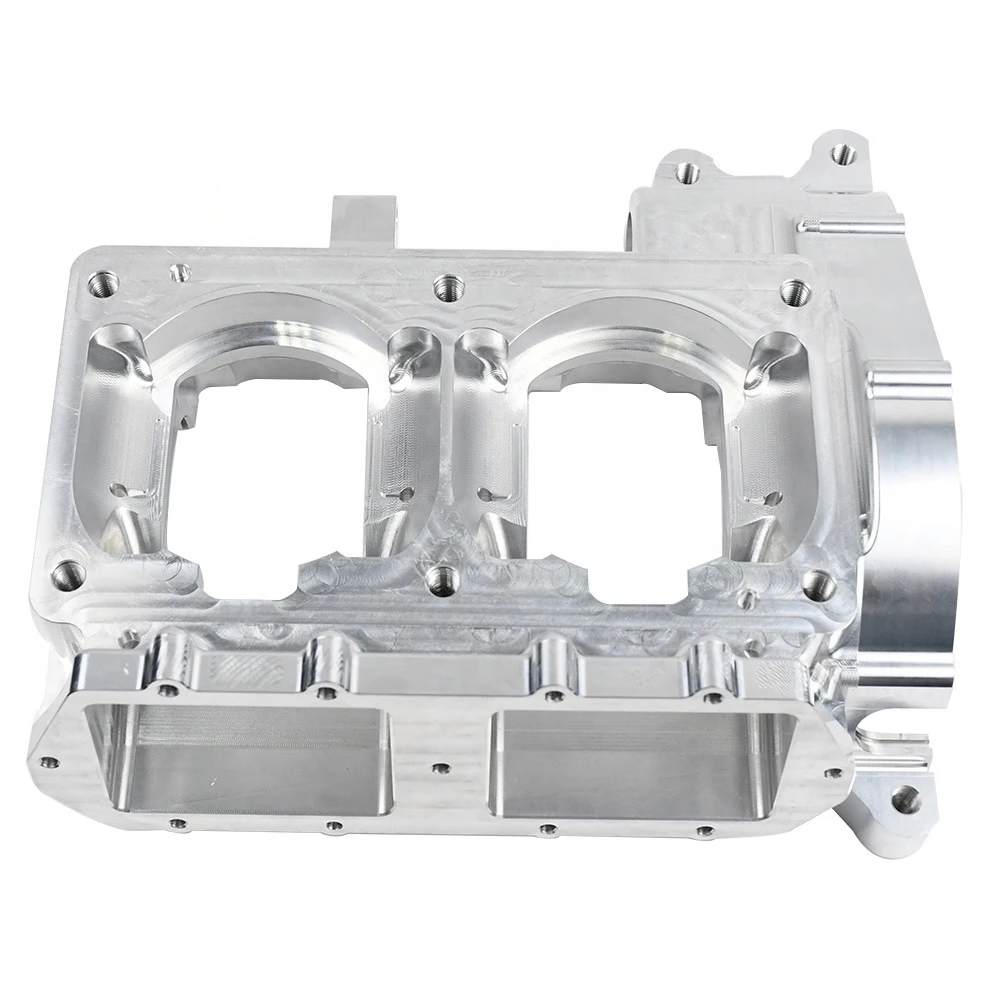
What this page covers
The machining reality behind the question, and the legal boundary that sits in front of it.
Yes on the machine, no on the assumption
A 5-axis machining center does not know what it is cutting. Give it a model of a lower receiver, a bolt carrier or a trigger housing and it will remove metal to those coordinates. The toolpath does not care about the laws in your country, the intent behind the part, or whether the drawing came from a factory or a garage laptop.
So the answer to can make gun cnc splits into two parts. On the technical side, the geometry is machinable and the tolerances are achievable. On the legal side, the part you are cutting decides whether the job is allowed at all, and that decision happens before any spindle turns.
This page walks through where the legal lines sit, which components are restricted, what a shop can and cannot accept, and the machining problems that make firearm parts harder than they look. Read it before you send a drawing.
Where the legal line sits
In the United States, the frame or receiver is the regulated part. Under the Gun Control Act, a receiver that is already finished and functional must carry a serial number and be transferred through a licensed dealer. A partially finished forging or casting, often called an 80 percent lower, is not treated as a firearm by federal law until the machining is complete enough to house the fire control group.
Once you complete that machining, you have manufactured a firearm. Federal law allows an individual to make one for personal use without a license, provided the person is legally allowed to own a firearm and the gun is not for sale or transfer. Making one for someone else, or making several to sell, moves the activity into manufacturing, which requires a federal firearms license.
There is a second layer. States and cities add their own rules, and some require serial numbers on homemade firearms, ban certain configurations outright, or forbid the sale of the parts kits entirely. A part that is legal in one state can be a felony two states away. The machine shop has no way to verify your local law, which is why most shops decline this work.
Outside the United States, rules vary widely. Many countries treat any firearm component as controlled, some ban private manufacture completely, and export controls can apply to the drawings themselves. If you are unsure which category your part falls into, ask a lawyer who works in firearms law before you ask a machine shop.
- 1Frame or receiverSerialized and dealer-transferred in the US once functional; the core regulated part.
- 2Barrel and boltOften unrestricted as parts in the US but heavily controlled in other countries.
- 3Magazines and stocksRegulated by state capacity and feature bans, not by federal manufacturing law.
- 4Silencer and select-fire partsControlled under the NFA; private manufacture is not permitted without registration.
What a contract shop will and will not accept
A production machine shop is not a legal test case. GreatLight and most contract manufacturers in this tier decline firearm frames, receivers, silencer components and select-fire parts. It is not a statement about machining ability. It is that the legal exposure sits with the shop that cuts the part, and no tolerance spec justifies that risk.
We do machine legal, clearly documented hardware that happens to look similar on a drawing: trigger guards for airsoft replicas, magazine body prototypes for paintball markers, recoil simulation fixtures for testing labs, and OEM parts for licensed manufacturers who supply their own federal license numbers and purchase orders.
When a licensed manufacturer sends work, we ask for the license before quoting. If you cannot provide it, we cannot take the job, regardless of the geometry. That rule is firm and it applies to every order, including one-off prototypes.
Part-by-part machining and legal view
How common firearm-adjacent parts behave under US federal rules and in a contract shop.
| Part | Federal status (US) | Shop acceptance |
|---|---|---|
| Finished lower receiver | Firearm, serialized | Declined |
| 80% lower, completed | Firearm once functional | Declined |
| 80% lower, unfinished | Not a firearm federally | Limited, license check |
| Barrel blank | Part, not serialized | Declined for firearm use |
| Trigger guard, replica | Not a firearm | Accepted with docs |
| Magazine body prototype | Part, state rules vary | Case by case |
| Test fixture, dummy | Not a firearm | Accepted |
| Suppressor baffle | NFA item | Declined |
Why firearm parts are hard to machine
Take the legal issue off the table for a moment and the parts are still difficult. A receiver has deep internal pockets, thin walls and a fire control cavity that must line up with pin holes on a separate axis. Reach is the first problem. A 3-axis mill cannot get a tool into the rear pocket without a long, thin cutter that deflects and chatters.
The pin holes are the second problem. Trigger and hammer pin holes typically sit on a true position tighter than ±0.05 mm, and they must be parallel to each other across the width of the receiver. If they are not, the trigger group binds or the pins walk. This is where simultaneous 5-axis work earns its cost, because the part can be held once and the holes bored from the same datum.
Material adds a third layer. Receivers are often cut from 7075 aluminum or 4140 steel. Aluminum 7075 machines cleanly but moves after heat treatment, so stress relief matters. 4140 in the annealed state is gummy and tears; in the hardened state it needs carbide and light depths of cut. Bolt carrier groups in 8620 or 9310 cases are even less forgiving.
Surface finish inside the action affects function. A rough bolt raceway wears the bolt and collects carbon. We hold Ra 0.8–1.6 μm on functional sliding surfaces and Ra 0.2–0.8 μm where a seal or a tight fit matters. Those numbers are achievable, but they force slower feeds and more tool changes, which is part of why these parts cost more than their size suggests.
Which machining process fits which part
Not every firearm-adjacent part needs a 5-axis center. A flat trigger guard, a magazine floor plate or a mounting rail can be cut on a 3-axis mill with two setups and a good fixture. Cycle time is short and the cost is low. Choose 3-axis when the part is prismatic and all features are reachable from two or three directions.
Move to 4-axis when you need features on four sides of a part without re-fixturing, such as a cylindrical receiver extension with cross holes. The rotary table, Ø400 mm in our shop, lets the part index and keep one datum. That removes the stacking error you get from flipping the part by hand.
Simultaneous 5-axis is the right call for receivers, bolt carriers and any part with compound-angle ports or deep pockets. The tool stays normal to the surface, so you can use a stubby cutter instead of a long one and hold tolerance on thin walls. It is also the only practical way to machine an internal cavity with curved walls in one setup.
For low-volume work, rapid prototyping in aluminum or engineering plastic is often enough to prove fit and function before committing to a production run. We regularly cut functional prototypes in 6061 and 7075, then move the same program to a production cell once the design freezes.
Common questions
Can a CNC machine make a complete gun from scratch?
A CNC machine can cut most of the metal components, but a functional firearm also needs a barrel with rifling, a chamber cut to headspace, springs, and often a heat-treated bolt. Those steps need rifling equipment, heat treatment and assembly, not just a mill.
In practice, no single machine builds a complete gun. A shop would need several processes and a license to manufacture.
Do I need a license to machine a receiver for myself?
In the US, federal law allows an individual to make a firearm for personal use without a license, as long as the person may legally own a firearm and the gun is not made for sale or transfer. State law may add serialization or ban the activity.
If you intend to sell, give away or make more than one for others, you generally need a federal firearms license. Talk to a firearms attorney for your state.
Will a machine shop cut an 80 percent lower for me?
Most contract shops will not. Completing an 80 percent lower turns it into a regulated firearm, and the shop doing the final machining takes on the manufacturing role.
Some shops will sell the unfinished forging but refuse to run the finishing operations. Our policy is to decline the finishing work entirely.
What tolerance do firearm parts actually need?
Pin holes and locking surfaces are the tight ones. True position of ±0.05 mm or better is common for trigger and hammer pins, and bore-to-bore alignment matters more than any single dimension.
Cosmetic and non-critical surfaces can sit at ±0.1 mm or looser. Over-tolerancing the whole part adds cost without improving function.
Which materials are used for receivers and bolts?
Common choices are 7075-T6 aluminum for lightweight receivers, 4140 and 4340 steel for bolts and barrels, and 8620 or 9310 for case-hardened bolt carriers.
Stainless 416 and 17-4PH appear in some barrels and small parts. Material choice follows the load and the wear surface, not the other way around.
Can you sign an NDA before I send drawings?
Yes. We can sign a mutual NDA before you upload files, and all uploads are handled as confidential.
For licensed manufacturers, we also need the license number on file before quoting the job.
Have a legal part that needs tight tolerances?
Send the drawing and we will return a quote with a free DFM review within 12 hours. Licensed manufacturers, include your license number with the files.
12-hour quoteFree DFM analysisNDA on request100% inspection









